
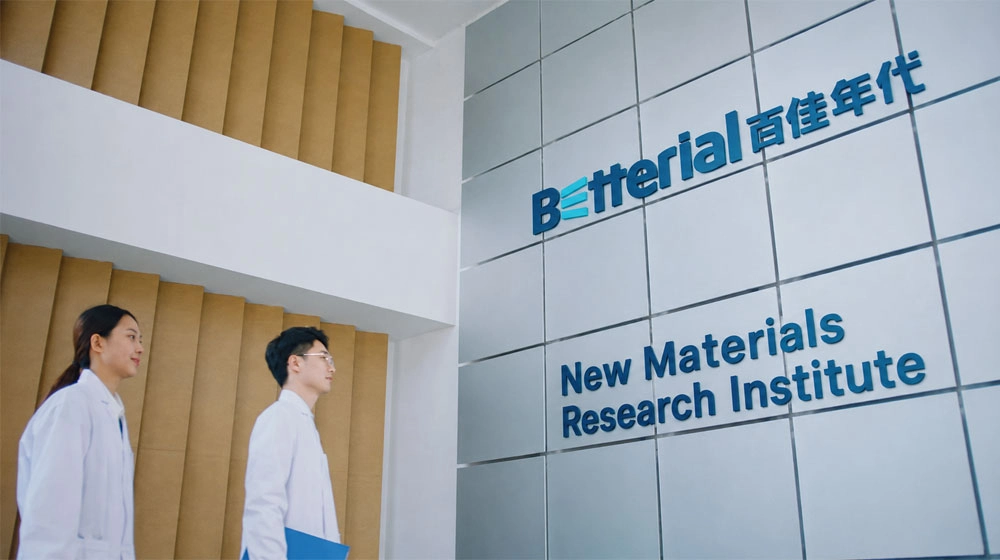







Betterial New Materials Research Institute
Betterial has successively partnered with universities and research institutions including:
- Sichuan University
- University of Science and Technology of China
- Changzhou University
- Harbin Institute of Technology
- Xihua University
- Southeast University
- Wuxi Research Institute of Harbin Institute of Technology
- We had established materials R&D centers, Betterial New Materials Research Institute, and polymer materials laboratories.
- By strengthening industry-academia-research collaboration and technical exchanges, we have gradually developed core technological capabilities that bridge fundamental processes and product innovation. Our products have also been certificated and tested by authoritative third-party certification institutions such as TÜV Rheinland and UL.
- Betterial has been granted a total of 233 domestic patents, including 57 invention patents and 162 utility model patents, as well as 1 overseas patent.
The Product Development Milestone For Photovoltaic Application
2025
- Thermoplastic TPO Encapsulation Film for Perovskite Tandem Solar Cells.
- Encapsulation Film for Desert Environments.
- Ultra-High Transmittance Encapsulation Film.
2024
- High-Reflective Thermoplastic TPO Encapsulation Film for Perovskite Thin-Film Solar Cells B606LW.
- Ultra-Low Basis Weight Encapsulation Film for BC Solar Cells.
- Grid-Pattern Backsheet.
2023
- Thermoplastic TPO film for crystalline silicon cell encapsulation – B606.
- Lightweight flexible fiberglass frontsheet and backsheet.
- Specialized skin film for 0BB lamination – B601HP 0BB.
2022
- Light conversion film for HJT encapsulation – HC806.
- Thermoplastic TPO encapsulant film for perovskite thin-film cell – B606.
- Single-sided coated backsheet PPF.
2021
- Black infrared reflective encapsulant film – B601RS.
- 2nd generation soft white encapsulant film – B601WM.
- Super anti-PID EVA film – B601HP.
- White POE encapsulant film.
- Double-sided coated backsheet – BPF.
2020
- Optimized pre-crosslinked white EVA for dual-glass modules.
- 2nd generation POE encapsulant film.
- Hot-melt UV-curing encapsulant film – B603.
2019
- 2nd generation POE film for bifacial multi-busbar PV modules – B602M.
2018
- Pre-crosslinked white EVA film for dual-glass modules – B601W.
2017
- 2nd generation POE film for bifacial modules – B602.
2016
- High reflective white EVA encapsulant film – B601W.
2014
- Anti-PID EVA encapsulant film – B601HP.
2013
- High transmittance EVA encapsulant Film – B601H.
2012
- Fast crosslinked EVA encapsulant film – B601.
2011
- Standard curing EVA film – B601.



Core Technologies
Multilayer Co-Extrusion Equipment and Process
- Achieving interlayer thickness tolerances of ±5% across a die width of 2.6 meters, the system utilizes adjustable transverse stretching chains,polyester materials (such as PET, PEN, PCT, and PETG) with thicknesses of 800 μm or more are stretch and formed.
- In-line coating enhances product adhesion, antistatic properties, transparency, anti-static and anti-adhesive properties, thereby improving overall product performance.
Optimizing Optical Properties of Encapsulation Materials
- By adjusting the refractive index of the resin, encapsulant films with higher light transmittance can be developed to allow more light to pass through.
- High reflective encapsulant films with a wider reflection angle help reflect more light back onto the solar cells.
- Down-conversion encapsulant films convert ultraviolet light into visible light, maintaining high fluorescence intensity after aging.
Reactive Grafting of Resins
- The reactive grafting of resins has facilitated the further modification of traditional resins through melt grafting.
- Laboratory evaluations of thermoplastic TPO films have been completed, and TPO resins have been jointly developed in collaboration with partner enterprises.
Chemical Synthesis Technology
- Synthesize film-grade polyimide resins with high light transmittance and low coefficient of thermal expansion (CTE), suitable for the continuous casting and re-stretching process. New monomers were designed based on the structures of dicarboxylic acids and dianhydrides.
- By introducing highly electronegative groups, alicyclic rings, large substituents, and asymmetric and rigid non-coplanar structures into the monomers, light transmittance and heat resistance were enhanced.
- Additionally, a bisphenol A-based structural anhydridation design was employed to improve the processability and toughness of the film material.
Flexible Device Encapsulation
- A water-resistant, ultra-tough, and weather-resistant combination of MPET film/encapsulating film achieves high flexural and impact moduli, excellent peel strength, and impact resistance with minimal degradation after aging. This composite film serves as a replacement for PVB and SGP in BIPV applications.
- Thin-film and perovskite solar cells have passed initial evaluations, and we are collaborating with major clients in a phased approach to develop a one-step encapsulation solution for future implementation.
New Technology Leader
-
In-situ Polymerization of Silicone
-
Optical Performance Adjustment
-
High Anti-PID Suppression
-
High and Low Surface Adhesion
-
Multiple Curing Adjustment
Through the migration of organosilicon to the interfacial layer of the E/P/E multilayer co-extruded encapsulant film, In-situ UV polymerization formed a bonding layer in the EPE co-extruded film. This significantly enhances the interlayer peel strength between EVA and POE encapsulation films.
Enhancing the light transmittance of transparent encapsulant films, maximizing the reflection angle of white films, and achieving high-transparency diffusion effects; developing highier reflective EVA white film products with superior light-gain performance, as well as optical matte diffusion films.
By reducing the release of ions and acetate ions, while enhancing ion- and acetate-capturing technology, we improve the long-term stability of EVA encapsulant films after aging. This helps minimize corrosion and ion deposition, enabling anti-PID EVA encapsulant films for bifacial solar module applications.
Significantly improves adhesion to materials with both high or low surface energy, such as PTFE, ETFE, PVDF, PP, metals, metal oxides, and coatings, enabling the bonding of materials with significantly different surface energies. This includes encapsulation films for HTJ, perovskite encapsulation films, and thin-film solar cell encapsulation.
By releasing curing agents via microcapsules, the curing behavior is precisely adjusted. During low-temperature extrusion, sensitivity to thermal crosslinking is minimized; conversely, during high-temperature lamination, the capsules release curing agents to rapidly accelerate the crosslinking rate, thereby enhancing module encapsulation efficiency.
With customized formulation, die, and screw design, precise extrusion speed control, could enhance the ultra-speed which is exceeding the industry average speed by 50%.