
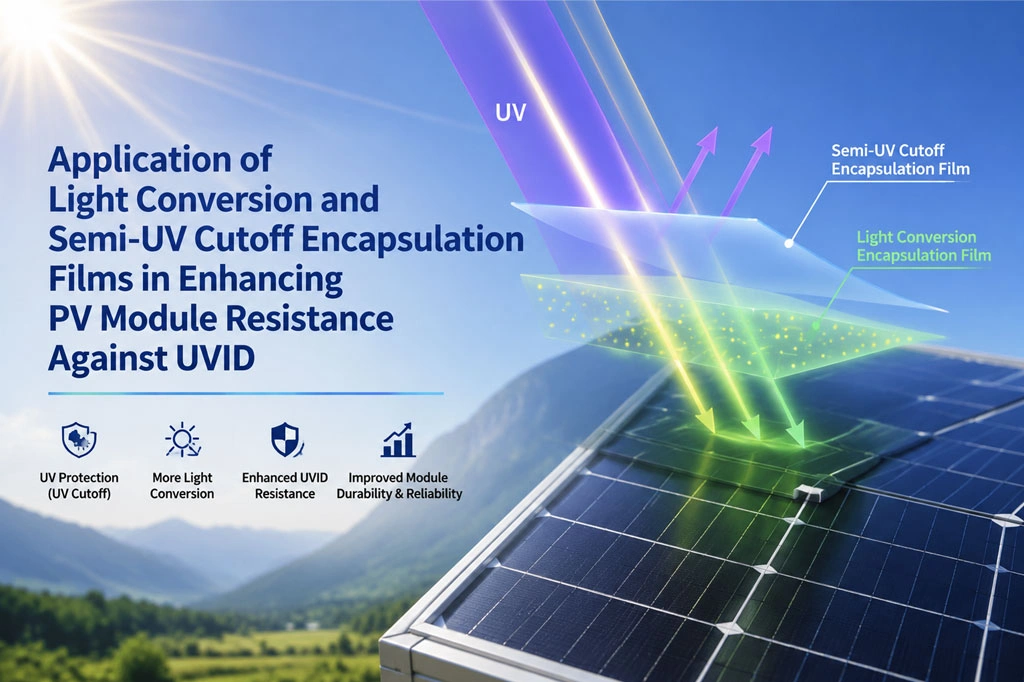
As photovoltaic (PV) technology advances toward higher efficiency, solar modules are becoming increasingly sensitive to environmental stress factors. While improvements in cell structures such as TOPCon, HJT, BC (Back Contact), and tandem perovskite technologies have pushed conversion efficiency to new levels, long-term reliability remains a critical challenge.
Among various degradation mechanisms, Ultraviolet-Induced Degradation (UVID) has attracted increasing attention, particularly in high-radiation environments such as deserts, high-altitude regions, and tropical areas.
Unlike traditional degradation factors such as thermal cycling or moisture penetration, UVID directly affects the electrical performance of photovoltaic cells by damaging sensitive semiconductor structures and passivation layers.
A key insight emerging from recent PV reliability research is:
Improving solar cell efficiency without addressing UV-induced damage may limit real-world energy yield over the module lifetime.
To mitigate UVID, advanced encapsulation materials—including light conversion films and semi-UV cutoff encapsulation films—are becoming important solutions for next-generation PV modules.
1. Understanding UVID: Why UV Radiation Threatens PV Module Reliability
Solar radiation contains ultraviolet wavelengths, visible light, and infrared radiation. Although UV radiation represents only a small portion of total solar energy, its high photon energy makes it highly reactive.
The most damaging UV range for PV modules is generally concentrated between:
300–400 nm
High-energy UV photons can trigger several degradation pathways:
1.1 Passivation Layer Degradation
For advanced solar cells such as TOPCon and HJT, surface passivation layers play a critical role in reducing carrier recombination.
UV exposure may:
- Break Si–H bonds
- Increase interface defects
- Reduce passivation effectiveness
- Increase carrier recombination
The result:
- Lower open-circuit voltage
- Reduced fill factor
- Continuous power degradation
1.2 Encapsulant Aging and Optical Loss
Long-term UV exposure can also accelerate:
- EVA yellowing
- Additive depletion
- Polymer chain degradation
- Reduced optical transmission
This creates a double impact:
- Less sunlight reaches the solar cell
- The cell itself suffers UV-related electrical degradation
1.3 Higher Risk in Desert and High-Altitude Applications
PV systems installed in extreme environments experience much stronger UV stress.
Typical challenges include:
| Environment | Main UV Challenges |
|---|---|
| Desert PV | High UV intensity + high temperature |
| Mountain PV | Strong solar radiation + low temperature |
| Offshore PV | UV + humidity + salt corrosion |
| Agrivoltaic PV | Long-term outdoor exposure |
Therefore, conventional encapsulation strategies may no longer be sufficient for future high-efficiency modules.
2. Light Conversion Encapsulation Film: Turning Harmful UV Into Useful Energy
2.1 What Is Light Conversion Film?
Light conversion encapsulation film introduces special optical functional materials into traditional encapsulation layers.
Instead of simply blocking UV radiation, the film can:
Absorb harmful UV photons → Convert them into longer-wavelength light → Improve photovoltaic utilization
This mechanism is commonly known as:
Down-conversion technology
2.2 How Light Conversion Technology Improves Module Performance
Traditional PV cells have limited response to certain ultraviolet wavelengths.
Light conversion materials can transfer:
High-energy UV photons
into:
Visible photons better absorbed by silicon solar cells
The benefits include:
Reduced UV Damage
By absorbing high-energy UV radiation:
- Less UV reaches the cell surface
- Passivation layers receive lower UV stress
- UVID risk is reduced
Improved Spectral Utilization
Converted wavelengths can contribute additional photon absorption.
Potential advantages:
- Improved short-circuit current
- Enhanced spectral response
- Better energy harvesting under real-world conditions
Extended Module Lifetime
By reducing UV exposure to internal components:
- Encapsulant aging slows down
- Cell degradation decreases
- Long-term power retention improves
3. Semi-Cutoff Encapsulation Film: Precision UV Management for PV Modules
3.1 What Is Semi-Cutoff Encapsulation Film?
Semi-cutoff encapsulation film is designed to selectively control UV transmission.
Unlike traditional UV-blocking films that completely absorb ultraviolet radiation, semi-cutoff films create a more balanced approach:
- Block harmful UV wavelengths
- Maintain useful optical transmission
- Preserve module power output
3.2 Why Complete UV Blocking Is Not Always the Best Solution
A common misconception is:
The more UV blocked, the better the module reliability.
However, excessive UV filtering may reduce the amount of usable solar radiation reaching the cell.
The challenge is finding the optimal balance between:
Protection vs. Energy Conversion
Semi-cutoff technology provides controlled UV management.
4. Light Conversion Film vs Semi-Cutoff Film: Different Approaches to UVID Protection
| Technology | Primary Function | Main Benefit |
|---|---|---|
| Light Conversion Film | Transforms harmful UV into useful wavelengths | Improves spectral utilization while reducing UV damage |
| Semi-Cutoff Film | Selectively blocks damaging UV wavelengths | Protects sensitive cell structures |
| Traditional UV EVA | Blocks part of UV radiation | Basic protection |
The future direction is not simply blocking UV radiation but intelligently managing the solar spectrum.
5. Application in TOPCon Solar Modules
TOPCon technology has become one of the fastest-growing PV technologies due to its high efficiency potential.
However, its advanced passivation structure also introduces new reliability challenges.
UVID Risks for TOPCon
UV exposure may cause:
- Passivation degradation
- Interface defect generation
- Efficiency loss
Advanced encapsulation films can help by:
- Reducing UV photon penetration: Semi-cutoff films limit high-energy UV exposure.
- Improving optical management: Light conversion films optimize the solar spectrum reaching the cell.
- Enhancing long-term power retention: Better UV management contributes to lower degradation rates.
6. Application in BC and HJT Solar Modules
6.1 Back Contact (BC) Modules
BC cells remove front metal grids to maximize light utilization.
Advantages:
- Higher efficiency
- Better aesthetics
However:
The absence of front metal grids places greater importance on:
- Encapsulation stress control
- Optical optimization
- Long-term reliability
Light conversion films can support BC modules by improving photon utilization without sacrificing reliability.
6.2 HJT Modules
HJT cells use thin amorphous silicon layers and temperature-sensitive structures.
Encapsulation requirements include:
- Low-temperature processing
- Excellent optical properties
- Strong UV resistance
Semi-cutoff encapsulation films provide additional protection against UV-induced interface degradation.
Conclusion: From UV Protection to UV Optimization
As photovoltaic modules become more efficient, environmental reliability challenges become increasingly important.
UVID represents a critical limitation for next-generation PV technologies, especially under extreme climate conditions.
Advanced encapsulation solutions such as light conversion films and semi-cutoff films provide a new approach:
- Reducing harmful UV exposure
- Improving spectral utilization
- Protecting sensitive cell structures
- Enhancing long-term power retention