
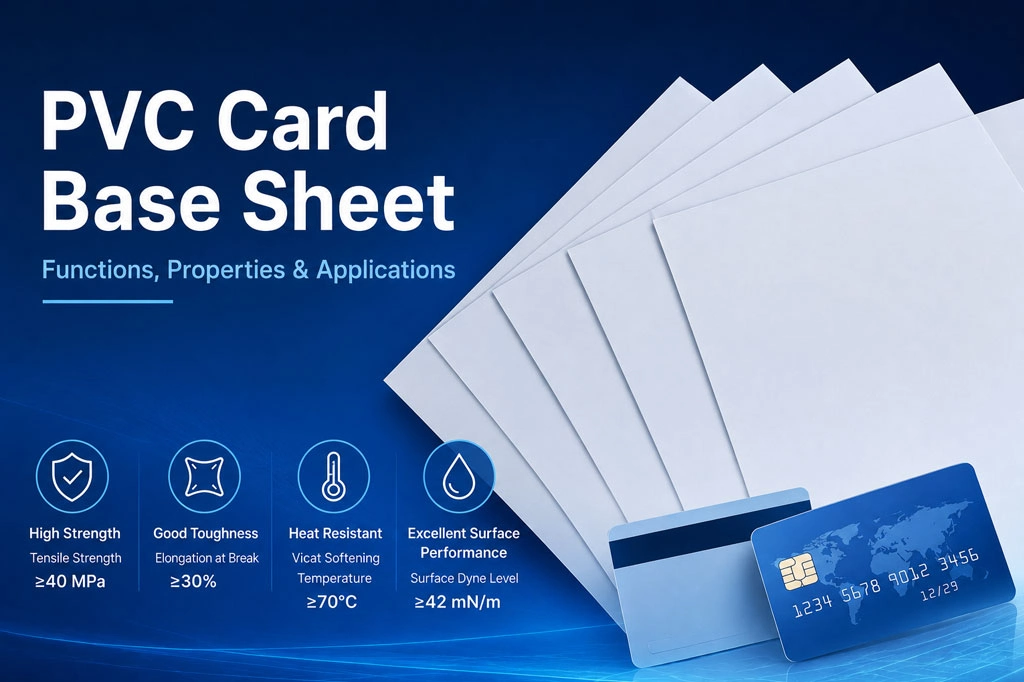
PVC card base sheet is a functional sheet or film material made primarily from polyvinyl chloride (PVC) and specifically developed for card manufacturing processes. It is also commonly referred to as PVC card film, PVC card base film, or PVC card-making sheet.
In a card structure, PVC card base sheet can be used to:
- Carry printed graphics, text, and background colors;
- Support the coating of magnetic information-recording materials;
- Provide the necessary rigidity and mechanical strength for the card body;
- Be thermally laminated with other card materials;
- Serve as the base material for card punching and subsequent personalization processes.
PVC card base sheet is not the same as a finished card. During card production, graphics are first printed or functional materials are coated onto the PVC base film. The material is then arranged, layered, and hot-laminated to form a complete card sheet. Finally, the sheet is punched and further processed into individual cards.
Main Functions of PVC Card Base Sheet in Card Manufacturing
1. Supporting Printed Graphics and Text
Brand logos, background graphics, numbering areas, and instructional text on cards are typically printed onto the surface of the PVC card base sheet.
If the surface properties of the substrate are unstable, printing defects such as poor ink wetting, incomplete coverage, ink shrinkage, pinholes, or insufficient adhesion may occur. Therefore, PVC card base sheet should have good surface uniformity and printability.
2. Supporting Functional Coatings
Some magnetic cards require information-recording materials to be coated onto the base film. The PVC card base sheet must therefore provide good coating compatibility while ensuring that the functional coating remains stable during subsequent hot lamination and throughout the service life of the card.
3. Providing Card Rigidity
Cards require sufficient rigidity to withstand printing, lamination, punching, and everyday use. If the card base is too soft, the finished card may bend or deform easily. If the material is too brittle, cracking may occur during punching or use.
A suitable PVC card base sheet should maintain an appropriate balance between rigidity, strength, and elongation.
4. Adapting to Hot Lamination Processes
PVC cards are generally manufactured by laminating multiple material layers under heat and pressure to form an integrated card body.
During this process, the card base must maintain good processing stability under elevated temperature and pressure, helping to prevent excessive softening, graphic displacement, card sheet warping, or poor interlayer bonding.
Key Technical Specifications of Betterial PVC Card Base Sheet
| Technical Property | Specification |
|---|---|
| Tensile Strength | ≥40 MPa |
| Elongation at Break | ≥30% |
| Vicat Softening Temperature | ≥70°C |
| Surface Dyne Level | ≥42 mN/m |
Tensile Strength
Tensile strength indicates a material’s ability to resist failure under tensile stress.
During unwinding, printing, layer assembly, hot lamination, and punching, PVC card base sheets are subjected to mechanical forces in different directions. Higher tensile strength helps reduce stretching, deformation, breakage, and processing instability.
Betterial PVC card film has a tensile strength of at least 40 MPa, providing the mechanical support required for card manufacturing and the finished card structure.
Elongation at Break
Elongation at break indicates how much a material can deform before breaking and is an important parameter for evaluating material toughness.
If the elongation capability is too low, the material may become susceptible to brittle cracking during punching, bending, or use at low temperatures. An elongation at break of at least 30% helps PVC card base sheet maintain a certain degree of toughness while retaining sufficient rigidity.
However, higher elongation is not necessarily always better. Card-making materials must also provide adequate dimensional stability, rigidity, and processing precision.
Vicat Softening Temperature
The Vicat softening temperature is used to evaluate the temperature at which a thermoplastic material begins to soften under specified test conditions.
Betterial PVC card film has a Vicat softening temperature of at least 70°C. This parameter can serve as a useful reference when designing hot lamination process conditions.
It is important to note that the Vicat softening temperature is not the same as the lamination temperature that should be directly set on production equipment. Actual hot lamination conditions should also take the following factors into consideration:
- Specific grade of the card base material;
- Base film thickness;
- Printing ink or functional coating system;
- Thermal properties of other laminated materials;
- Lamination time and pressure;
- Cooling and setting conditions.
Surface Dyne Level
Surface dyne level indicates the wettability of a material surface and is closely related to the spreading and adhesion of inks and coatings on PVC card base sheets.
Betterial PVC card film has a surface dyne level of at least 42 mN/m, helping support good printing and coating performance.
However, actual printing results are also influenced by the ink system, coating material, equipment speed, ambient temperature and humidity, and material storage time. Therefore, trial printing and adhesion testing with the actual ink system are recommended before mass production.
Key Features of Betterial PVC Card Base Sheet
Good Printability
PVC card base sheet can be used for printing card graphics, logos, and text. Stable surface properties help inks spread evenly across the substrate, reduce printing defects, and improve image clarity and batch-to-batch consistency.
Good Rigidity
Appropriate material rigidity improves handling stability during printing, layer assembly, and punching while helping finished cards resist bending and deformation.
Balanced Mechanical Properties
A proper balance between tensile strength and elongation at break helps the material withstand stretching, bending, and localized mechanical stress during manufacturing and everyday use.
Suitable for Functional Material Coating
In addition to graphic printing, PVC card base sheets can be used for coating magnetic information-recording materials, making them suitable for the production of magnetic cards and other functional cards.
Durable Performance
Good rigidity, mechanical strength, and toughness contribute to card durability, allowing finished cards to withstand daily carrying, repeated insertion and removal, and frequent use.
Main Applications of Betterial PVC Card Base Sheet
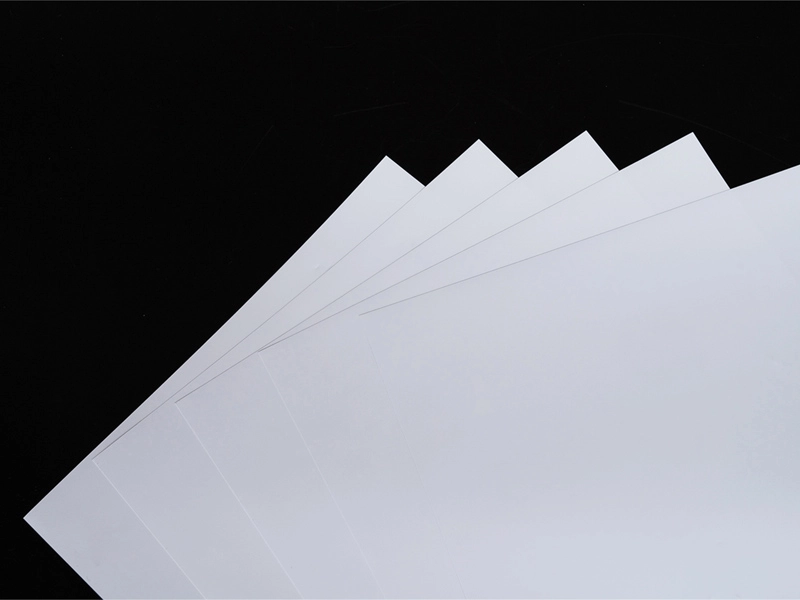
Betterial PVC card base sheets are mainly used in the production of various consumer cards and bank cards.
Bank Cards
PVC card base sheet can be used for credit cards, debit cards, prepaid cards, and other payment cards. These applications typically require materials with:
- Good printability;
- Stable hot lamination performance;
- Appropriate rigidity and toughness;
- Compatibility with magnetic stripes or other functional materials;
- Good dimensional stability and durability.
Membership Cards
Membership cards often display brand logos, membership levels, promotional information, and other visual elements. A high-quality PVC substrate surface helps achieve clear and consistent printing results.
Gift Cards and Stored-Value Cards
Gift cards and stored-value cards often emphasize visual design and may also incorporate magnetic stripes, barcodes, QR codes, or other information-recording methods. PVC card base sheet provides a reliable substrate for both graphic printing and functional material coating.
Hotel Key Cards and Access Cards
Some hotel key cards and access control cards use magnetic stripes or other identification technologies. Material selection should take into account usage frequency, bending performance, functional layer adhesion, and expected service life.
Other Consumer Cards
PVC card base sheets can also be used for loyalty cards, campus payment cards, shopping cards, service cards, and other card products. The specific material structure should be designed according to the card’s intended function and manufacturing process.
How to Choose the Right PVC Card Base Sheet
Consider the Printing and Coating Process
Before purchasing PVC card base sheet, card manufacturers should inform the material supplier about the printing method, ink type, and whether information-recording materials need to be coated onto the substrate.
This helps determine whether the surface properties of the selected material are suitable for the intended process.
Evaluate Mechanical Properties
For bank cards and frequently used consumer cards, particular attention should be paid to tensile strength, elongation at break, rigidity, and bending resistance.
Insufficient mechanical strength may cause deformation during processing, while excessive brittleness may increase the risk of cracking during punching or everyday use.
Confirm Hot Lamination Compatibility
Different card structures may require different hot lamination conditions. The appropriate processing window should be determined by considering the Vicat softening temperature, material thickness, and properties of other laminated materials.
Check Dimensional and Appearance Stability
The thickness, width, surface flatness, color consistency, and batch-to-batch stability of PVC card base sheets can all affect subsequent card manufacturing quality.
For applications requiring high printing registration accuracy, dimensional changes in both the machine and transverse directions during hot lamination should also be evaluated.
Conduct Sample Testing
Before placing a large-volume order, it is recommended to conduct tests using the actual production equipment, including:
- Printing or coating tests;
- Ink adhesion tests;
- Hot lamination tests;
- Laminated card sheet flatness inspection;
- Punching tests;
- Finished card bending and durability tests.
Sample testing helps card manufacturers verify the compatibility of the PVC card base sheet with their existing production processes and reduce risks during mass production.
Conclusion
PVC card base sheet is an important base material used in the production of consumer cards and bank cards. Its tensile strength, elongation at break, Vicat softening temperature, surface dyne level, and rigidity can directly influence multiple manufacturing processes, including printing, coating, hot lamination, and punching.
Betterial PVC card film offers good printability and rigidity and can be used for graphic printing as well as the coating of magnetic information-recording materials. After hot lamination, it can be processed into various types of consumer cards and bank cards.
Key technical specifications include a tensile strength of ≥40 MPa, elongation at break of ≥30%, Vicat softening temperature of ≥70°C, and surface dyne level of ≥42 mN/m.
For detailed product specifications, samples, or technical support, visit the Betterial PVC card film product page or contact Betterial for card material selection recommendations.