
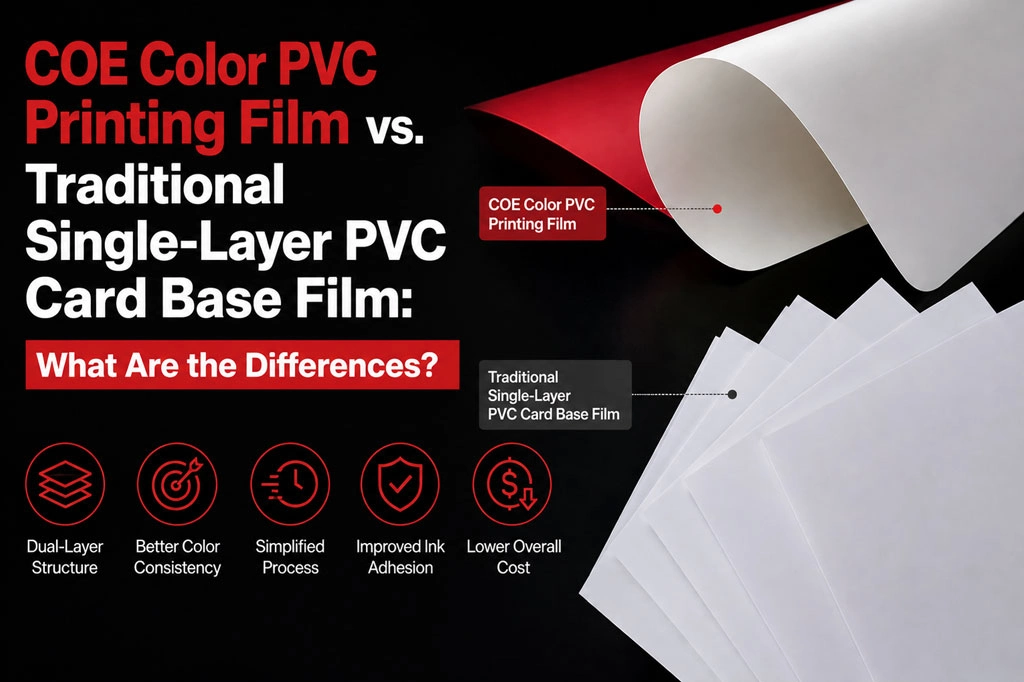
PVC card base film is a widely used base material for bank cards, payment cards, consumer cards, and other plastic cards. As bank card designs move toward greater color variety, personalization, and higher consistency requirements, traditional single-layer PVC card base film may require an additional white screen-printing process in certain colored card applications to ensure accurate color reproduction in subsequent printing.
COE color PVC printing film uses a dual-layer structure consisting of white PVC + colored PVC, integrating the white printing base traditionally created through screen-printed white ink directly into the card base material.
Therefore, the key difference between COE color PVC printing film and traditional single-layer PVC card base film is not simply the color of the material, but also the material structure and downstream card manufacturing process.
What Is COE Color PVC Printing Film?
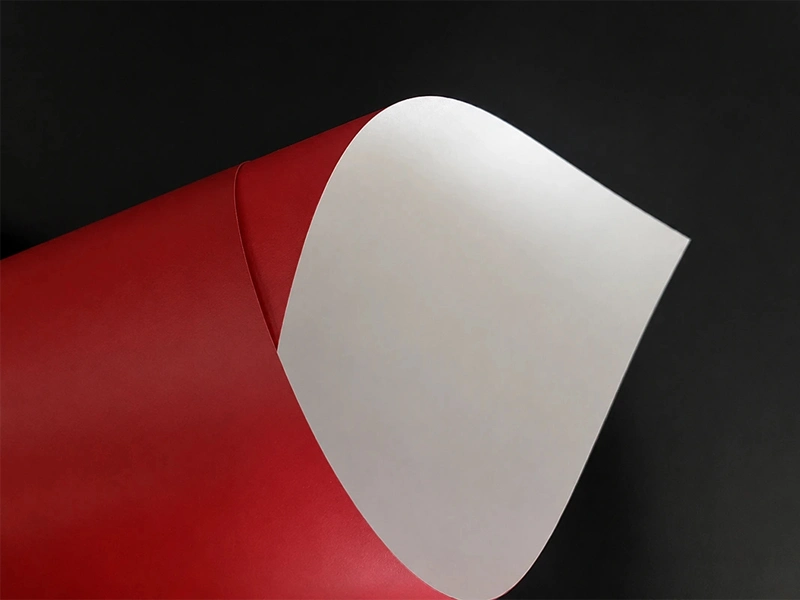
COE color PVC printing film is a dual-layer card material primarily developed for the production of colored bank cards. It consists of two main layers:
- White PVC layer;
- Colored PVC layer.
The white PVC layer can replace the screen-printed white ink layer used in conventional colored card production and provides a white printing base for subsequent graphic printing. The colored PVC layer provides the required base color of the card body.
COE card material is manufactured with its dual-layer structure formed in a single film-forming process. It is not produced by card manufacturers simply stacking or bonding two separate PVC sheets during downstream card production.
This integrated structure can eliminate the secondary white screen-printing process traditionally required for colored cards while helping improve color consistency across different colors and production batches.
What Is Traditional Single-Layer PVC Card Base Film?
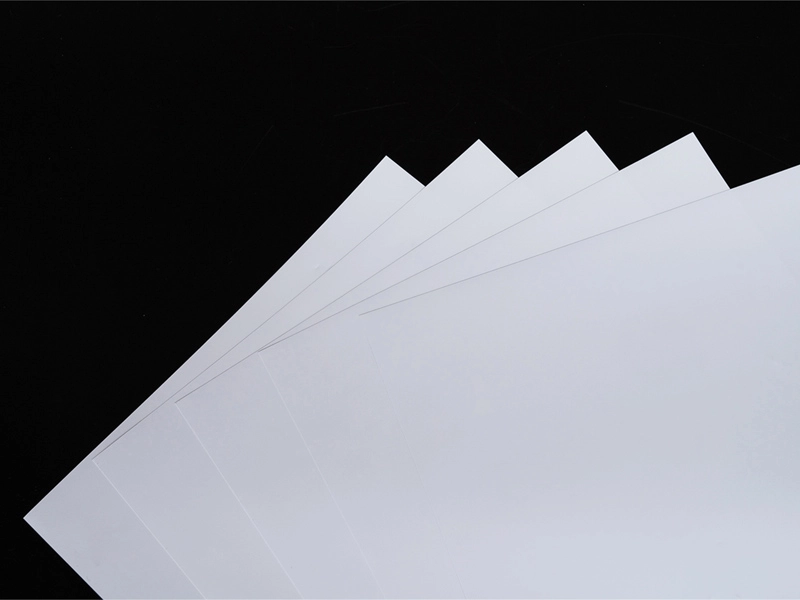
Traditional single-layer PVC card base film is a card-making substrate consisting of a single PVC material layer. It can be white, transparent, or colored.
PVC card film offers good printability and rigidity. Graphics can be printed onto its surface, or magnetic information-recording materials can be coated onto the base film. The material can then be laminated under heat and pressure to manufacture bank cards and various types of consumer cards.
Traditional single-layer PVC card base film is supported by mature manufacturing processes and has a broad range of applications. It can meet the production requirements of conventional bank cards, magnetic stripe cards, membership cards, gift cards, and many other plastic cards.
However, when producing colored bank cards, printing directly onto a dark-colored PVC substrate may affect the appearance and color accuracy of the graphics printed above it. Therefore, conventional manufacturing processes often require a layer of white ink to be screen printed onto the colored PVC before subsequent graphic printing.
COE Color PVC Printing Film vs. Single-Layer PVC Card Base Film
| Comparison | COE Color PVC Printing Film | Traditional Single-Layer PVC Card Base Film |
|---|---|---|
| Material structure | Dual-layer white PVC + colored PVC | Single-layer PVC |
| Primary application | Colored bank cards | Bank cards and various consumer cards |
| White printing base | Integrated white PVC layer | Colored card production typically requires screen-printed white ink |
| Forming method | Dual-layer structure formed in a single film-forming process | Single-layer base film |
| Printing surface | Subsequent graphics are printed on the white PVC layer | Printing is performed directly on PVC or on a screen-printed white ink layer |
| Color consistency | Defined color-difference control for both white and colored layers | Influenced by PVC color, white ink, and screen-printing conditions |
| Number of processing steps | Can eliminate secondary white screen printing | Colored cards may require additional white ink printing and curing |
| Ink adhesion | Printing ink bonds directly to the PVC material | Subsequent printing ink may bond to the screen-printed white ink layer |
| Aging resistance | Better ink-to-substrate adhesion and aging performance | Depends on compatibility among PVC, white ink, printing ink, and processing conditions |
| Inventory and storage | Integrated material simplifies stocking and storage | Card base film, white ink, and other materials may need to be managed separately |
| Production efficiency | Fewer processing steps and less rework can improve efficiency | Mature process, but colored card production involves more steps |
| Overall cost | Helps reduce screen-printing, curing, and rework costs | Simple material structure, but additional processing costs must be considered |
| Application flexibility | Better suited to colored cards requiring high color and batch consistency | Broader application range for various conventional cards |
Difference 1: Material Structure
COE Color PVC Printing Film uses a dual-layer structure combining white PVC with colored PVC. The white PVC layer performs the function traditionally provided by white ink, while the colored PVC layer provides the required base color.
Traditional single-layer PVC card base film consists of only one PVC material layer. When colored PVC is used for colored cards, a white ink layer usually needs to be added by screen printing to prevent the substrate color from interfering with the graphics printed above it.
The structural difference can therefore be summarized as follows:
- COE integrates the white printing layer directly into the card base material;
- Traditional colored PVC card base film creates the white printing layer through an additional screen-printing process.
This structural difference further affects printing, curing, quality control, and overall production costs.
Difference 2: Colored Card Manufacturing Process
Typical Process Using COE Color PVC Printing Film
- Prepare the dual-layer white PVC + colored PVC COE card base;
- Print graphics onto the white PVC layer;
- Arrange and stack it with other card-making materials;
- Laminate under heat and pressure to form the card sheet;
- Punch the cards and complete subsequent personalization processes.
Typical Process Using Traditional Colored PVC Card Base Film
- Prepare the single-layer colored PVC card base;
- Screen print white ink onto the designated areas;
- Dry or cure the white ink layer;
- Print the subsequent graphics onto the white ink layer;
- Stack it with other card-making materials;
- Laminate under heat and pressure;
- Punch the cards and complete subsequent processing.
The COE solution can eliminate white ink screen printing and the associated drying, curing, and inspection steps, helping shorten the overall production process.
The exact manufacturing process may still vary depending on card design, printing equipment, and customer quality requirements.
Difference 3: Color Consistency
Colored bank cards typically have demanding requirements for color consistency. Noticeable color differences between production batches can create difficulties during customer acceptance or increase the risk of rework.
With conventional manufacturing processes, the final color can be influenced by multiple variables, including:
- Batch-to-batch variation in colored PVC card base film;
- Whiteness of the screen-printing ink;
- Thickness of the white ink layer;
- Condition of the screen-printing mesh;
- Ink viscosity;
- Screen-printing equipment parameters;
- Drying or curing conditions.
COE Color PVC Printing Film integrates the white printing base directly as a PVC material layer, reducing the influence of white ink thickness variations and screen-printing process fluctuations.
Betterial COE color PVC printing film provides the following color-control specifications:
| Item | Specification |
|---|---|
| Color difference of COE white PVC layer | ΔE ≤ 1.0 |
| Color difference of COE colored PVC layer | ΔE ≤ 1.5 |
Lower color-difference values help maintain consistency both within the same production batch and across different batches of COE card materials.
Difference 4: Printing Surface
In traditional colored card manufacturing, subsequent graphics are typically printed onto a screen-printed white ink layer. As a result, printing quality can be affected by the surface smoothness, curing condition, and surface properties of the white ink layer.
In COE color PVC printing film, the white section is made of PVC material, allowing subsequent graphics to be printed directly onto the white PVC surface. The white PVC layer provides better printing performance than a conventional screen-printed white ink layer and facilitates more effective color reproduction during offset printing.
Key advantages include:
- A more uniform white PVC surface;
- Reduced influence from screen-printing mesh patterns;
- Less variation caused by inconsistent white ink thickness;
- More uniform wetting of subsequent printing inks;
- Improved color stability during offset printing.
However, before mass production, trial printing, adhesion testing, and lamination testing should still be conducted using the actual inks and production conditions.
Difference 5: Ink Adhesion and Aging Resistance
In conventional colored card production, the layer structure is typically:
Colored PVC Card Base → Screen-Printed White Ink → Subsequent Printing Ink
The final bonding performance therefore depends on two interfaces: the interface between the PVC and white ink, and the interface between the white ink and subsequent printing ink.
If either interface has poor compatibility, it may result in interlayer delamination or reduced bonding strength after aging.
COE Color PVC Printing Film replaces screen-printed white ink with a white PVC layer, allowing subsequent printing ink to bond directly to the PVC printing surface and eliminating one ink-to-ink interface.
Betterial COE color PVC printing film offers the following performance characteristics:
- High adhesion between the printing ink and substrate after printing;
- Good aging resistance;
- Bonding strength between the white PVC layer and colored PVC card base after aging: ≥20 N/cm.
The ≥20 N/cm value refers specifically to the bonding strength between the COE white PVC layer and colored PVC layer after aging. It should not be confused with peel-strength specifications used for conventional protective or overlay films.
Difference 6: Production Efficiency and Overall Cost
From the perspective of material structure alone, traditional single-layer PVC card base film is simpler. However, for colored bank card manufacturing, the more meaningful comparison is the total cost required to produce the same finished card.
Traditional colored PVC card base film may involve additional processes and costs, including:
- White ink purchasing and inventory management;
- Screen-printing equipment occupancy;
- Screen preparation and cleaning;
- White ink drying or curing;
- Labor and energy consumption;
- Inspection of white ink thickness and appearance;
- Rework caused by color differences or adhesion problems.
COE Color PVC Printing Film eliminates the secondary white ink screen-printing process, helping reduce manufacturing steps, lower the probability of rework, and improve production efficiency.
Therefore, the cost advantage of COE should be evaluated based on the overall card manufacturing cost, rather than simply comparing the purchase price per square meter of card base material.
Difference 7: Inventory Management
Traditional colored card manufacturing may require manufacturers to separately stock colored PVC card base film, screen-printing white ink, and related auxiliary materials. White ink batches, shelf life, and storage conditions must also be controlled.
COE Color PVC Printing Film uses an integrated dual-layer structure. According to the product specifications, it avoids downstream bonding issues between separate base materials and makes it easier for customers to prepare inventory according to their production schedules.
For colored bank card projects involving multiple colors and strict batch-consistency requirements, this integrated material can reduce some of the variables associated with production and material management.
When Is COE Color PVC Printing Film a Better Choice?
COE can be particularly suitable when:
- Colored bank cards are the primary products being manufactured;
- Colored PVC substrates require a white printing area;
- High color consistency across different card batches is required;
- The manufacturer wants to eliminate the white ink screen-printing process;
- White ink color variation and thickness fluctuation need to be reduced;
- High ink-to-substrate adhesion and aging resistance are required;
- Rework rates or screen-printing costs for colored cards are relatively high;
- Simplified inventory and material management are desired.
When Is Traditional Single-Layer PVC Card Base Film More Suitable?
Traditional PVC card film remains a suitable choice when:
- Producing white bank cards or standard consumer cards;
- The card design does not require a white printing base;
- Magnetic information-recording materials need to be coated onto the card base;
- Color and batch consistency requirements are relatively conventional;
- The manufacturer already operates a mature and stable screen-printing line;
- A wide variety of card types requires more flexible, general-purpose materials;
- The project prioritizes standardized production and broad material compatibility.
Conclusion
The fundamental difference between COE Color PVC Printing Film and traditional single-layer PVC card base film lies in their material structure and the way the white printing base is created.
Traditional colored PVC card base film generally requires a screen-printed white ink layer to establish a white printing base. In contrast, COE Color PVC Printing Film uses an integrated white PVC + colored PVC dual-layer structure formed in a single film-forming process, allowing the white PVC layer to directly replace the conventional screen-printed white ink layer.
This structure can help improve color and batch consistency, enhance offset printing performance and ink adhesion, and reduce secondary screen-printing processes, thereby lowering rework, improving production efficiency, and optimizing overall card manufacturing costs.
Traditional single-layer PVC card base film, meanwhile, continues to offer the advantages of mature processing technology, broad applicability, and material flexibility, making it a practical solution for white bank cards, magnetic stripe cards, and a wide variety of conventional consumer cards.