
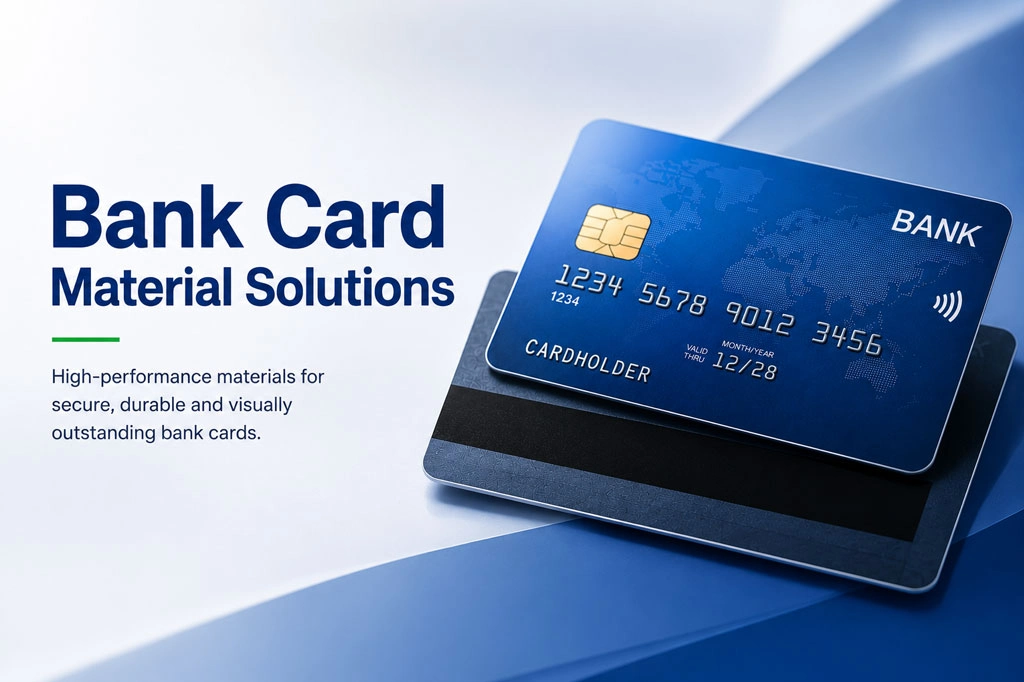
A bank card may look like a simple, thin plastic card, but it is typically composed of multiple functional materials, including transparent protective layers, printing layers, adhesive films, magnetic stripe lamination films, card base materials, and inlays.
The thickness, thermal properties, surface characteristics, and bonding performance of these materials must be carefully matched to ensure stable processing throughout printing, lamination, die cutting, chip embedding, magnetic stripe processing, and personalization.
For financial payment cards such as credit cards, debit cards, and prepaid cards, Betterial provides comprehensive bank card material solutions consisting of white films, transparent films, adhesive films, magnetic stripe lamination films, printing layers, inlays, and other related materials.
The solution supports printing layers, inlay layers, and other card structures and is compatible with card manufacturing processes such as embossing, magnetic stripe lamination, direct coating, and direct printing. It can meet the requirements of both customized card projects and large-scale production.
What Material Challenges Does Bank Card Manufacturing Face?
Bank cards must withstand prolonged exposure to wallet friction, repeated bending, insertion and removal, temperature changes, and everyday contamination. Improper material selection can result in problems such as delamination, warpage, ink peeling, poor magnetic stripe adhesion, or deformation around the chip area.
Bank card materials generally need to meet the following requirements:
Good Printability
The front and back surfaces of a bank card may contain bank logos, payment network logos, background graphics, cardholder information, and other design elements.
The printing layer should have stable surface tension and consistent surface characteristics so that inks can wet the surface evenly and adhere firmly. Unstable surface properties may result in ink shrinkage, uncovered areas, color variation, registration errors, or ink peeling after lamination.
Reliable Lamination Performance
Bank cards typically use a multilayer structure in which different materials are bonded together under controlled heat and pressure to form the complete card body.
Insufficient lamination performance may lead to:
- Interlayer delamination;
- Edge opening;
- Localized bubbles;
- Poor magnetic stripe bonding;
- Card warpage;
- Reduced bonding strength after aging.
Appropriate Rigidity and Flexural Resistance
Bank cards need to remain flat and sufficiently rigid while also withstanding repeated bending during everyday use. Materials that are too soft may compromise card stability, while overly brittle materials may cause cracking.
Compatibility with Magnetic Stripes, Chips, and Antennas
Different bank cards may incorporate magnetic stripes, contact chips, contactless antennas, or combinations of multiple functions. The materials must be compatible with the installation, lamination, and operating requirements of these components.
Stable Color and Appearance
For large-volume bank card projects, whiteness, color, and surface appearance should remain consistent both within individual production batches and between different batches. Significant color variations may affect printing quality and customer acceptance.
Balance Between Production Efficiency and Cost
Card materials must not only meet finished-card performance requirements but also provide a stable processing window that helps reduce lamination adjustments, appearance defects, rework, and material waste.
What Does the Betterial Bank Card Material Solution Include?
Betterial’s bank card material solution mainly includes four categories of materials:
- Adhesive film;
- Magnetic stripe lamination film;
- Printing layer;
- Inlay.
| Technical Item | Adhesive Film | Magnetic Stripe Lamination Film | Printing Layer | Inlay |
|---|---|---|---|---|
| Thickness | 0.04–0.15 mm | 0.04–0.15 mm | 0.08–0.35 mm | 0.35–0.45 mm |
| Density | 1.12–1.25 g/cm³ | — | 1.12–1.25 g/cm³ | — |
| Supply Form | Rolls / Sheets | Rolls / Sheets | Rolls / Sheets | Customizable |
| Maximum Width | ≤1450 mm | ≤600 mm, 8 magnetic tracks | ≤1450 mm | Customizable |
| Color Difference | No obvious visual difference | No obvious visual difference | ≤1.0 | — |
| Vicat Softening Temperature | 68±2°C | 68±2°C | (72–78)±2°C | — |
| Surface Dyne Level | — | — | 36–38 dyn/cm | — |
| Peel Strength | ≥8 N/cm | ≥8 N/cm | — | — |
| Strength After Aging | ≥6 N/cm | ≥6 N/cm | — | — |
| Chip Type and Brand | — | — | — | Selected according to customer requirements |
In addition, white films, transparent films, and other related card manufacturing materials can be supplied according to the card design and structural requirements.
These materials can be used individually or combined according to the bank card structure to create a material system tailored to specific projects.
1. Adhesive Film for Bank Cards
Adhesive film is mainly used for interlayer bonding in bank cards and can be thermally laminated with printing layers or other card materials.
In a typical bank card structure, adhesive film can perform several functions:
- Bond the transparent protective layer to the printing layer;
- Improve interlayer adhesion between different materials;
- Protect printed graphics;
- Reduce the risk of edge delamination;
- Improve the long-term reliability of the finished card.
Betterial’s bank card adhesive film is available in thicknesses ranging from 0.04 to 0.15 mm and can be supplied in rolls or sheets, with a maximum width of 1450 mm.
Its key bonding performance specifications include:
- Initial peel strength ≥8 N/cm;
- Strength after aging ≥6 N/cm.
Initial peel strength reflects the bonding performance immediately after lamination, while strength after aging helps evaluate the long-term interlayer reliability of the card during storage and extended use.
2. Magnetic Stripe Lamination Film for Bank Cards
Magnetic stripe lamination film combines magnetic data-recording functionality with card lamination materials and is primarily used in bank cards incorporating magnetic stripes.
Its main functions include:
- Supporting or laminating the magnetic stripe;
- Securely integrating the magnetic recording layer into the card body;
- Withstanding bank card hot-lamination processes;
- Maintaining magnetic stripe positioning and card surface flatness;
- Improving the long-term bonding reliability of the magnetic stripe area.
Betterial magnetic stripe lamination film is available in thicknesses ranging from 0.04 to 0.15 mm and can be supplied in rolls or sheets.
For structures with eight magnetic tracks, the product width is up to 600 mm. Key performance specifications include:
- Initial peel strength ≥8 N/cm;
- Strength after aging ≥6 N/cm;
- Vicat softening temperature of 68±2°C;
- No obvious visible color difference.
When selecting magnetic stripe lamination materials, manufacturers should consider not only film adhesion but also compatibility with the magnetic stripe type, recording performance, lamination parameters, and overall card structure.
3. Printing Layer for Bank Cards
The printing layer carries the graphics, text, brand colors, and other visual information on the bank card while potentially contributing to the structural support of the card body.
Betterial’s bank card printing layer provides good printability and rigidity and can be used for direct printing or coating processes.
Its main specifications include:
| Technical Item | Printing Layer Specification |
|---|---|
| Thickness | 0.08–0.35 mm |
| Density | 1.12–1.25 g/cm³ |
| Supply Form | Rolls or sheets |
| Maximum Width | ≤1450 mm |
| Color Difference | ≤1.0 |
| Vicat Softening Temperature | (72–78)±2°C |
| Surface Dyne Level | 36–38 dyn/cm |
4. Bank Card Inlay
The inlay is a functional structural layer used in smart bank cards and can integrate electronic components such as chips and antennas.
The inlay structure can vary significantly depending on whether the card is a contact, contactless, or dual-interface bank card. When selecting inlay materials and configurations, several factors should be considered:
- Chip type and brand;
- Antenna structure;
- Inlay thickness;
- Adhesion to upper and lower card layers;
- Compatibility with lamination temperatures;
- Warpage and flatness after lamination;
- Functional performance of the chip and antenna after lamination.
Betterial bank card inlays typically have a thickness of 0.35–0.45 mm, while their length and width can be customized according to project requirements. Chip types and brands can also be selected based on customer requirements.
An inlay should not be considered independently from the overall card structure. Its thickness, material properties, and thermal behavior need to be designed together with the printing layer, adhesive film, and protective layers to ensure the required thickness and flatness of the finished bank card.
Key Advantages of Betterial’s Bank Card Material Solutions
Good Printability and Rigidity
The printing layer must support clear, high-quality graphics while also contributing to a stable card structure. Appropriate rigidity helps ensure reliable handling during layout, lamination, die cutting, and personalization processes.
Flexural Resistance
Bank cards are repeatedly bent during everyday use. Good flexural resistance helps reduce the risk of card cracking, interlayer delamination, and failure of functional components.
Long-Term Durability
The adhesive film and magnetic stripe lamination film are designed with defined initial and post-aging bonding strength requirements, helping maintain interlayer stability throughout long-term card use.
Compatibility with Multiple Processing Methods
The solution supports embossing, magnetic stripe lamination, direct coating, and direct printing, allowing card manufacturers to select suitable manufacturing processes according to different bank card types.
Support for Customization and Large-Scale Production
Printing layers, adhesive films, and magnetic stripe lamination films can be supplied in rolls or sheets, while inlay dimensions and chip configurations can be customized according to customer requirements. This flexibility supports both customized card projects and high-volume bank card manufacturing.
One-Stop Material Matching
Betterial provides more than individual film materials. Based on the overall card structure, Betterial can assist customers in matching printing layers, adhesive films, magnetic stripe lamination films, and inlays, helping reduce compatibility risks associated with sourcing materials from multiple suppliers.