
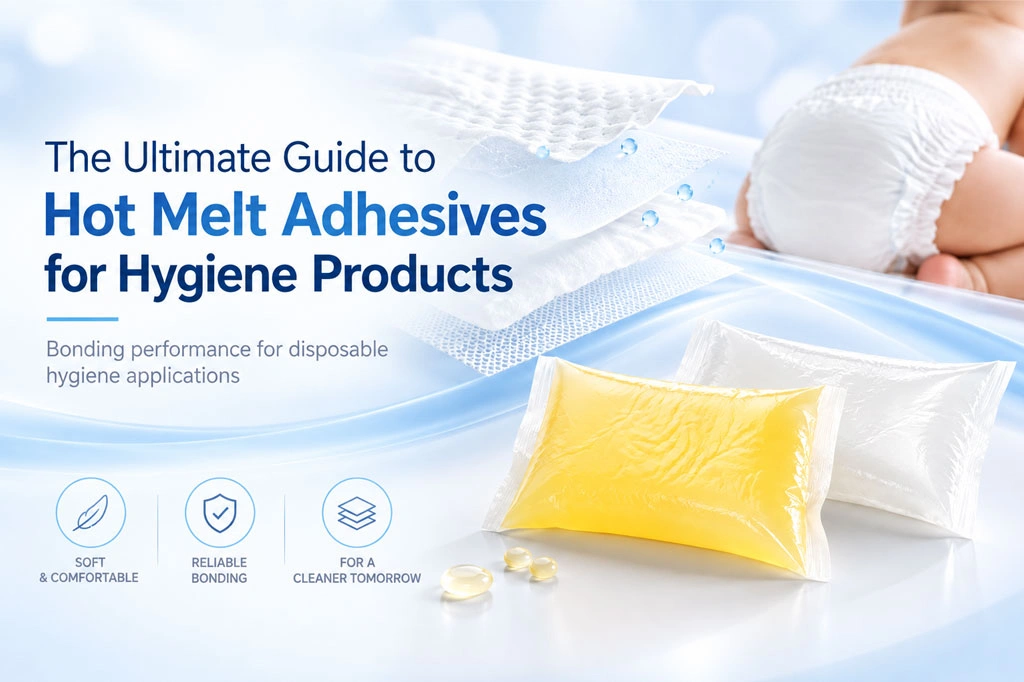
Disposable hygiene products such as baby diapers, sanitary napkins, underpads, and adult incontinence products may appear to consist primarily of nonwoven fabrics, absorbent cores, breathable films, and elastic materials.
However, an important bonding material is required to reliably combine these different components into a complete product: hot melt adhesive for hygiene products.
Hygiene hot melt adhesives are a category of thermoplastic adhesives specifically developed for the manufacturing processes of disposable hygiene products. When heated, the adhesive melts into a flowable state and is applied to substrates such as nonwoven fabrics, PE films, elastic materials, and absorbent cores through spraying, slot coating, or other application methods. It then cools rapidly to form a bond.
Compared with conventional hot melt adhesives used in packaging or general industrial applications, hygiene hot melt adhesives must provide more than reliable bonding performance. They must also meet the requirements of high-speed production, low odor, thermal stability, flexibility, and good adhesion to a wide range of substrates.
For this reason, different types of hot melt adhesives are typically selected according to the structure and functional requirements of individual hygiene products.
1. Where Are Hygiene Hot Melt Adhesives Used?
A diaper or sanitary napkin typically consists of multiple layers made from different materials.
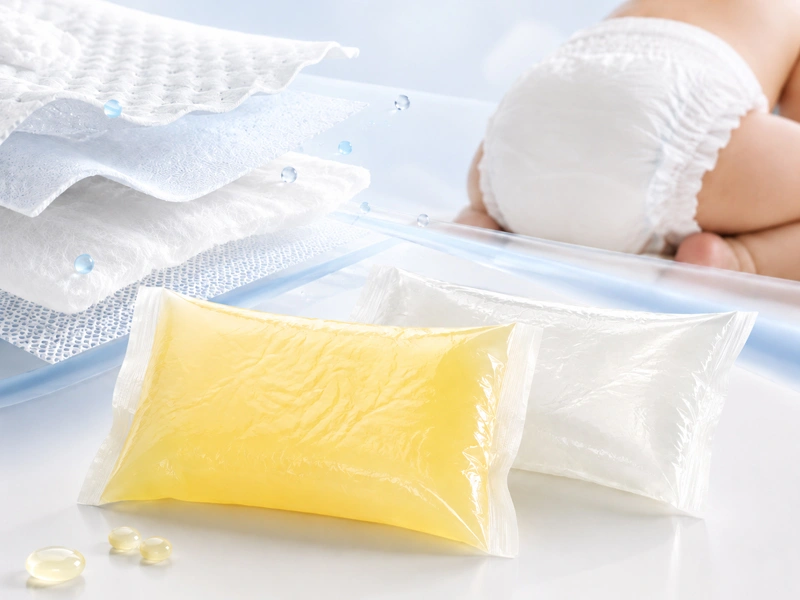
For example, a baby diaper may include a hydrophilic nonwoven topsheet, an acquisition and distribution layer, an absorbent core, a backsheet film, leg cuff materials, an elastic waistband, and hook-and-loop fastening components. These materials must be bonded, laminated, or secured together to form the finished product.
Hygiene hot melt adhesives are commonly used for:
- Structural bonding between nonwoven fabrics and PE films;
- Lamination of nonwoven fabrics to nonwoven fabrics;
- Fixation and stabilization of absorbent core structures;
- Stabilization of superabsorbent polymer (SAP) and fluff pulp structures;
- Attachment of elastic materials in leg cuffs and waistbands;
- Positioning adhesive for sanitary napkins;
- Attachment of hook-and-loop fasteners, wings, and other functional components.
Because these areas perform different functions, their adhesive performance requirements also vary considerably.
For example, adhesives used for large-area lamination need to balance bonding strength with softness, while adhesives used for elastic waistbands must maintain reliable bonding as the materials undergo repeated stretching and recovery.
Therefore, manufacturers of hygiene products generally do not use a single hot melt adhesive grade for every bonding application.
2. What Are the Main Types of Hygiene Hot Melt Adhesives?
According to their application position and function, hygiene hot melt adhesives can generally be divided into construction adhesives, elastic attachment adhesives, positioning adhesives, and core adhesives.
2.1 Construction Adhesive
Construction adhesive is mainly used to laminate different material layers in disposable hygiene products. It is one of the most widely used types of hot melt adhesive in baby diapers, sanitary napkins, and adult incontinence products.
Typical substrates include:
- Nonwoven fabrics;
- Breathable PE films or backsheets;
- Film/nonwoven laminates;
- Materials surrounding the absorbent core.
Construction adhesives should provide reliable bonding at relatively low coat weights while minimizing their impact on product softness and breathability.
For high-speed hygiene product manufacturing lines, construction adhesives must also provide good sprayability and processing stability to support continuous, high-speed production.
2.2 Elastic Attachment Adhesive
Modern diapers commonly incorporate elastic materials around the leg cuffs and waist areas to improve fit and conformability to the body.
Elastic attachment adhesives are used to secure these elastic components.
Unlike ordinary structural bonding, elastic materials are continuously subjected to stretching and recovery during use. Therefore, elastic attachment adhesives need to provide good initial tack, cohesive strength, and creep resistance.
If the adhesive does not hold the elastic securely, the elastic strands may shift, retract, or detach, reducing the effectiveness of the leg cuffs or waistband.
For this reason, creep resistance is one of the key performance indicators used to evaluate elastic attachment adhesives.
2.3 Positioning Adhesive
Positioning adhesives are mainly applied to the back of sanitary napkins and panty liners to secure the products to underwear during use.
These adhesives need to achieve a balance between two seemingly contradictory requirements.
On the one hand, they need sufficient initial tack and holding power to prevent the hygiene product from shifting significantly during use.
On the other hand, the product should still be easy to remove after use while minimizing adhesive residue on the fabric surface.
Therefore, positioning adhesives need to balance initial tack, peel performance, holding power, and residue control.
3. What Properties Should Hygiene Hot Melt Adhesives Have?
Disposable hygiene products are typically manufactured using highly automated, continuous production processes. This creates adhesive requirements that differ significantly from those of conventional industrial bonding applications.
Good Bonding Performance
Hygiene products contain a variety of materials with different surface characteristics, including nonwoven fabrics, PE films, elastomers, and absorbent materials.
The hot melt adhesive must form reliable bonds with the appropriate substrates to prevent delamination or adhesive failure during production, packaging, transportation, and use.
Good Application and Spray Performance
Modern hygiene product manufacturing lines typically require continuous, high-speed adhesive application.
At the operating temperature, the hot melt adhesive should maintain suitable melt viscosity and flow properties to produce uniform, stable adhesive lines or spray patterns.
Good processing performance can help reduce issues such as stringing, nozzle clogging, and uneven adhesive application.
Thermal Stability
Hot melt adhesives may remain in heated melting equipment for extended periods.
If an adhesive has insufficient thermal stability, prolonged exposure to heat can cause changes in color, viscosity, or other properties and may increase the risk of char formation and equipment maintenance problems.
Stable thermal performance is therefore essential for continuous manufacturing operations.
Flexibility and Softness
Consumers increasingly expect diapers, sanitary napkins, and other hygiene products to be thinner, softer, and more comfortable.
If the adhesive becomes too rigid after cooling, or if an excessive amount of adhesive is applied, it may negatively affect the natural softness and hand feel of nonwoven fabrics and films.
Hygiene hot melt adhesives therefore need to provide an appropriate balance between bonding strength and flexibility.
Low Odor
Disposable hygiene products are used in close contact with consumers in everyday life, making odor an important material consideration.
Using low-odor hot melt adhesives can help improve both the manufacturing environment and the end-user experience of the finished hygiene product.
4. How Do Hygiene Hot Melt Adhesives Work?
Hygiene hot melt adhesives are usually supplied in solid form.
Once introduced into the production line, the adhesive is first heated in hot melt equipment to the appropriate application temperature. This transforms the adhesive from a solid into a flowable molten state.
The molten adhesive is then applied to the material surface using spray nozzles, slot applicators, or other adhesive dispensing equipment according to a predetermined coat weight and application pattern.
A second material layer is then brought into contact with the adhesive-coated substrate.
As the temperature decreases, the hot melt adhesive cools rapidly and forms a bond, securing the different materials together.
Because the process generally does not rely on the evaporation of water or solvents for curing, hot melt adhesives are particularly well suited to continuous, high-speed manufacturing of disposable hygiene products.
5. How to Choose the Right Hot Melt Adhesive for Hygiene Products
When selecting a hygiene hot melt adhesive, manufacturers should not evaluate only a single parameter such as “bonding strength.”
The first step is to identify the specific application.
A construction adhesive used to laminate nonwoven fabric to a backsheet has very different performance requirements from an elastic attachment adhesive used to secure an elastic waistband. Similarly, positioning adhesives for sanitary napkins require particular attention to positioning stability and peel performance.
The actual substrates must also be considered.
Even within the same category of nonwoven fabric, differences in fiber type, basis weight, surface treatment, and supplier can result in different surface properties and therefore affect actual adhesive performance.
Manufacturers should also evaluate factors such as:
- Production line speed;
- Adhesive application equipment;
- Operating temperature;
- Adhesive coat weight;
- Spray or coating method;
- Open time;
- Product storage conditions;
- Final application environment.
Therefore, the right hygiene hot melt adhesive should be systematically matched with the substrates, equipment, manufacturing process, and final product requirements.
Conclusion
Choosing the right hygiene hot melt adhesive provides more than strong bonding between materials. It can also contribute to product reliability, comfort, and manufacturing stability.
As disposable hygiene products continue to evolve toward thinner and softer structures, higher production speeds, and more differentiated functionality, adhesive suppliers need to provide more application-specific solutions covering everything from raw material compatibility and adhesive formulation to dispensing and application processes.
Betterial can provide hygiene hot melt adhesive products and technical support based on customers’ product structures, substrate combinations, and production equipment requirements, helping manufacturers improve bonding reliability and production efficiency.