
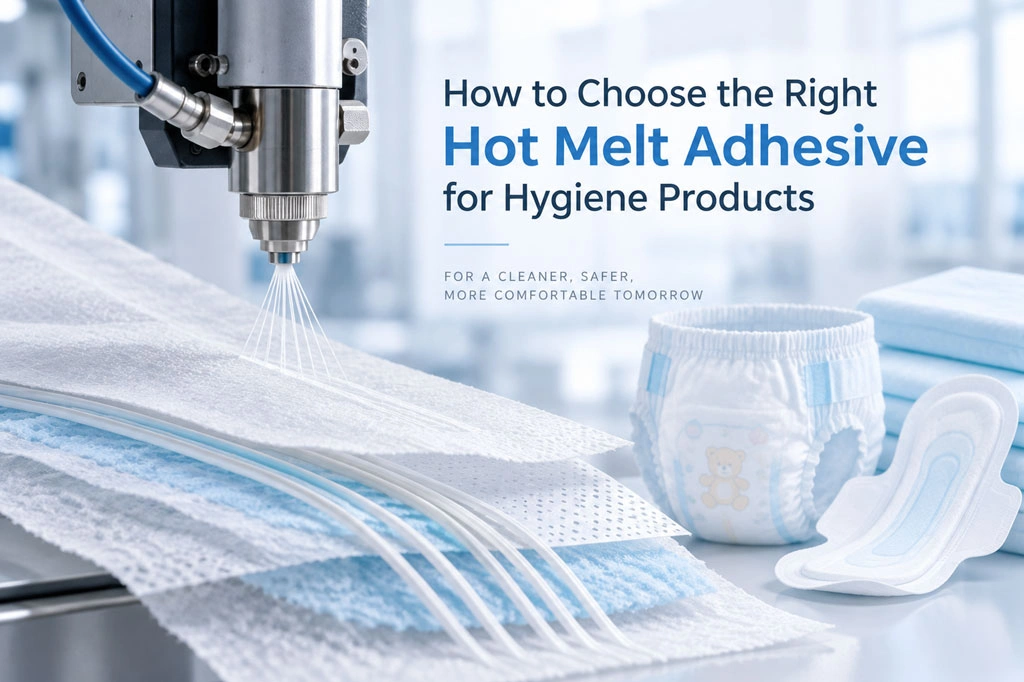
In the production of disposable hygiene products such as baby diapers, sanitary napkins, pull-up pants, and underpads, hot melt adhesive may account for only a small proportion of the total material used, but it directly affects product structural integrity, wearing comfort, and the operating efficiency of high-speed production lines.
Therefore, selecting a hot melt adhesive for hygiene products should not be based simply on whether the adhesive is “sticky enough.” Instead, the selection should take into account the bonding position, substrates, production process, and performance requirements of the finished product.
So, how can manufacturers choose a hot melt adhesive that is truly suitable for both their products and production lines?
1. First, Identify Where the Hot Melt Adhesive Will Be Used
The first step in selecting a hot melt adhesive for hygiene products is to identify the specific bonding application.
A single diaper or sanitary napkin may contain several adhesive application areas, each serving a different function. Therefore, the same performance criteria cannot simply be applied to every bonding position.
Construction Bonding
Construction adhesives are mainly used for laminating nonwoven fabrics, PE films, absorbent cores, and other material layers.
These applications generally require good initial tack and bonding strength while also ensuring compatibility with different substrates such as thin films and nonwoven materials.
Key factors to evaluate include:
- Bonding performance on materials such as nonwoven fabrics and PE films;
- Whether the open time matches the production speed;
- Uniformity of adhesive spray;
- Whether stringing, charring, or other processing problems occur during long production runs;
- Whether stable bonding can still be maintained after finished-product storage.
Elastic Material Attachment
In diapers, pull-up pants, and similar products, elastic strands, spandex, or other elastic materials are commonly used around the leg cuffs and waist areas.
These areas require more than simple adhesion. The adhesive must maintain stable bonding during repeated stretching and recovery. Therefore, elastic attachment adhesives generally require good adhesion to elastic materials, creep resistance, and aging resistance.
If creep resistance is insufficient, elastic materials may slip or retract during storage or use, reducing the fit and performance of the leg cuffs or waistband.
Positioning Adhesive for Sanitary Napkins
The function of the positioning adhesive on the back of a sanitary napkin is significantly different from that of ordinary construction adhesive.
It must hold the sanitary napkin securely to the underwear fabric while still allowing it to be removed smoothly after use. Therefore, this type of hot melt adhesive must achieve an appropriate balance between positioning strength and removability.
Insufficient tack may cause the product to shift during use, while excessive tack may make removal difficult, leave adhesive residue, or negatively affect the user experience.
Therefore, before selecting an adhesive, manufacturers should first clearly determine:
What materials will the hot melt adhesive bond, where will it be applied, and what function must that bonding area perform?
Only after the application is clearly defined does it become meaningful to compare adhesive performance.
2. Select the Adhesive According to the Substrates
Hygiene products are typically composed of multiple materials, such as:
- PP nonwoven fabric;
- Breathable PE film;
- SMS nonwoven fabric;
- Elastic nonwoven fabric;
- Spandex strands;
- Absorbent cores;
- Release paper;
- Various fibers and composite materials.
These materials differ in surface energy, surface roughness, pore structure, and temperature resistance. As a result, the same hot melt adhesive may perform very differently on different substrates.
For example, an adhesive that provides excellent bonding on conventional nonwoven fabric may not achieve the same results on low-surface-energy PE film or elastic materials.
For this reason, adhesive selection should not rely solely on the general technical parameters provided by the supplier. Actual bonding tests using the intended production materials are even more important.
If a hygiene product manufacturer changes suppliers of nonwoven fabric, backsheet film, elastic strands, or other raw materials, it is also advisable to reconfirm the compatibility between the hot melt adhesive and the new substrates.
3. Pay Attention to Bonding Strength
Bonding performance is one of the most fundamental criteria for evaluating hot melt adhesives used in hygiene products.
However, “the stronger the bond, the better” is not the correct selection principle.
For construction bonding, the adhesive must prevent delamination or bond failure during production, packaging, transportation, storage, and use. For positioning adhesives, both adhesion and removability must be considered. For elastic areas, stability under continuous stress must also be evaluated.
Depending on the application, the following properties should be considered:
Initial Tack
How quickly the hot melt adhesive develops an effective bond after contacting the substrate.
Peel Strength
The ability of the bonded materials to resist separation.
Holding Power
The ability of the adhesive to maintain bonding under continuous load.
Creep Resistance
Particularly important for elastic strands, elastic waistbands, and other structures that remain under continuous retraction stress.
A suitable hot melt adhesive for hygiene products should provide a reasonable balance among these properties rather than simply maximizing one individual value.
4. Consider Production Line Speed
Modern production lines for diapers, sanitary napkins, and other disposable hygiene products typically operate at high speeds. Therefore, the hot melt adhesive must be compatible with the actual production cycle.
During high-speed manufacturing, the time between adhesive application, material combining, and compression can be extremely short.
If the open time is too short, the adhesive may lose sufficient wetting capability before the two material layers are fully combined, resulting in insufficient bonding.
Conversely, if the open time does not match the production process, it may also affect downstream processing and finished-product stability.
When selecting a hot melt adhesive, manufacturers should therefore provide the adhesive supplier with actual production conditions, including:
- Production line speed;
- Adhesive application method;
- Adhesive coat weight;
- Spray width;
- Distance between the nozzle and substrate;
- Time between adhesive application and material combining;
- Adhesive tank and hose temperatures.
Matching the adhesive based on these real operating conditions is generally more reliable than comparing technical data alone.
5. Consider Odor, Color, and Thermal Stability
Diapers, sanitary napkins, and personal care products remain in close contact with consumers for extended periods. As a result, adhesive odor and appearance are also important factors.
For baby diapers, feminine hygiene products, and premium care products in particular, a noticeable adhesive odor may directly influence the consumer’s perception of product quality.
At the same time, hot melt adhesive often remains in a molten state for long periods during production. If its thermal stability is poor, continuous heating inside the adhesive tank may result in:
- Darkening of the adhesive;
- Changes in viscosity;
- Increased odor;
- Gel formation;
- Increased charring.
Therefore, continuous and high-speed production lines should place particular emphasis on long-term thermal stability rather than evaluating only the condition of the adhesive immediately after melting.
6. Pay Attention to Environmental Performance
As consumers place greater emphasis on the safety, odor, and environmental performance of hygiene products, the environmental characteristics of hot melt adhesives have also become an increasingly important selection factor.
Products such as diapers, sanitary napkins, pull-up pants, and underpads are typically used in close contact with the human body. In addition to meeting basic bonding requirements, manufacturers should evaluate whether the adhesive raw materials and finished products comply with the environmental and chemical substance management requirements of their target markets and product systems.
Key considerations include:
- VOC and odor control;
- Whether the formulation contains substances of concern or restricted chemicals;
- Compliance of raw materials and formulation;
- Ability to meet applicable regulations and customer standards in target markets;
- Whether noticeable odors may develop during long-term use or storage;
- Whether the supplier can provide relevant test reports and compliance documentation.
For products such as baby diapers and feminine hygiene products, where odor and user experience are particularly important, low-odor and low-VOC hot melt adhesives can help improve the overall consumer experience.
It should be noted that “environmentally friendly” should not be judged solely based on supplier marketing claims.
Hygiene product manufacturers should request appropriate technical documentation and test reports according to the destination market, customer requirements, and their own quality management systems, while also carrying out validation on the finished products.
7. Consider Low-Temperature Application Performance
Application temperature is another important factor when selecting hot melt adhesives for hygiene products.
Traditional hot melt adhesives generally need to remain molten at relatively high temperatures. However, thin or heat-sensitive hygiene substrates such as nonwoven fabrics and breathable PE films may be more susceptible to deformation, shrinkage, or even damage when exposed to excessive heat.
Therefore, provided that bonding and application performance remain satisfactory, manufacturers may consider hygiene hot melt adhesives with good low-temperature application performance.
Lower application temperatures can potentially provide several advantages:
1. Reduced Risk of Damage to Heat-Sensitive Materials
Some PE films, ultra-thin nonwoven fabrics, and elastic materials used in diapers and sanitary napkins are relatively sensitive to heat. Lowering the adhesive application temperature can help reduce the local thermal impact on these substrates.
2. Reduced Energy Consumption During Production
Hot melt adhesive systems continuously heat adhesive tanks, hoses, and nozzles. Under otherwise comparable operating conditions, a lower temperature setting can reduce heating demand and create opportunities for energy savings on the production line.
3. Reduced Effects of Long-Term High-Temperature Exposure on the Adhesive
Prolonged exposure to high temperatures may cause hot melt adhesives to oxidize, darken, change viscosity, or form char. Appropriately lowering the operating temperature may help reduce these heat-related changes, although the actual effect depends on the adhesive formulation and equipment operating conditions.
4. Improved Production Working Environment
Lowering the operating temperatures of adhesive tanks, hoses, and nozzle systems can reduce the thermal load generated by high-temperature equipment and may also help reduce operational risks associated with handling molten adhesive.
However, low-temperature application does not mean that the lower the temperature, the better.
If the application temperature is too low, adhesive viscosity may become too high, affecting pumping, spraying, substrate wetting, and final bonding performance.
Therefore, the appropriate application temperature should be determined according to the adhesive’s viscosity-temperature characteristics, application equipment, production speed, and substrates.
The key consideration is:
At a suitably reduced application temperature, the hot melt adhesive should still maintain good flowability, application performance, substrate wetting, and bonding reliability.
If a hygiene product manufacturer wishes to reduce application temperature, production-line trials are recommended. Viscosity, spray quality, adhesive coat weight, bonding strength, and equipment operation should be compared at different temperature settings before the final process parameters are established.
Conclusion
The right hot melt adhesive for hygiene products is not necessarily the product with the highest bonding strength or the lowest price. It should be the adhesive that best matches the specific product structure, substrates, production equipment, and end-use requirements.
For diapers, sanitary napkins, pull-up pants, underpads, and other hygiene products, manufacturers should first identify the bonding location and required function, and then comprehensively evaluate factors such as substrate compatibility, bonding strength, creep resistance, viscosity, open time, low-temperature application performance, spray stability, thermal stability, environmental performance, and long-term aging resistance.
As hygiene product manufacturing continues to move toward higher production speeds, lighter and thinner structures, energy efficiency, and improved environmental performance, hot melt adhesives are expected to do more than simply “hold materials together.” They also need to provide low odor, regulatory compliance, relatively low application temperatures, stable processing performance, and competitive overall production costs.