
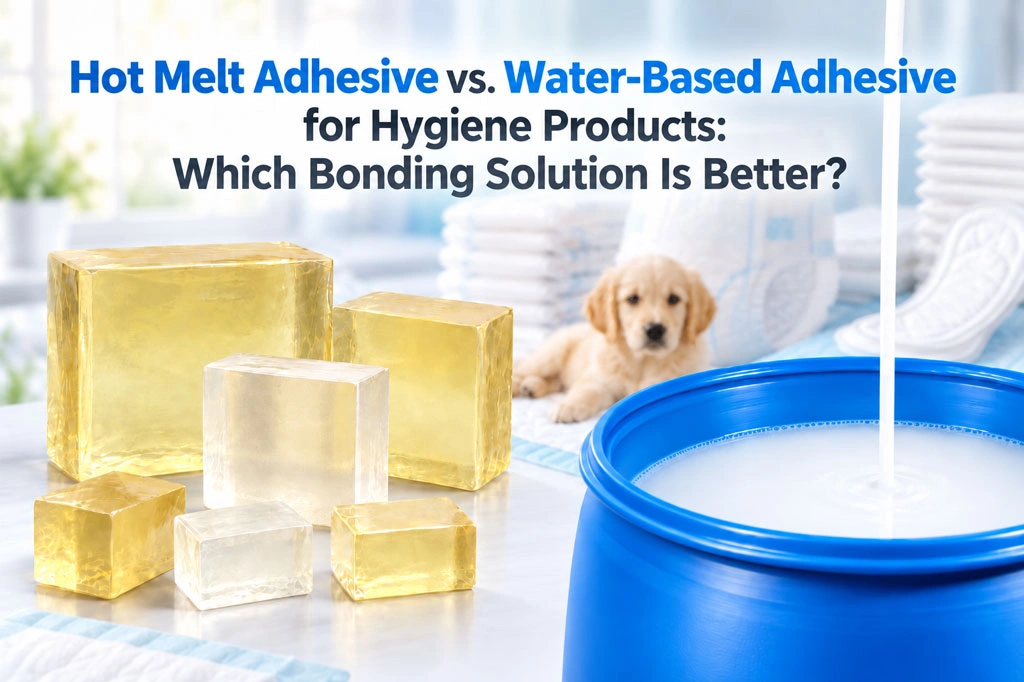
Common bonding solutions used in hygiene product manufacturing include hot melt adhesives and water-based adhesives. Both can be used to bond materials such as nonwoven fabrics, PE films, and absorbent cores, but they differ significantly in application methods, drying requirements, production speed, energy consumption, and suitable applications.
So, what are the key differences between hot melt adhesives and water-based adhesives? For modern high-speed hygiene product production lines, which solution is more suitable?
1. What Is Hot Melt Adhesive?
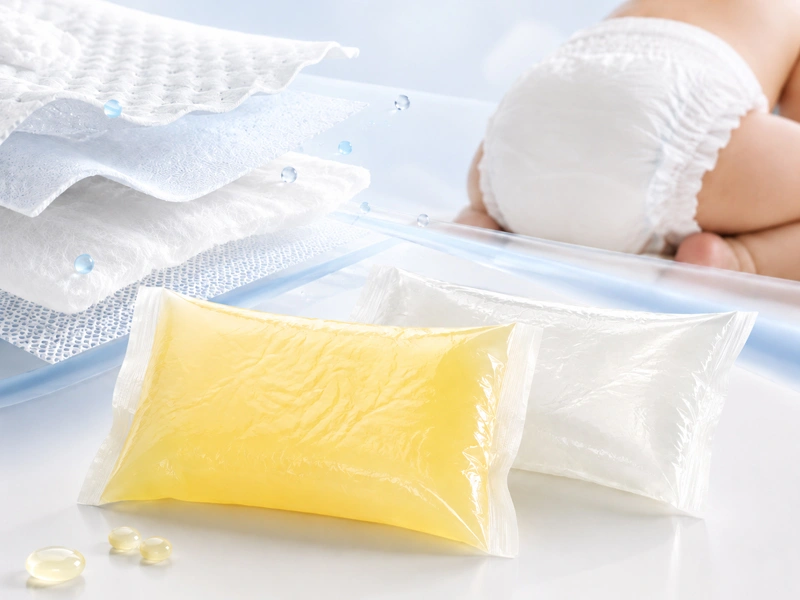
Hot melt adhesive for hygiene products is a type of thermoplastic adhesive specifically developed for disposable hygiene applications.
During production, the adhesive is melted using heating equipment and then applied to substrates such as nonwoven fabrics, PE films, elastic materials, or absorbent cores through spray coating, slot coating, spiral spraying, or other application methods.
Once applied, the hot melt adhesive forms a bond as it cools, without requiring additional evaporation of water or solvents.
As disposable hygiene product manufacturing increasingly moves toward higher speeds, greater automation, and continuous production, hot melt adhesives have become one of the most important bonding materials used in the industry.
2. What Is Water-Based Adhesive?
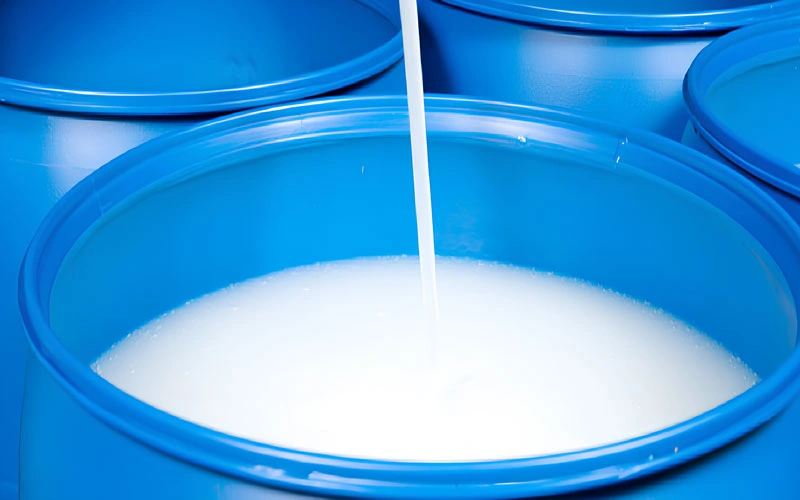
Water-based adhesive is an adhesive system in which water serves as the primary dispersion medium.
After application, the water contained in the adhesive must be removed through natural evaporation, hot-air drying, or other drying methods. The remaining polymer then forms a continuous adhesive layer that bonds different materials together.
Compared with solvent-based adhesives, water-based adhesives significantly reduce the use of organic solvents, providing clear advantages in terms of environmental performance and production safety.
However, using water as the dispersion medium also means that water-based adhesives normally require a dehydration and drying process.
For conventional laminating, paper converting, or certain non-continuous manufacturing processes, this requirement may not be a major limitation. On high-speed disposable hygiene product lines, however, drying time, equipment length, energy consumption, and substrate sensitivity to moisture may all become important considerations.
3. Hot Melt Adhesive vs. Water-Based Adhesive: Key Differences
| Comparison Item | Hot Melt Adhesive for Hygiene Products | Water-Based Adhesive |
|---|---|---|
| Main Form | 100% solids thermoplastic adhesive | Polymer dispersed in water |
| Application Method | Melted by heating and then sprayed or coated | Applied at room temperature or moderate temperature |
| Bond Formation | Bond forms through cooling | Adhesive layer forms after water evaporation |
| Drying Equipment | Usually not required | Usually required |
| Bonding Speed | Fast | Relatively slower |
| Suitability for High-Speed Production | High | Limited by drying speed |
| Impact on Moisture-Sensitive Substrates | Relatively low | Moisture effects must be considered |
| Main Equipment Requirements | Melting, adhesive delivery, and spraying systems | Coating, drying, and moisture-removal systems |
| Typical Hygiene Applications | Construction bonding, elastic attachment, positioning, etc. | Certain laminating and specialized bonding applications |
Therefore, the difference between the two is not simply a matter of which adhesive provides stronger bonding performance. Instead, the choice involves compatibility with the entire hygiene product manufacturing process.
4. Why Is Hot Melt Adhesive Preferred for High-Speed Hygiene Product Manufacturing?
No Need to Wait for Water to Evaporate
This is one of the most important processing differences between hot melt adhesives and water-based adhesives.
After a water-based adhesive is applied, sufficient time must be allowed for the water to evaporate. As production speeds increase, manufacturers may need to increase drying capacity, extend the drying path, or optimize adhesive coating weight to ensure that the adhesive layer is adequately dried.
Hot melt adhesive works differently.
Once the molten adhesive is applied to the substrate through the nozzle, it rapidly develops bonding strength as its temperature decreases, allowing the material to move directly into the next processing stage.
For continuous high-speed manufacturing, this makes the bonding process easier to integrate into a production sequence such as:
Unwinding → Adhesive Application → Lamination → Forming → Cutting → Packaging
Better Suited to High-Speed Automated Production
Products such as diapers and sanitary napkins are typically manufactured on continuous automated production lines.
As machine speeds increase, the adhesive must do more than simply “stick.” It also needs appropriate:
- Open time;
- Initial tack;
- Cohesive strength;
- Spray stability;
- Thermal stability;
- Substrate wetting performance.
Hot melt adhesives specifically developed for hygiene applications can be formulated according to production speed, adhesive application method, and substrate characteristics. This makes them easier to adapt to modern high-speed hygiene product manufacturing equipment.
Easier Control of Moisture Effects on Materials
Hygiene products use large quantities of lightweight materials, including nonwoven fabrics, tissue paper, fluff pulp, absorbent cores, and thin polymer films.
When significant amounts of moisture are introduced into the process, certain materials may experience moisture absorption, dimensional changes, or incomplete drying.
This does not mean that water-based adhesives cannot be used with these materials. However, manufacturers must pay closer attention to the balance between adhesive coating weight, drying conditions, substrate characteristics, and production speed.
Hot melt adhesives do not require water evaporation to form a bond, which helps reduce these processing variables.
5. What Are the Advantages of Water-Based Adhesives?
This does not mean that water-based adhesives have no advantages.
In suitable manufacturing environments, water-based adhesives remain a mature and widely used industrial bonding technology.
Lower Application Temperature
Water-based adhesives generally do not need to be maintained at the elevated temperatures required to keep conventional hot melt adhesives in a molten state.
From an equipment operation perspective, this can reduce some of the thermal management requirements associated with continuously heated adhesive systems.
Good Environmental Characteristics
Because water is used as the primary dispersion medium, water-based adhesives can significantly reduce the use of organic solvents compared with traditional solvent-based adhesives.
However, whether an adhesive is environmentally friendly should not be evaluated solely based on whether it is water-based or hot melt.
A more comprehensive assessment should also consider:
- VOC emissions;
- Odor;
- Raw material composition;
- Energy consumption;
- Waste generation;
- Adhesive consumption;
- Manufacturing emissions;
- Final product safety requirements.
Modern hot melt adhesives for hygiene products typically do not rely on organic solvent evaporation either, giving them important advantages in environmentally conscious hygiene product manufacturing.
6. Which Bonding Solution Is More Suitable for Hygiene Product Manufacturing?
The answer depends on the specific production process.
If the manufacturing process allows sufficient drying time, production speed requirements are relatively moderate, and the existing production line is already equipped with a mature water-based adhesive coating and drying system, water-based adhesive can still be a reasonable option.
However, for applications such as:
- High-speed diaper production lines;
- Sanitary napkin production lines;
- Adult incontinence product production lines;
- Underpad production lines;
- Elastic waistband and leg cuff structures;
- Multilayer lamination of nonwoven fabrics and PE films;
- Continuous production processes requiring rapid bond formation;
hot melt adhesives for hygiene applications generally provide greater process compatibility.
In modern high-speed automated manufacturing environments in particular, characteristics such as no drying requirement, rapid bond formation, precise adhesive application, and compatibility with a wide range of lightweight substrates make hot melt adhesives easier to integrate into continuous hygiene product manufacturing processes.