
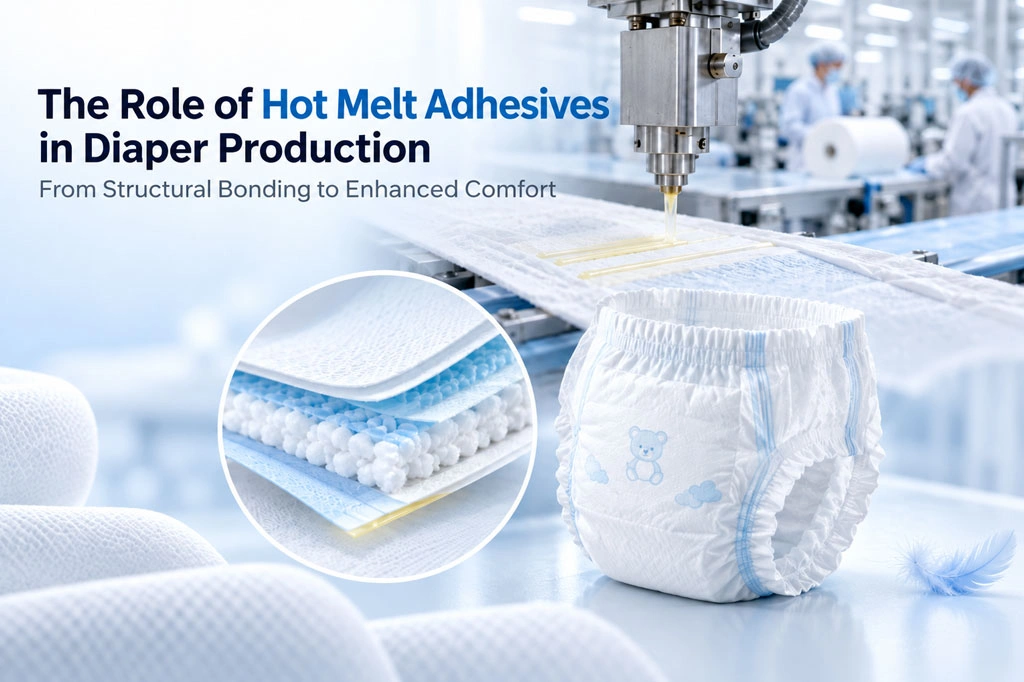
Hot melt adhesives for hygiene products are among the essential bonding materials used in diaper manufacturing. They not only bond different material layers together but also help secure elastic waistbands, leg cuffs, absorbent cores, and other functional areas.
As diapers continue to evolve toward thinner, softer, and more comfortable designs, the role of hygiene hot melt adhesives has expanded beyond simply “holding materials together.” Modern hygiene adhesives are increasingly expected to balance bonding reliability, material softness, elastic retention, low odor, and production efficiency.
1. Why Are Hot Melt Adhesives Needed in Diaper Production?
Diapers typically consist of a multilayer structure, with different areas performing different functions. For example:
- Topsheet: Comes into direct contact with the skin and needs to remain soft while allowing liquid to pass through quickly.
- Acquisition and distribution layer: Helps distribute liquid rapidly across the absorbent area.
- Absorbent core: Absorbs and retains liquid.
- Backsheet and nonwoven layer: Provide leakage protection, structural protection, and a textile-like appearance.
- Elastic waistband and leg cuffs: Help the diaper fit closely around the body.
- Side tapes, frontal tape, and other fastening components: Enable the diaper to be worn and secured properly.
These components may include nonwoven fabrics, PE films, elastic materials, and absorbent core materials. Because these substrates differ significantly in surface properties and mechanical characteristics, an adhesive system suitable for high-speed hygiene product manufacturing is required.
Hot melt adhesives are widely used in diaper production because they are solvent-free, set quickly, support continuous high-speed application, and can bond a wide range of substrates.
2. How Do Hot Melt Adhesives Affect Diaper Softness?
Consumers normally cannot see the hot melt adhesive used inside a diaper, but they can feel its impact on the finished product.
One of the most noticeable characteristics is softness.
If a hot melt adhesive forms an excessively rigid adhesive layer after cooling, or if too much adhesive is applied per unit area, the originally soft nonwoven material may become locally stiff after lamination.
This is one reason why modern diaper manufacturing increasingly emphasizes lower adhesive coat weights.
By optimizing adhesive formulations, bonding performance, and application processes, manufacturers can reduce unnecessary adhesive consumption while maintaining sufficient structural integrity. This helps minimize the effect of the adhesive layer on the natural softness of the surrounding materials.
For products such as baby diapers and pull-up pants, where skin-friendly comfort is a major selling point, achieving this balance is especially important:
The bond must be strong enough, but higher bonding strength should not come at the expense of softness.
3. How Do Hot Melt Adhesives Influence Diaper Fit and Comfort?
Comfort depends not only on softness but also on how well the diaper dynamically fits the body.
Babies and young children continuously roll over, crawl, sit, stand, and walk while wearing diapers. As a result, the diaper is constantly subjected to stretching, bending, and recovery.
If hot melt adhesives can securely hold elastic materials in the waist and leg areas, the elastic structures can continue functioning effectively and allow the diaper to stretch and recover with body movement.
This stability can directly influence:
- Waist coverage and fit;
- Leg cuff conformity;
- Freedom of movement;
- Protection against side leakage;
- Structural stability during extended wear.
From the perspective of the end-user experience, hot melt adhesive remains hidden inside the diaper, but it plays an important role in connecting the product’s material structure with its wearing comfort.
4. Low-Temperature Application Helps Protect Heat-Sensitive Materials
Diaper manufacturing involves large quantities of thin nonwoven fabrics, PE films, and elastic materials, some of which can be relatively sensitive to heat.
Conventional hot melt adhesives need to be heated to a certain temperature before they can be pumped and applied. If the application temperature is too high, it may increase the risk of deformation or performance changes in heat-sensitive substrates while also increasing the energy required to heat the production line.
For this reason, low-temperature application performance is becoming an important development direction for hygiene hot melt adhesives.
Hot melt adhesives that maintain good flow, sprayability, and bonding performance at relatively lower temperatures can help diaper manufacturers:
- Reduce thermal impact on heat-sensitive films, nonwovens, and other substrates;
- Lower the temperature load on adhesive tanks, hoses, and nozzles;
- Reduce heating energy consumption during production;
- Minimize the risk of adhesive degradation caused by prolonged exposure to high temperatures;
- Support stable, continuous, high-speed manufacturing.
As diaper materials continue to become lighter and thinner, the importance of low-temperature application performance is expected to increase further.
5. Low Odor and Environmental Requirements Are Receiving Greater Attention
Diapers are disposable hygiene products that remain in close contact with the human body for extended periods. Therefore, in addition to bonding performance, manufacturers are placing increasing emphasis on adhesive odor, VOC levels, and material safety.
This is particularly important for baby diapers, as consumers are highly sensitive to product odor. Even if an adhesive odor does not directly affect structural performance, a noticeable smell can negatively influence consumers’ perception of product quality.
Hot melt adhesives are already well suited to high-speed hygiene product manufacturing because they do not require traditional solvents during application. Through further optimization of raw materials and formulation systems, manufacturers can also move toward lower odor, lower VOC emissions, and more environmentally responsible production.
For diaper brands and manufacturers, adhesive selection should therefore not be based solely on initial bond strength. Material compliance, odor performance, production conditions, and the final product application should also be considered.
6. High-Speed Production Lines Place Greater Demands on Hot Melt Adhesives
Modern diaper manufacturing involves much more than simply bonding materials together. A high-speed continuous production line must complete a series of operations, including unwinding, laminating, adhesive application, elastic attachment, folding, cutting, and packaging.
As a result, hygiene hot melt adhesives must perform reliably under actual production conditions.
For example, the adhesive needs stable melt viscosity and good sprayability. If its thermal stability is insufficient, prolonged exposure to heat inside the melt system may result in char formation or changes in adhesive properties, increasing maintenance requirements for filters, hoses, and nozzles.
For diaper manufacturers, a suitable hot melt adhesive should not only provide reliable bonding in the finished product but should also take the following factors into account:
- Application stability under high-speed production conditions;
- Risk of nozzle clogging;
- Stringing and adhesive overspray;
- Thermal stability during prolonged heating;
- Compatibility with different nonwoven fabrics and films;
- Adhesive coat weight per unit area;
- Equipment cleaning and maintenance frequency.
Therefore, hygiene hot melt adhesives should not be evaluated separately from the actual production line. Comparing laboratory bond strength alone is not sufficient.
Conclusion
As the diaper industry continues to develop, competition has expanded beyond basic absorbency and leakage protection toward thinner, softer, more breathable, lightweight, and more comfortable products. This evolution has also changed the role of hot melt adhesives in diaper manufacturing.
In the past, the primary purpose of an adhesive may have simply been to ensure that “the materials do not separate.” Today, however, adhesives are expected to provide reliable bonding at lower coat weights, on thinner substrates, and within increasingly complex product structures, while minimizing their impact on softness, elasticity, and other material properties.
From construction adhesives and elastic attachment adhesives to absorbent core bonding applications, hygiene hot melt adhesives are involved in multiple critical stages of diaper production.