
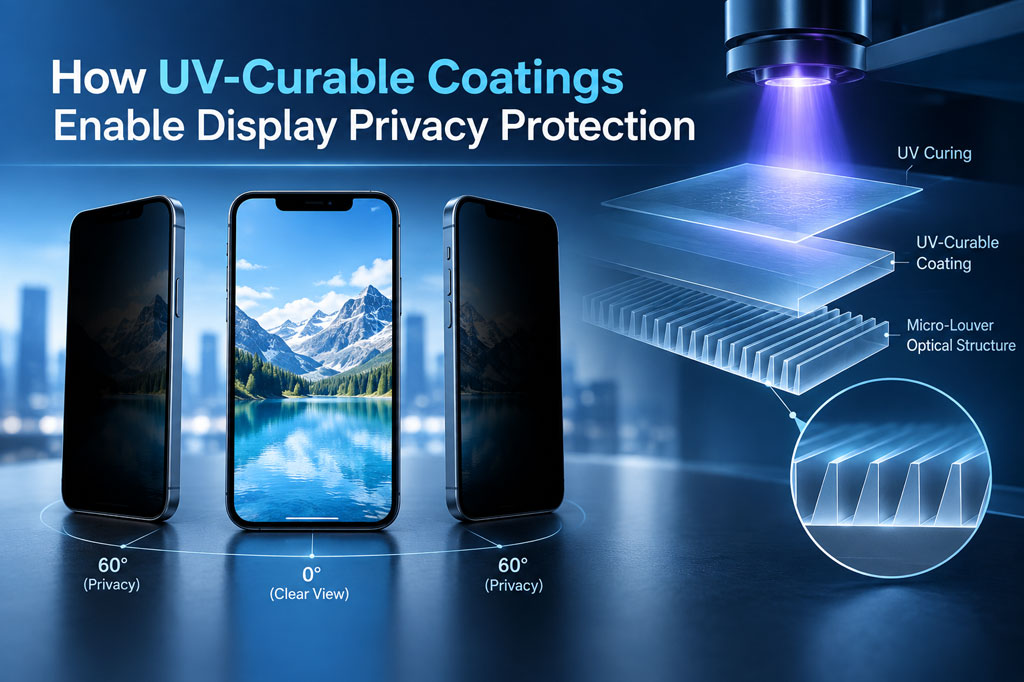
With the widespread use of smartphones, laptops, automotive displays, financial terminals, and public information devices, the risk of visual information leakage from display screens has received increasing attention.
In open-plan offices, airports, high-speed trains, cafés, and other public environments, even when a device itself has no data security vulnerabilities, people nearby may still be able to directly view confidential or private information displayed on the screen.
Optical privacy film is a type of functional optical film developed specifically to address this problem.
Unlike ordinary screen protection films, privacy films do not simply reduce screen brightness. Instead, they control the direction in which display light travels, allowing users positioned directly in front of the screen to view the content normally while significantly reducing brightness and readability when the screen is viewed from larger side angles.
Among current privacy film manufacturing technologies, UV-curable coatings combined with microstructure replication represent an important technical approach. UV-curable materials can rapidly form precise microstructures on PET and other substrates, providing the basis for manufacturing micro-louver, micro-groove, and other optical light-control structures.
So, how exactly do UV-curable coatings help achieve display privacy protection?
1. The Core of Privacy Film Is Not “Darkening” the Screen, but Controlling the Viewing Angle
To understand how privacy film works, it is first necessary to understand how light is emitted from a display.
Light from an ordinary display travels in multiple directions. As a result, not only can a person sitting directly in front of the screen see the image, but people positioned to the left or right can also receive sufficient display light to view the content.
The purpose of privacy film is to restrict this laterally traveling light.
One widely used solution is the Micro-Louver structure.
Its operating principle is similar to that of architectural blinds, except that the “louvers” are extremely small and typically consist of periodically arranged microscopic optical structures.
When the user is positioned directly in front of the screen, display light can travel through the transmission channels formed by the microstructures, allowing the screen to remain clearly visible.
When an observer views the screen from a larger side angle, however, the light is blocked or absorbed by light-absorbing regions or shielding structures within the micro-louver system. This causes the lateral brightness to decrease rapidly, reducing the visibility and readability of the screen content.
For this reason, micro-louver technology is widely used in display privacy protection and viewing-angle control applications.
The fundamental principle of privacy protection can therefore be summarized as:
High frontal light transmission + restricted lateral light transmission.
2. What Role Do UV-Curable Coatings Play in Privacy Film?
Strictly speaking, UV curing itself does not directly create the privacy effect.
The actual privacy function is produced by carefully designed micro-optical structures and light-absorbing structures.
The primary value of UV-curable coatings is that they can serve as the forming material for these precise microstructures.
Typical UV-curable optical coatings generally consist of a resin system, reactive diluents, a photoinitiator system, and other functional additives depending on the required performance.
When the coating is exposed to ultraviolet light of a suitable wavelength, the photoinitiator system triggers a polymerization reaction, rapidly converting the liquid or semi-liquid coating into a solid crosslinked polymer network.
If a mold, embossing roller, or microstructured master with a predetermined pattern is pressed against the coating before curing, microscopic optical structures can be replicated into the coating and permanently fixed through UV curing.
This is the basic principle behind UV microstructure replication for privacy films:
UV coating application → microstructure embossing → UV curing → demolding → formation of a stable micro-optical structure.
Research has demonstrated that UV-curable resin can be coated onto PET substrates, followed by embossing with a silicone mold and UV irradiation to create micro-louver patterns. This confirms that UV micro-replication technology can be used to manufacture viewing-angle control structures.
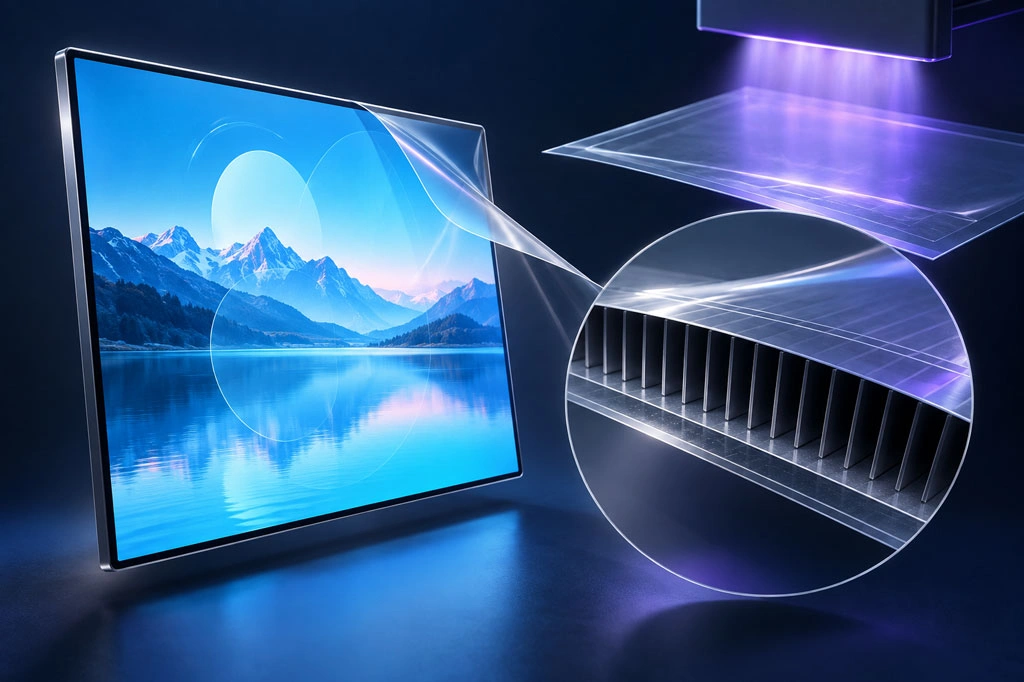
3. How Do UV-Curable Privacy Coatings Form “Microscopic Blinds”?
Using a typical micro-louver privacy structure as an example, the manufacturing process can be divided into several stages.
3.1 Preparation of PET or Other Transparent Substrates
Privacy film first requires a substrate with good transparency, dimensional stability, and mechanical properties.
PET is one of the commonly used substrate materials.
The substrate not only supports the entire optical structure but must also maintain dimensional stability during subsequent coating, embossing, lamination, and die-cutting processes.
3.2 Precision Coating of UV-Curable Optical Material
A UV-curable optical coating is then uniformly applied to the PET surface.
At this stage, the coating should provide good:
- Leveling performance;
- Coating uniformity;
- Substrate wettability;
- Thickness stability;
- Microstructure replication capability.
Significant variations in coating thickness or leveling can directly affect the consistency of the microstructures formed in subsequent processing.
3.3 Microstructure Embossing
Before the UV coating is fully cured, a precision mold or microstructured roller is pressed onto the coating surface.
The mold contains a predefined periodic microstructure. During embossing, the liquid UV material flows into and fills the fine cavities of the mold.
UV irradiation is then applied.
3.4 Rapid UV Curing
Exposure to ultraviolet light causes the resin to polymerize and crosslink, permanently replicating and fixing the microstructure from the mold.
This stage is critical to the final quality of the privacy film.
Insufficient curing may result in:
- Microstructure deformation;
- Difficult demolding;
- A tacky surface;
- Structural collapse during subsequent processing;
- Reduced heat resistance and durability.
At the same time, excessive material shrinkage during curing can cause dimensional deviations in the replicated microstructures, potentially changing the designed optical viewing angle.
Therefore, curing speed, curing depth, and volumetric shrinkage must be carefully balanced.
3.5 Formation of Light-Absorbing or Light-Shielding Structures
Transparent micro-grooves alone may not provide sufficient lateral light-blocking performance.
Some micro-louver structures therefore incorporate light-absorbing materials into specific regions so that laterally traveling light is absorbed while frontal light can continue to pass through transparent channels.
For example, some research has introduced materials such as ZnO into UV-embossed micro-louver structures and investigated how different filling heights influence brightness at different lateral viewing angles.
In practical product development, the coating formulation, microstructure geometry, and light-absorbing structure normally need to be optimized together.
Conclusion
Optical privacy film is not simply a “dark film” added to the surface of a display. Its fundamental function is based on precise micro-optical structures that control the direction in which display light propagates.
UV-curable coatings provide an efficient way to manufacture these structures.
Through precision coating, microstructure embossing, and UV curing on transparent substrates such as PET, stable micro-louver or micro-groove structures can be formed. These structures allow frontal display light to pass through effectively while restricting light transmission at larger side angles.
The result is the characteristic privacy effect of:
Clear viewing from the front and reduced visibility from the side.