
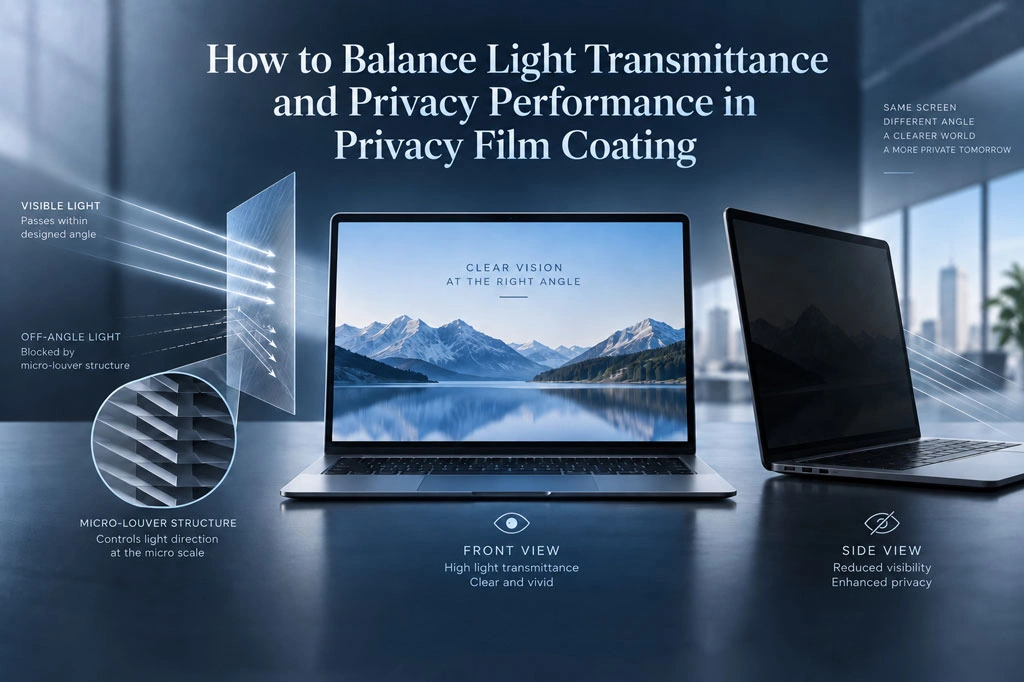
For privacy films, users generally expect two things at the same time:
On the one hand, the screen should remain bright, clear, and visually comfortable when viewed from the front, without noticeable darkening or color distortion. On the other hand, once the viewing angle moves beyond a certain range from the front, the displayed content should quickly become darker or difficult to recognize, thereby protecting visual privacy.
These two requirements may sound straightforward, but in practice they create a significant technical conflict.
Stronger privacy performance usually means that more oblique light needs to be restricted. However, the stronger the restriction on light propagation, the greater the potential loss in overall light transmittance.
Therefore, the real technical challenge in privacy film coating design and production is not simply to maximize privacy protection. It is to establish a reasonable balance among light transmittance, privacy viewing angle, image clarity, haze, and coating stability.
1. Why Is There an Inherent Conflict Between Light Transmittance and Privacy Performance?
The design objective of an ordinary transparent protective film is usually to allow as much light as possible to pass through. Therefore, the main concerns are material transparency, haze, and surface defects.
Privacy films are fundamentally different.
They need to selectively control light traveling in different directions.
When the user views the screen from the front, light emitted by the display should pass through the privacy layer as efficiently as possible. However, as the viewing angle gradually shifts away from the front, part of the light must be absorbed, blocked, or redirected.
In this sense, a privacy film performs a form of angle-selective optical management.
If the optical structure does not sufficiently restrict oblique light, several problems may occur:
- The effective privacy angle becomes too wide;
- Screen content remains visible from the side;
- Privacy protection is insufficient.
However, if the restriction is too strong, other problems may arise:
- Front-view brightness decreases significantly;
- The entire screen appears darker;
- Color saturation is reduced;
- Users may need to increase screen brightness;
- Display power consumption may increase.
Therefore, the key to optimizing privacy film performance is not to maximize a single parameter, but to find an appropriate optical balance.
2. What Are the Core Performance Indicators of Privacy Films?
During the development of privacy film coatings, several optical parameters usually need to be considered simultaneously.
2.1 Front Light Transmittance
Light transmittance directly affects screen brightness when viewed from the front.
If transmittance is too low, even a film with excellent privacy performance may deliver a poor user experience.
This is especially important for smartphones, tablets, automotive displays, and high-brightness screens, where users generally expect the display to remain sufficiently bright after the privacy film is applied.
Therefore, privacy film coating design should minimize unnecessary light absorption and scattering wherever possible.
2.2 Privacy Viewing Angle
The privacy viewing angle determines the angle at which screen content begins to become noticeably darker.
For example, as a viewer gradually moves from the front toward the left or right side of the screen, brightness decreases progressively.
A privacy film with strong privacy performance is generally expected to provide:
- Clear visibility from the front;
- Rapid brightness reduction beyond the designed viewing range;
- Poor readability of text and images from side angles.
However, a narrower viewing angle is not always better.
If the visible range is too narrow, even a small change in the user’s sitting position or viewing posture may cause a noticeable decrease in brightness, negatively affecting usability.
For this reason, different applications require different privacy viewing angles.
2.3 Haze
Haze indicates the degree to which light is scattered after passing through the film.
A controlled level of optical scattering can help adjust visual performance, but excessive haze may result in:
- A whitish screen appearance;
- Reduced text sharpness;
- Blurred image edges;
- Lower contrast.
Therefore, privacy coating design requires careful control of functional fillers, resin refractive index, and microstructure uniformity in order to minimize uncontrolled scattering.
2.4 Image Clarity and Contrast
For high-resolution displays, high light transmittance alone does not necessarily guarantee good image quality.
If the coating contains microscopic defects, particle agglomeration, or non-uniform optical interfaces, the film may still produce problems such as:
- Moiré patterns;
- Rainbow effects;
- Uneven local brightness;
- Grainy image appearance;
- Reduced contrast.
Therefore, a high-performance privacy film must balance light transmittance with image quality at the same time.
3. Key Factors Affecting the Balance Between Light Transmittance and Privacy Performance
3.1 Optical Microstructure Design
The performance of a privacy film depends heavily on its internal optical structure.
Conventional privacy structures commonly use fine gratings, microlouver structures, or other directional microstructures to restrict oblique light.
For products in which the optical functional layer is formed through a coating process, the dimensions, arrangement, aspect ratio, and uniformity of these structures directly affect the final privacy performance.
If the structures are too densely arranged, side-light blocking becomes stronger, but front light transmittance may decrease.
If the spacing between structures is too large, screen brightness may improve, but privacy performance may become insufficient.
Therefore, the microstructure should be optimized according to the target privacy viewing angle rather than simply making the structures as dense as possible.
3.2 Refractive Index Matching of the Coating System
When light passes through interfaces between different materials, refraction and reflection occur.
If there is a large refractive index difference between the base film, coating resin, and internal functional materials, additional optical loss may occur.
This can lead to:
- Reduced light transmittance;
- Increased interfacial reflection;
- Higher haze.
For this reason, refractive index matching between the resin system and functional materials is an important consideration in privacy coating formulation.
A properly designed refractive index system can help reduce forward light loss while maintaining the required angle-selective optical performance.
3.3 Distribution of Functional Particles or Light-Absorbing Materials
Some privacy coating systems use special functional materials to control light propagation.
The particle size, concentration, and dispersion state of these materials can all affect the final optical performance.
If the dosage is too low, sufficient privacy performance may not be achieved.
If the dosage is too high, it may cause:
- Reduced front light transmittance;
- Darkening of the coating;
- Increased haze;
- Higher surface roughness.
In addition, particle agglomeration may create localized optical defects.
Therefore, dispersion stability and particle size control are particularly important during privacy coating production.
4. How Can Light Transmittance and Privacy Performance Be Balanced in Actual Production?
A more practical development approach is to first define the target application and then determine the required optical parameters, rather than simply pursuing the strongest possible privacy effect.
Business Laptops
Business environments generally place greater emphasis on privacy protection, so stronger left-and-right viewing restrictions may be appropriate.
However, text must still remain sufficiently clear and readable when the screen is viewed directly from the front.
Smartphones and Tablets
Users of mobile devices frequently change their viewing angle.
If the privacy angle is too narrow, even a small change in the way the device is held may cause noticeable brightness variation.
Therefore, these applications usually require greater attention to the balance among:
screen brightness, privacy viewing angle, and viewing comfort.
ATMs and Financial Terminals
ATMs, POS terminals, and other financial equipment generally require a higher level of visual privacy.
Compared with entertainment-oriented displays, these applications can often tolerate a certain degree of brightness loss in exchange for stronger side-view information protection.
Automotive Displays
The design logic for automotive displays is different again.
In some cases, the purpose is not simply to prevent nearby people from seeing the screen. Instead, the objective may be to reduce light propagation in a specific direction, such as minimizing distracting light reaching the driver or reducing reflections on the windshield.
Therefore, directional optical control should be designed according to the actual display installation position and viewing environment.
Conclusion
The core technical challenge in privacy film coating production is essentially a complex optical balancing problem.
If light transmittance is too high, side-angle light control may be insufficient. If privacy performance is too strong, screen brightness and image clarity may be sacrificed.
Therefore, a high-performance privacy film should not simply aim to make the screen “darker” or reduce the viewing angle as much as possible.
Instead, more precise angle-selective light transmission should be achieved through coordinated optimization of material formulation, optical microstructure design, refractive index matching, coating thickness control, and UV-curing processes.
By carefully balancing these factors, privacy films can provide effective visual privacy protection while maintaining good front-view brightness, clarity, and overall display quality.