
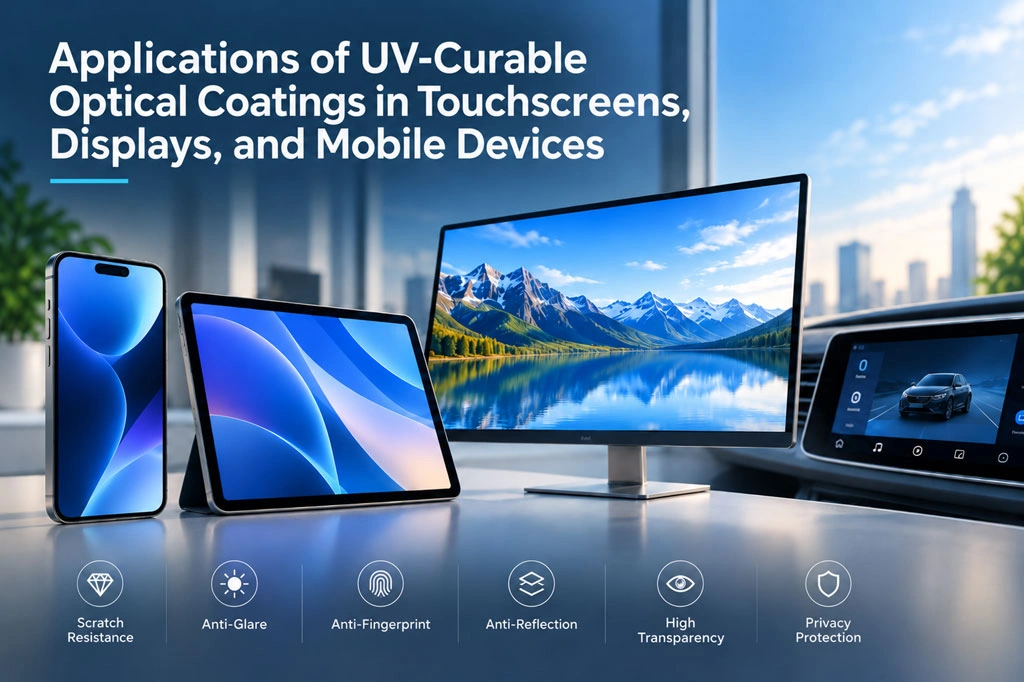
With the rapid development of smartphones, tablets, automotive displays, industrial touchscreens, and various smart terminals, users now expect much more from display devices than simply being able to see the screen clearly. Requirements have expanded to include scratch resistance, anti-glare performance, fingerprint resistance, high light transmittance, anti-reflection properties, and privacy protection.
The optical performance of a display surface has a direct impact on visual experience, touch feel, and the long-term reliability of the device.
Among various surface treatment technologies, UV-curable optical coatings have been widely adopted in touchscreens, displays, and mobile electronic devices due to their fast curing speed, highly adjustable coating properties, suitability for continuous production, and excellent optical performance.
1. Applications of UV-Curable Optical Coatings in Touchscreens
Smart touchscreens are one of the most typical application areas for UV-curable optical coatings.
Whether used in consumer electronics, industrial control panels, automotive touchscreens, or medical equipment displays, these surfaces are frequently tapped, swiped, and wiped during long-term use. As a result, high surface durability is essential.
1.1 Improving Surface Scratch Resistance
PET, PC, and PMMA substrates without surface hardening treatment generally have limited hardness and can easily develop scratches during everyday use.
UV hard coatings form a highly cross-linked polymer network that can significantly improve surface hardness and abrasion resistance.
These hard coatings are commonly used in:
- Touch panel protective films
- PET hard-coated films
- PC display panels
- PMMA display windows
- Industrial control screens
- Automotive display panels
For industrial equipment that requires frequent and long-term touch operation, good scratch resistance can significantly extend the service life of the display panel.
1.2 Reducing Fingerprints and Smudges
Touchscreens can easily accumulate fingerprints, skin oils, and sweat during use.
These contaminants not only affect appearance but may also reduce visual clarity.
By adding a low-surface-energy functional layer to the surface of an optical film, the adhesion of oils and contaminants can be reduced, making fingerprints easier to wipe away.
For this reason, many smartphones, tablets, and automotive touchscreens use UV functional coatings with properties such as:
- Anti-fingerprint performance
- Oil resistance
- Easy-clean surfaces
1.3 Improving Touch and Sliding Feel
For touchscreen devices, the surface coefficient of friction is also an important consideration.
By optimizing the surface energy and microscopic structure of the UV coating, manufacturers can improve finger glide and provide a smoother, more natural touch experience.
Therefore, premium touch devices often need to balance:
optical performance, mechanical durability, and touch feel.
2. Applications of UV-Curable Optical Coatings in Displays
Computer monitors, industrial displays, automotive center displays, and commercial display devices are frequently affected by ambient light.
When external light reaches the screen surface, specular reflection can create noticeable glare, reducing display contrast and readability.
This is another important application area for UV-curable optical coatings.
2.1 AG Anti-Glare Coatings
AG, or Anti-Glare, is one of the most common surface optical treatment technologies used in the display industry.
The basic principle is to create a controlled microscopic texture on the coating surface.
When ambient light reaches this textured surface, concentrated specular reflection is scattered in different directions, thereby reducing visible reflections and glare.
AG coatings are particularly suitable for:
- PC monitors
- Laptop displays
- Industrial displays
- Interactive educational displays
- Automotive displays
- Medical equipment screens
- Outdoor displays
For example, in office environments, windows and overhead lighting can easily produce noticeable reflections on computer monitors.
AG coatings can reduce interference from ambient light and improve screen readability under bright lighting conditions.
However, AG coating design is not simply a matter of increasing haze.
If the surface roughness or haze level is too high, image sharpness may be reduced and the screen may appear grainy.
Therefore, an appropriate balance must be achieved between:
gloss, haze, light transmittance, and image clarity.
2.2 AR Anti-Reflection Coatings
Unlike AG coatings, which reduce glare through light scattering, AR, or Anti-Reflection, coatings mainly reduce surface reflection within specific wavelength ranges through optical interference.
AR coatings can improve screen transmittance and make displayed images appear clearer and more transparent.
In some premium display systems, multiple surface treatment technologies may be combined, such as:
Hard Coat + AG + AR
This combination can simultaneously improve scratch resistance, reduce glare, and enhance light transmission.
Such optical coating solutions are widely used in:
- High-end monitors
- Automotive displays
- Instrumentation display windows
- Professional visual terminals
3. Applications of UV-Curable Optical Coatings in Smartphones and Tablets
Mobile devices place more comprehensive requirements on optical coatings.
On the one hand, smartphones and tablets require high light transmittance and excellent image clarity. On the other hand, their surfaces may experience hundreds or even more touch interactions every day.
Therefore, their surface coatings often need to provide a combination of:
- High light transmittance
- Low haze
- Scratch resistance
- Fingerprint resistance
- Abrasion resistance
- Easy-clean performance
- Smooth touch feel
In addition, as mobile working and information security become increasingly important, privacy protection has also become an important development direction for optical functional films.
4. Applications of Privacy Optical Coatings in Mobile Devices
When smartphones or laptops are used in public environments such as subways, airports, offices, and banks, people nearby may be able to see the screen from the side.
For this reason, privacy films are increasingly used on mobile devices.
Traditional privacy films generally use micro-louver structures to limit the propagation direction of display light and reduce the visible viewing angle.
At the same time, privacy technologies based on specialized UV-curable optical coatings and microstructure designs are also continuing to develop.
By controlling the optical structures inside or on the surface of the coating, it is possible to modify the propagation and scattering behavior of light at different viewing angles.
As a result, the screen can maintain relatively good brightness when viewed directly from the front, while brightness decreases significantly when viewed from larger side angles.
These technologies can be applied to:
- Smartphone privacy films
- Tablet privacy films
- Laptop privacy filters
- ATM displays
- POS terminals
- Medical displays
- Business display terminals
Compared with coatings that provide only a single surface-hardening function, future optical films are increasingly expected to integrate multiple functions, such as:
Hard Coat + AG + AF + Privacy
5. Different Devices Require Different UV Optical Coating Properties
UV-curable optical coatings generally need to be specifically designed according to the final application.
For example:
Smartphones and tablets
Place greater emphasis on high light transmittance, fingerprint resistance, scratch resistance, and smooth touch feel.
Computer monitors
Focus more on anti-glare performance, image clarity, and the reduction of ambient light reflection.
Automotive displays
Require not only good optical performance but also resistance to high and low temperatures, UV aging, and long-term environmental exposure.
Industrial touchscreens
Often place greater emphasis on abrasion resistance, chemical resistance, and long-term touch durability.
Privacy display devices
Focus more on front-view light transmittance, side-view brightness, and viewing-angle control.
Therefore, there is no single optical coating solution that is suitable for every type of display device.
Instead, coating formulations and structures need to be designed according to the substrate, display construction, manufacturing process, and final operating environment.
Conclusion
From smartphones and tablets to computer monitors, industrial touchscreens, and automotive displays, UV-curable optical coatings have become important surface materials for improving display performance.
UV-curable optical coatings can not only enhance scratch and abrasion resistance, but can also provide functions such as anti-glare, anti-fingerprint, anti-reflection, and privacy protection through different optical designs.
As display devices continue to develop toward higher resolutions, larger screen sizes, touch-based interaction, and greater levels of intelligence, optical coatings will gradually evolve from simple protective surface layers into important functional components of modern display systems.