
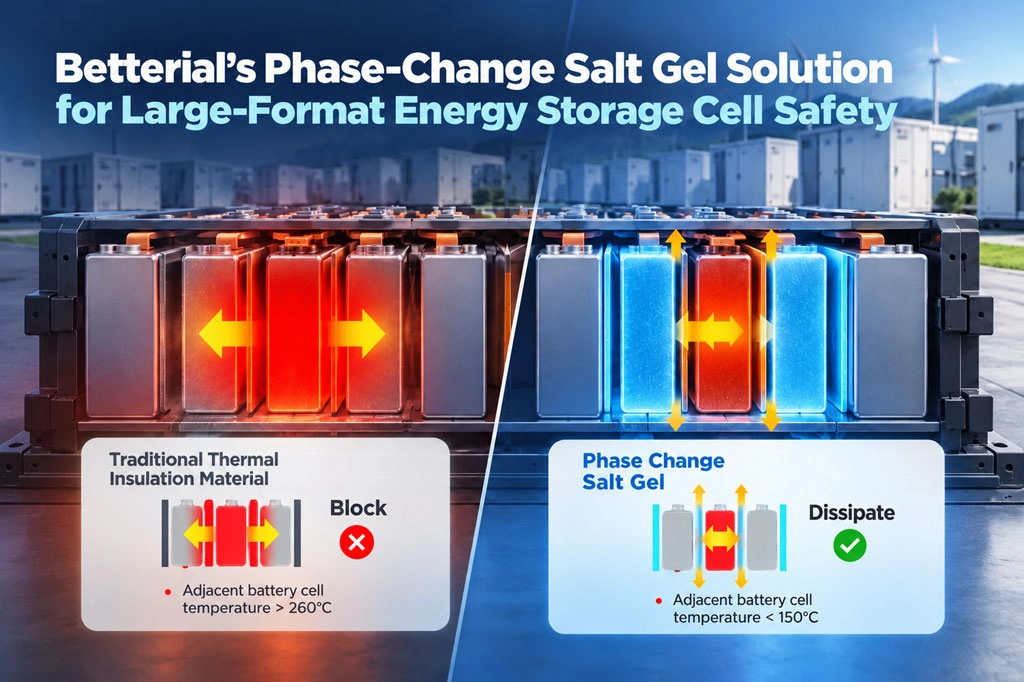
As the energy storage industry continues to evolve rapidly, the capacity of energy storage battery cells is increasing significantly. Ultra-large-format cells, represented by 587Ah models, are gradually entering large-scale applications, with future developments expected to move toward even higher ampere-hour capacities.
Compared with 314Ah cells, ultra-large-format cells such as 587Ah models contain substantially more energy per cell, resulting in a significant increase in the total thermal enthalpy released during thermal runaway. Meanwhile, their reduced surface-area-to-volume ratio makes heat dissipation more difficult within enclosed battery PACKs, creating new challenges for passive thermal protection.
China’s updated national standard, GB 38031-2025, introduces mandatory requirements for thermal propagation safety, requiring batteries to avoid fire and explosion under thermal runaway conditions.
Consequently, the industry’s approach to evaluating passive thermal protection materials is undergoing a fundamental transformation. Traditional protection strategies that rely solely on low thermal conductivity to block heat transfer are reaching their performance limits.
I. From Heat Blocking to Thermal Enthalpy Dissipation
From the perspective of advanced industry research, thermal runaway protection can be divided into two main technical approaches:
1.1. Physical Thermal Insulation
Materials such as nano-insulation panels, aerogels, and ceramifiable silicone rely on porous or dense structures to reduce thermal conductivity.
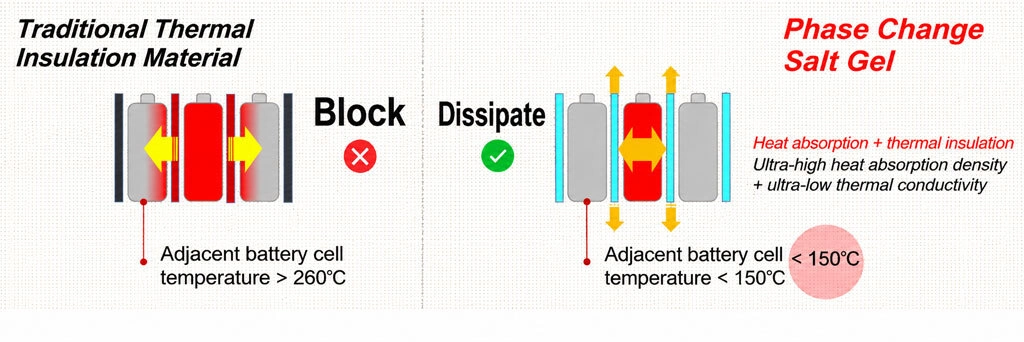
Essentially, these materials block heat flow rather than eliminate heat. Thermal energy remains confined within a localized area.
In enclosed environments involving 587Ah ultra-large-format cells, high thermal enthalpy, and prolonged exposure to elevated temperatures, simply increasing insulation thickness to improve safety margins occupies valuable module space and reduces the system’s volumetric energy density.
1.2. Thermochemical Heat Absorption and Dynamic Thermal Switching
This approach directly consumes the substantial thermal enthalpy released during thermal runaway through thermochemical reactions within the protective material.
At the same time, temperature-induced phase transformations enable a dynamic response characterized by heat absorption and consumption at lower temperatures, followed by an automatic transition into a thermal insulation barrier at higher temperatures.
This represents an important frontier in lithium battery safety research and development worldwide.
Phase-change salt gel belongs to a category of thermochemical thermal protection materials that goes beyond conventional physical insulation.
Designed to address excessive heat accumulation within enclosed, large-capacity energy storage battery systems, it provides a two-stage dynamic response combining thermal enthalpy absorption and consumption with carbonized thermal insulation.
This technology offers a new passive safety solution for large-capacity energy storage battery modules.
II. Fundamental Technical Limitations of Traditional Protective Materials in Enclosed Large-Format Battery PACKs
Thermal Saturation Limitations of Conventional Insulation Materials
High-performance thermal insulation materials, such as nano-insulation panels and aerogels, offer extremely low thermal conductivity at elevated temperatures. However, they can only delay heat transfer rather than consume thermal energy.
When thermal runaway occurs in a large-format battery cell, hundreds of kilojoules of thermal energy may be released almost instantaneously.
Within an enclosed battery compartment, heat continues to accumulate, gradually causing a thermal saturation effect in the protective layer.
Under sustained high-temperature radiation, the temperature at the material interface continues to rise until heat eventually penetrates the thermal barrier.
To improve protection levels, manufacturers often have to increase the thickness of insulation panels, directly reducing the volumetric energy density of energy storage systems.
Therefore, for next-generation large-capacity energy storage applications, simply blocking heat is no longer sufficient to fully address heat accumulation inside enclosed battery PACKs.
The industry urgently needs a new generation of protective materials capable of directly absorbing and dissipating thermal enthalpy.
III. Microscopic Mechanism of Phase-Change Salt Gel
3.1. Phase-Change Decomposition Reaction at Approximately 100°C
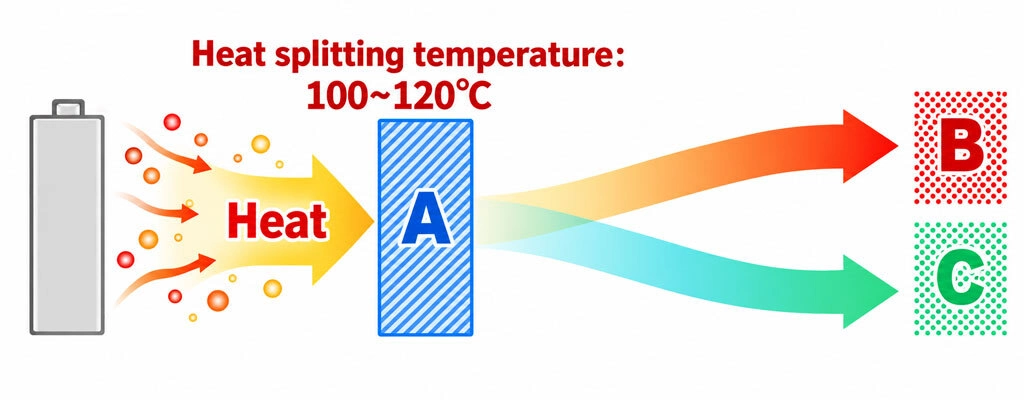
The salt gel undergoes a phase-change decomposition reaction when the temperature reaches approximately 100°C.
The reaction can be represented as:
A + Heat → B + C
During this process, the material absorbs thermal energy through an endothermic decomposition reaction.
3.2. Formation of a Low-Thermal-Conductivity Carbonized Insulation Layer
Following decomposition, the material forms a carbonized thermal insulation layer with low thermal conductivity, providing an additional thermal barrier.
3.3. Independently Developed Intellectual Property
The technology is supported by independently developed intellectual property, with patent protection being pursued globally.
3.4. Customizable Shapes and Dimensions
The material can be manufactured in various shapes, with customizable dimensions and thicknesses to meet different battery module requirements.
Key Physical Properties of Phase-Change Salt Gel
| Test Item | Unit | Technical Parameter | Test Standard |
|---|---|---|---|
| Thermochemical Decomposition Onset Temperature | °C | 100–120 | DSC (Differential Scanning Calorimetry) |
| Thermal Decomposition Enthalpy | kJ/kg | 1,758 | DSC (Differential Scanning Calorimetry) |
| Thermal Conductivity at Room Temperature (25°C) | W/(m·K) | ~0.52 | GB/T 10295-2008 |
| Steady-State Thermal Conductivity After Carbonization | W/(m·K) | ≤0.056 | GB/T 10294-2008 |
| Material Density | kg/m³ | 1,550 | Weighing Method |
| Available Thickness Range | mm | 1–2, customizable | Thickness Gauge |
IV. Experimental Validation: Technology Adaptation from Power Batteries to Energy Storage Applications
4.1 Validation Under Severe Operating Conditions: Comparative Abuse Testing of 182Ah Ternary Lithium Power Batteries
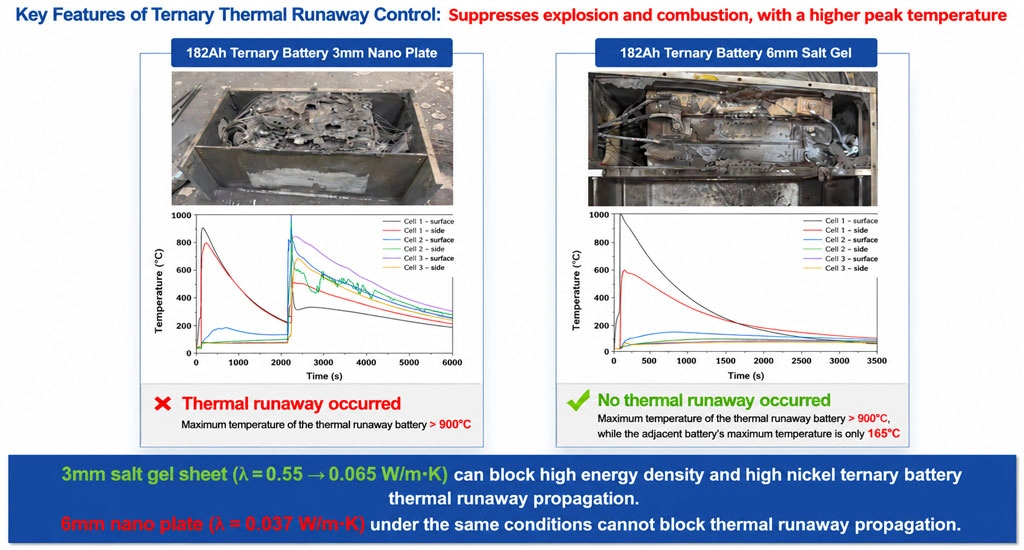
Thermal runaway in ternary lithium power batteries is characterized by intense combustion, potential explosions, and extremely high peak temperatures, making it a particularly demanding test for thermal protection materials.
Betterial conducted comparative abuse tests on 182Ah ternary lithium battery modules.
Under identical thermal runaway triggering conditions, the tests compared the effectiveness of 3 mm phase-change salt gel and 6 mm nano-insulation panels in preventing thermal runaway propagation.
4.2 Multi-Cell Array Module Testing: Validating Material Mechanisms Under Demanding Conditions to Support Energy Storage Applications
To reproduce the coupled thermal feedback effects between multiple battery cells inside an actual energy storage PACK, enclosed multi-cell array tests were conducted at the module level.
The tests used 2 mm thick phase-change salt gel and 314Ah lithium iron phosphate (LFP) energy storage cells to reproduce heat accumulation conditions within an enclosed battery module.
Test Conditions
Multiple 314Ah battery cells were arranged in an array, with 2 mm phase-change salt gel placed between adjacent cells.
A heating element was used to trigger thermal runaway in one of the cells.
Thermocouples positioned at multiple measurement points recorded the temperatures of cells at different distances from the triggered cell, simulating the coupled and cumulative heat transfer conditions inside an actual battery module.
Experimental Results
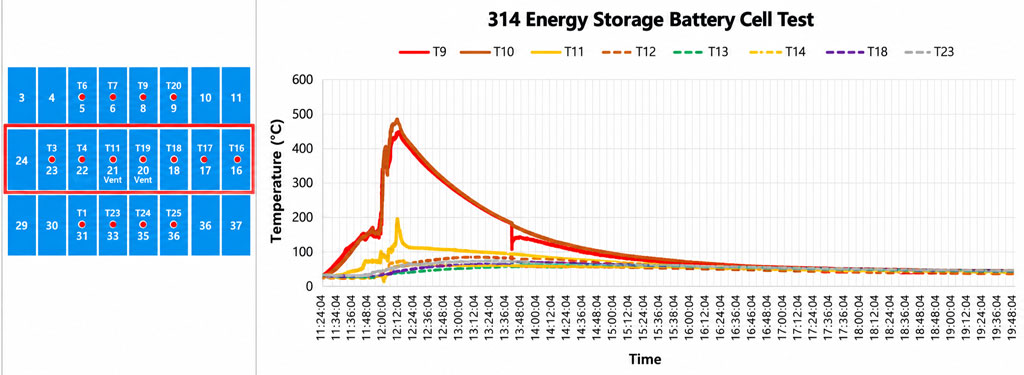
When the thermal runaway temperature reached 480°C, the temperature after insulation by the phase-change salt gel decreased to 81.6°C, representing a temperature difference of approximately 400°C.
The results met the customer’s testing requirements, and the PACK test was successfully passed.
The maximum temperatures of the remaining non-triggered cells in the array were maintained below their thermal runaway initiation thresholds, preventing thermal runaway propagation at the PACK level.
4.3 Comparative Testing: 2 mm Phase-Change Salt Gel vs. 2 mm Nano-Insulation Panel
Test Conditions
- Sample thickness: 2 mm for both materials
- Battery type: 314Ah prismatic battery cells
- Thermal runaway triggering conditions: Identical heating conditions
- Temperature monitoring: Simultaneous measurements of hot-side temperatures and cold-side temperatures at different layers
- Test control: Consistent triggering conditions to eliminate interference caused by differences in activation timing
1. Phase-Change Salt Gel Test Group
The measured temperatures were as follows:
- Peak heating element temperature: 640°C
- Cold-side temperature of Cell 1, adjacent to the heat source: 426.5°C
- Cold-side temperature of secondary Cell 2: 177.5°C
2. Nano-Insulation Panel Control Group
The measured temperatures were as follows:
- Peak heating element temperature: 603°C
- Cold-side temperature of Cell 1, adjacent to the heat source: 511°C
- Cold-side temperature of secondary Cell 2: 175.5°C
V. Research and Development Iteration and Application Validation Progress
Betterial’s phase-change salt gel has completed multiple rounds of progressive validation, establishing a comprehensive testing process that includes:
- Small-scale material property characterization
- Single-cell abuse testing
- Dual-cell comparative testing
- Enclosed multi-cell array module testing
Betterial is currently working with several energy storage system integrators and energy storage equipment manufacturers on sample evaluations and joint solution development.
The gel matrix formulation and sheet thickness can be customized according to battery cell specifications, available module assembly gaps, and thermal runaway protection requirements.
From the perspective of translating advanced research into industrial applications, future development will focus on further improving cycling stability, adjusting the onset temperature range of thermal decomposition, enhancing the density of the carbonized insulation layer, and continuously advancing comprehensive validation under various operating conditions at both the module and cabinet levels.
Conclusion
The energy storage industry is rapidly transitioning from smaller battery cells toward large-capacity cells of 314Ah and above.
The challenge of excessive heat accumulation inside enclosed battery PACKs is exposing the performance limitations of conventional physical thermal insulation solutions.
Advanced research in battery thermal protection is gradually shifting from simply blocking heat flow toward intelligent, responsive materials that combine thermal enthalpy dissipation with dynamic thermal insulation.
Betterial’s phase-change salt gel provides a newly developed thermochemical passive protection approach for large-capacity energy storage battery modules.