
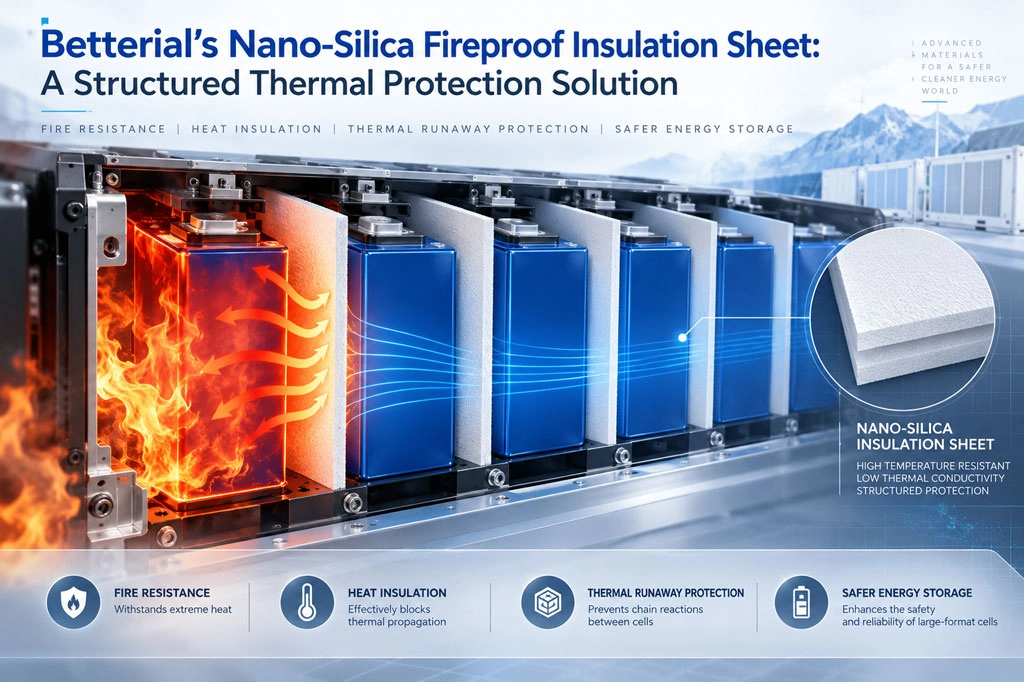
With the rapid development of the energy storage industry, large-capacity battery cells have become a mainstream choice for commercial and industrial energy storage cabinets.
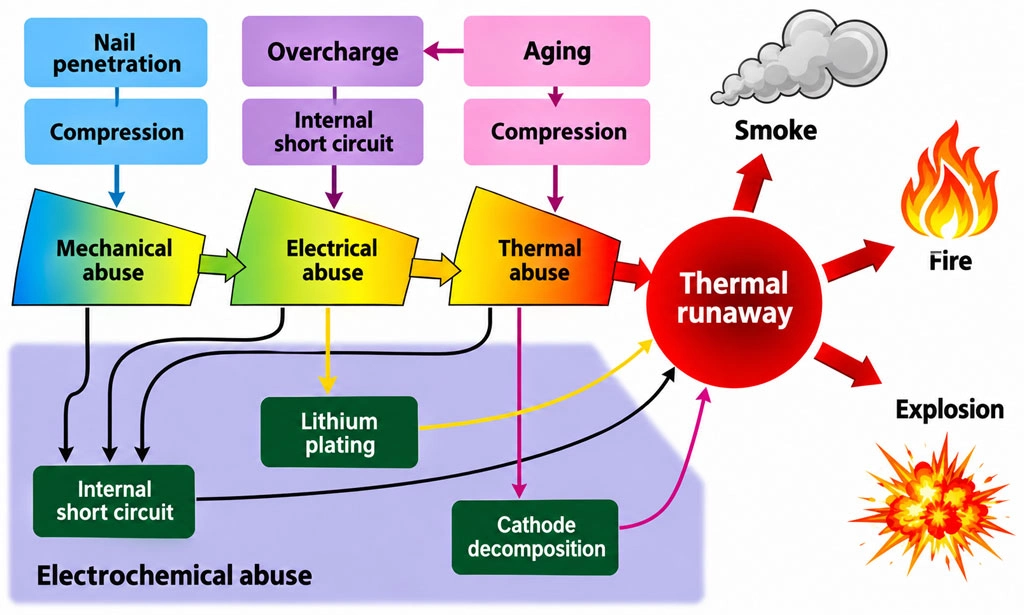
Large-format battery cells generate more heat during charging and discharging. Once thermal runaway occurs, heat can rapidly spread between cells and modules, potentially triggering fires.
The updated Chinese national standard GB 38031-2025 introduces mandatory requirements for battery thermal propagation, specifying that batteries must not catch fire or explode following thermal runaway. With the standard being implemented in phases, higher requirements are being placed on passive thermal protection materials used in energy storage systems.
Meanwhile, battery cells are being arranged in increasingly compact configurations, leaving very limited space for thermal insulation and protective structures. Simply stacking conventional insulation and fireproof materials is no longer sufficient to simultaneously meet requirements for thin profiles, high-temperature thermal insulation, burn-through resistance, and electrical insulation safety.
As a result, passive thermal protection has become an important technical approach for energy storage manufacturers seeking to meet evolving safety standards and improve the safety margins of energy storage cabinets.
Common thermal insulation materials currently used in the industry include flame-retardant foams, mica sheets, ceramifiable silicone rubber, and aerogel blankets. However, these materials generally have certain limitations, such as insufficient high-temperature resistance, relatively high cold-side temperatures under extreme heat, and limited burn-through resistance.
Some imported aerogel materials also present potential overseas patent risks, while their overall procurement costs remain relatively high.
1. Limitations of Conventional Materials in Large-Format Battery Energy Storage Cabinets
Materials such as rock wool, aluminum silicate, conventional aerogels, and ceramifiable silicone rubber are widely used in the thermal protection of large-capacity battery energy storage cabinets.
However, these materials exhibit significant limitations under the complex operating conditions associated with long-term energy storage applications.
Key Challenges in Protecting Large-Format Battery Energy Storage Cabinets
1.1. High Risk of Thermal Propagation
Large-format battery cells have high individual capacities and generate substantial amounts of heat during charging and discharging.
If a single cell experiences thermal runaway, high temperatures can rapidly transfer to adjacent cells, potentially triggering a chain reaction of thermal propagation.
1.2. Severe Space Constraints
Energy storage cabinets feature compact internal structures. Conventional insulation materials often require considerable thickness to achieve sufficient thermal protection.
This occupies valuable space needed for battery cells and wiring harnesses, making highly integrated cabinet designs more difficult.
1.3. Insufficient High-Temperature Performance
Many conventional materials experience rapid performance degradation at temperatures of 600–800°C.
Their limited burn-through resistance makes it difficult to provide prolonged protection against the extreme temperatures generated during thermal runaway.
1.4. Dust Generation and Electrical Insulation Risks
Fiber-based insulation materials may release dust particles that contaminate battery management systems (BMS) and high-voltage terminals.
Such contamination can increase the risk of reduced electrical insulation performance.
1.5. Patent and Cost Pressures
High-performance imported aerogel materials may involve potential patent infringement risks and relatively high procurement costs.
These factors can hinder the large-scale deployment of energy storage projects.
Together, these limitations represent critical technical challenges that must be addressed to improve thermal insulation, heat management, and safety protection in large-format battery energy storage cabinets.
2. Technical Approach of Nano-Silica Fireproof Insulation Sheets
Nano-silica fireproof insulation sheets operate through three fundamental thermal insulation mechanisms: suppressing heat conduction, blocking thermal radiation, and limiting heat convection.
The core technology incorporates independently developed nanomaterials, including thermal radiation shielding micropowders and high-temperature inhibitors. These materials work together to deliver the following performance characteristics.
2.1 Excellent High-Temperature Resistance
The material can withstand long-term exposure to temperatures of up to 1,200°C, with burn-through resistance lasting up to 2 hours.
2.2 Ultra-Low Thermal Conductivity at High Temperatures
The material maintains low thermal conductivity under high-temperature conditions, with only a gradual increase in thermal conductivity as temperatures rise.
2.3 Thin and Lightweight Design
Available in customizable thicknesses ranging from 1 to 5 mm, the insulation sheets are suitable for the narrow gaps between battery cells in compact energy storage cabinets.
2.4 Safety and Reliability
The material achieves a UL 94 V-0 flame-retardant rating.
Its asbestos-free inorganic composition is designed to prevent dust shedding, while its excellent electrical insulation properties help meet high-voltage insulation requirements.
2.5 Stable Mechanical Performance
The material provides stable mechanical properties and suitable compression and recovery characteristics, making it compatible with the compression requirements of battery module assembly.
It also complies with environmental regulations and directives, including RoHS, REACH, and ELV.
Core Technical Specifications
|
Test Item |
Unit |
Technical Specification |
Test Standard |
|---|---|---|---|
| Thermal Conductivity (25°C) | W/(m·K) | ≤0.023 | GB/T 10295-2008 |
| Thermal Conductivity (800°C) | W/(m·K) | ≤0.035 | GB/T 10294-2008 |
| Density | kg/m³ | 320 ± 20 | Weighing Method |
| Thickness Range | mm | 1–5, customizable | Thickness Gauge |
| Compression Performance | — | 15 ± 5% at 1 MPa | — |
| Tensile Strength | kPa | >800 | GB/T 17911-2006 |
| Insulation Resistance | — | >500 MΩ at 2,500 V DC for 60 s | GB/T 31838.4-2019 |
| Flammability Rating | — | V-0 | UL 94-2023 |
| RoHS Compliance | — | Complies with EU RoHS restriction requirements | — |
3. Integrated Protection System for Energy Storage Cabinets: Thermal Isolation Without Compromising Heat Dissipation
Rather than relying on the conventional approach of simply filling spaces with thermal insulation materials, Betterial’s integrated protection solution uses nano-silica fireproof insulation sheets as its core protective components.
The solution establishes thermal barriers between battery cells, fire-resistant separation structures between modules, and protective structures around critical heat sources inside energy storage cabinets.
The system follows a fundamental design principle:
“Thermal isolation and temperature buffering during normal operation, and thermal propagation prevention under fault conditions.”
3.1 Thermal Protection During Normal Operation
During normal battery charging and discharging, nano-silica insulation sheets reduce heat transfer between adjacent battery cells.
This helps minimize thermal interference between localized hotspots and supports more stable temperature distribution within battery modules.
3.2 Thermal Runaway Protection Under Fault Conditions
When thermal runaway occurs in an individual battery cell, the nano-silica fireproof insulation sheet acts as a passive fire barrier.
It limits the transfer of extreme heat to neighboring cells, delaying the propagation of thermal runaway.
This provides valuable additional time for system alarms, electrical shutdown procedures, and fire protection measures.
3.3 Supporting Protective Components
The integrated protection system can also incorporate inorganic sealing gaskets and high-temperature-resistant sealing components.
These auxiliary materials help seal gaps between insulation panels, reduce heat leakage through joints, and improve the overall integrity of the thermal protection system.
4. Application Validation and Testing Progress
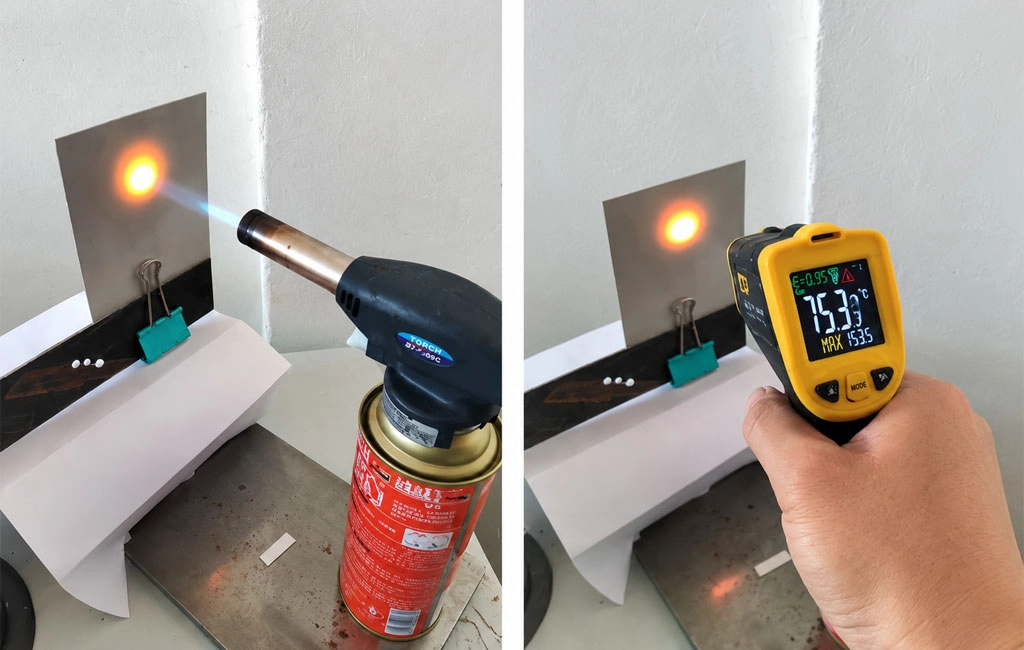
Betterial has completed multiple comparative tests simulating actual energy storage operating conditions.
These tests include:
- High-temperature hot-side and cold-side thermal insulation tests.
- Overcharge abuse tests on 314 Ah large-capacity battery cells.
- Battery module overheating tests.
- Third-party thermal runaway propagation verification.
Third-Party Thermal Runaway Propagation Test Results
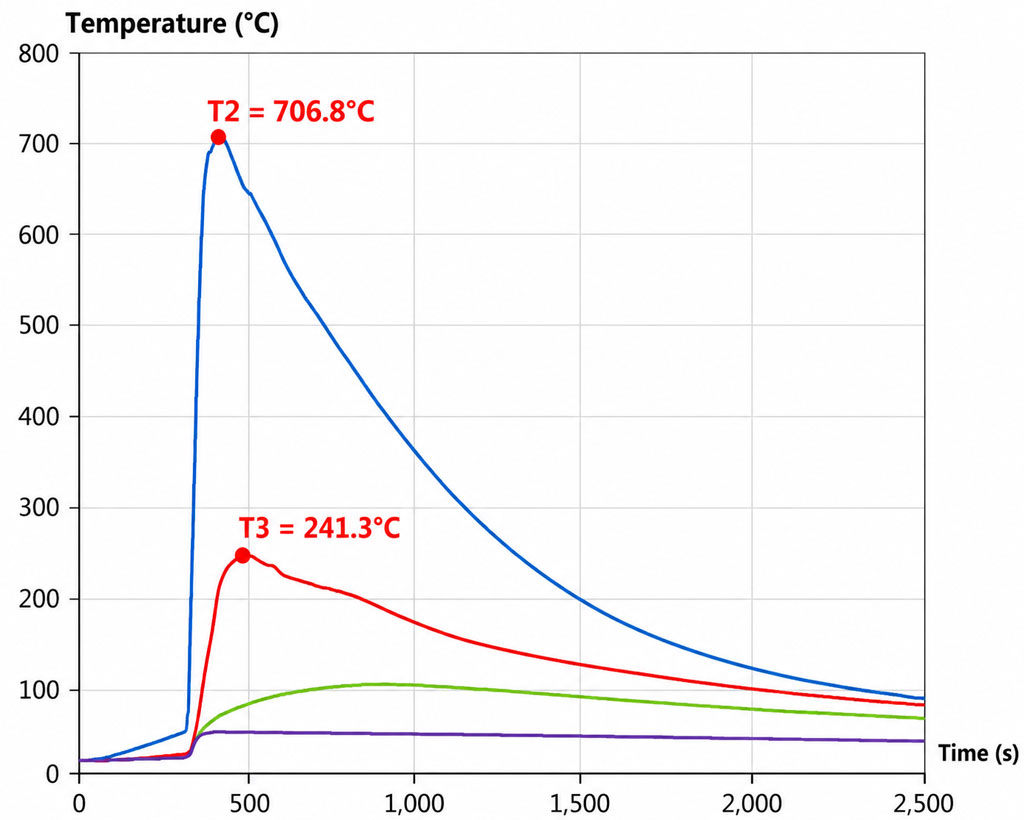
In third-party thermal runaway propagation testing, the peak hot-side temperature reached 706.8°C. After thermal isolation by the nano-silica fireproof insulation sheet, the maximum cold-side temperature was only 241.3°C, achieving a temperature difference of 465.5°C. Its overall performance was superior to that of an aerogel insulation pad of the same specifications.
Testing under simulated operating conditions demonstrates that nano-silica fireproof insulation sheets can effectively delay the propagation of thermal runaway within battery modules.
Currently, Betterial is collaborating with multiple energy storage system integrators and energy storage equipment manufacturers on sample testing and protective solution design. Based on energy storage cabinet dimensions, battery cell capacities, and fire protection requirements, Betterial can provide customized cutting services and tailored structural protection solutions.
Conclusion
The safety protection of large-capacity energy storage cabinets cannot rely solely on stacking conventional thermal insulation materials.
Betterial’s integrated nano-silica fireproof insulation sheet solution combines thermal isolation and temperature control between battery cells during normal operation with thermal runaway propagation protection under fault conditions.
The solution offers comprehensive advantages in several key areas, including thin and lightweight construction, efficient utilization of internal cabinet space, excellent high-temperature resistance, prolonged burn-through protection, dust-free performance, and reduced exposure to overseas patent risks.
By integrating these characteristics into a structured thermal protection system, Betterial provides a domestically developed solution for thermal insulation, heat management, and safety protection in large-format battery energy storage systems.