
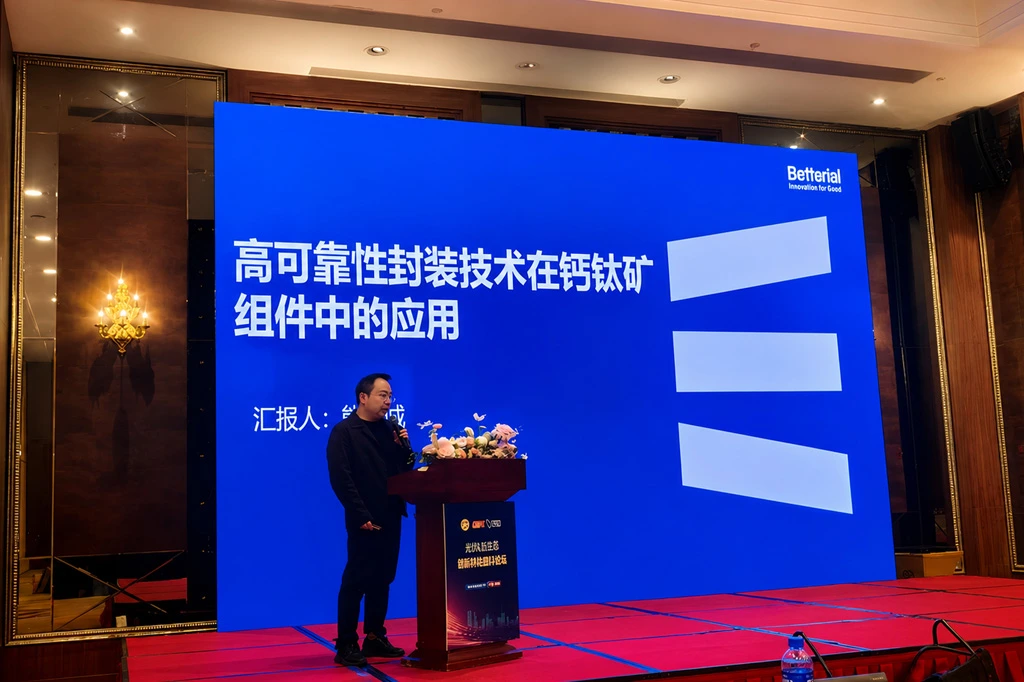
Recognized worldwide as one of the next-generation photovoltaic technologies, perovskite solar cells represent a major breakthrough in solar innovation. Driven by rapid technological progress and supportive policies, China’s perovskite photovoltaic industry chain has begun to take shape.
However, due to the unique characteristics of perovskite materials, encapsulation technology is critical to ensuring long-term module stability.
As the first company in the industry to achieve small-batch commercial delivery of perovskite encapsulation films, Betterial has been committed to advanced encapsulation solutions for perovskite photovoltaics for many years and has achieved new breakthroughs in both perovskite and tandem perovskite encapsulation technologies, further accelerating the commercialization of next-generation solar modules.
Perovskite: The Next Frontier in High-Efficiency Solar Technology
Conventional crystalline silicon solar cells are approaching their theoretical efficiency limit of approximately 29.4%, leaving limited space for further performance improvements.
In contrast:
- Single-junction perovskite solar cells offer a theoretical conversion efficiency of 33%.
- Tandem perovskite solar cells have the potential to reach efficiencies of up to 45%.
Perovskite is also a highly versatile platform technology that can be integrated with advanced N-type cell architectures such as TOPCon and HJT, creating silicon–perovskite tandem solar cells with tremendous market potential.
Industry commercialization is accelerating rapidly. Beginning in 2024, several gigawatt-scale perovskite module projects are expected to enter commercial production. According to the China Photovoltaic Industry Association (CPIA), perovskite photovoltaic modules could account for 30% of China’s PV market by 2030.
However, challenges remain, including limited lifetime, insufficient long-term stability, and difficulties in large-area manufacturing.
Why Encapsulation Matters
From the perspective of cell architecture, the stability challenges of perovskite solar cells are primarily associated with the light-absorbing layer, the electron transport layer (ETL), and the electrode materials.
Under conditions such as high temperature, humidity, and oxygen exposure, perovskite materials are prone to chemical reactions with acidic substances, peroxides, and small polar molecules. These reactions can not only compromise the passivation effect at the interfaces but also alter the crystal structure of the perovskite, ultimately leading to irreversible degradation of the cell’s power generation performance.
Therefore, selecting an appropriate encapsulation solution is essential to ensure the long-term stability of perovskite solar modules.
In conventional crystalline silicon (c-Si) modules, encapsulation typically relies on two layers of EVA encapsulant film to bond the solar cells to the front glass and the backsheet. However, this approach is not suitable for perovskite modules. During the aging process, EVA encapsulant releases trace amounts of acetic acid, which is corrosive to perovskite materials and can significantly impair cell performance. As a result, conventional EVA encapsulation cannot be used for perovskite solar modules.
Betterial’s Perovskite Encapsulation Solution
As the first company in the industry to achieve small-batch commercial delivery of perovskite encapsulation films, Betterial began researching perovskite encapsulation technology as early as 2018.

According to the company’s technical team,
Compared with conventional EVA encapsulation films, thermoplastic TPO encapsulation films offer lower lamination temperatures and lower water vapor transmission rates (WVTR). They also maintain excellent weather resistance and strong adhesion under low-temperature lamination conditions. Betterial’s thermoplastic TPO encapsulation film has been supplied to leading perovskite module manufacturers, including GCL Perovskite and CATL, since 2021, demonstrating the company’s technological leadership in this field.
Betterial’s Next-Generation Perovskite Encapsulation Film features a proprietary formulation that leverages advanced technologies such as polymer grafting and nano-interconnected network engineering. It delivers high peel strength after low-temperature, rapid lamination while effectively eliminating issues associated with residual polar small molecules and long-term storage performance degradation.
Validated by Industry Leaders
Betterial’s next-generation encapsulation film for perovskite solar modules provides enhanced protection for highly sensitive tandem solar cells, delivering stronger support for the long-term stability and reliability of both perovskite and perovskite-silicon tandem PV modules.
Presently, the product has successfully passed third-party testing and certification by the National Center of Supervision and Inspection on Solar Photovoltaic Products Quality (CPVT) and Suzhou Meihua Testing. Betterial has also established technical collaboration and sample validation programs with leading perovskite companies, including GCL, Microquanta, UtmoLight, and Wonder Solar. In addition, Betterial is working with customers such as LONGi, Trinasolar, and Auner on encapsulation technologies for next-generation perovskite-silicon tandem solar cells.
It is worth noting that encapsulation films account for only 11–16.4% of the total cost of perovskite modules, yet they are among the most critical materials determining module quality, reliability, and service lifetime. By introducing innovative encapsulation technologies and optimizing encapsulation processes, Betterial helps customers effectively reduce costs while improving performance, providing strong support for the commercialization and large-scale adoption of perovskite modules.
Building the Future of Perovskite Photovoltaics
Since its founding in 2007, Betterial has accumulated more than 17 years of expertise in functional film technologies and has established comprehensive technological capabilities across the photovoltaic encapsulation material value chain.
Leveraging its mature R&D platform, Betterial provides customized encapsulation solutions tailored to diverse application requirements.
Betterial has planned an encapsulation film production capacity exceeding 130 GW, supported by eight manufacturing bases located in:
- Changzhou
- Yancheng
- Xianyang
- Chuzhou
- Lianyungang
- Chuzhou
- Guangde
- Turkey
- Vietnam
Betterial’s shipment volume consistently ranks among the industry’s leading suppliers.
Betterial is currently working closely with leading photovoltaic manufacturers on national-level research programs and field demonstration projects for next-generation perovskite technologies. Betterial is also actively leading the development of industry standards for perovskite encapsulation technology, helping establish a more standardized and sustainable industry ecosystem.
In the future, Betterial will continue to increase our investment in research and development of new products and technologies, further optimize our product structure, and accelerate the cultivation and forging of new productivity to deliver more stable, lower-cost, and more technologically advanced products to the market, and continuously contribute to cost reduction and efficiency improvement in the industry.