
In the rapidly evolving photovoltaic (PV) industry, almost every component of a solar module has undergone dramatic technological transformation.
Solar cells have evolved from Al-BSF to PERC, TOPCon, HJT, BC, and even tandem perovskite technologies. Backsheets, frames, and junction boxes continue to be developed.
However, one material has demonstrated remarkable staying power for more than four decades: EVA encapsulation film.
Despite the emergence of advanced encapsulation materials such as POE, EPE, and TPO, EVA remains the most widely adopted encapsulant in the global PV industry.
The reason for EVA’s dominance comes from something more fundamental:
EVA represents one of the most successful engineering balances between reliability, manufacturability, cost efficiency, and global supply chain maturity.
For solar module manufacturers, the best material is not always the one with the highest individual performance. It is the material that delivers the optimal combination of lifetime value, production stability, and economic feasibility.
1. EVA’s 40-Year Success Story: Why Has It Survived Multiple Technology Cycles?
The photovoltaic industry has changed dramatically since commercial solar modules entered mass production.
In the 1980s and 1990s, module manufacturers faced a critical challenge:
How can solar cells be protected from moisture, mechanical stress, UV exposure, and temperature fluctuations while maintaining affordable production costs?
EVA emerged as the solution.
Over decades of application, EVA has continuously evolved through:
- Improved polymer formulation
- Better cross-linking technology
- Enhanced UV resistance
- Lower acetic acid generation
- Improved optical performance
- Better compatibility with different cell technologies
The key reason EVA survived is that solar modules are not only semiconductor products—they are 25–30 year outdoor energy devices.
A material must perform reliably under:
- −40°C to +85°C temperature cycles
- High humidity environments
- UV radiation
- Mechanical loading
- Long-term electrical stress
EVA has accumulated one of the largest real-world reliability databases among PV materials.
This long-term field experience creates a significant advantage.
A new material may demonstrate excellent laboratory performance, but EVA benefits from millions of installed modules proving its durability under actual operating conditions.
2. The Core Engineering Advantages of EVA Encapsulation Film
2.1 Excellent Optical Performance: Maximizing Energy Generation
One of the most important functions of encapsulation film is not only protection but also light transmission.
Solar cells convert sunlight into electricity, meaning every percentage point of optical loss affects module output.
High-quality EVA films typically provide:
- High visible light transmission
- Low haze
- Stable optical properties after aging
- Good refractive index matching between glass and cells
This helps reduce:
- Reflection losses
- Optical scattering
- Light mismatch between layers
For high-efficiency modules, optical performance becomes increasingly important because the available margin for energy loss is smaller.
2.2 Strong Adhesion: Protecting the Module Structure
A solar module is a multilayer structure:
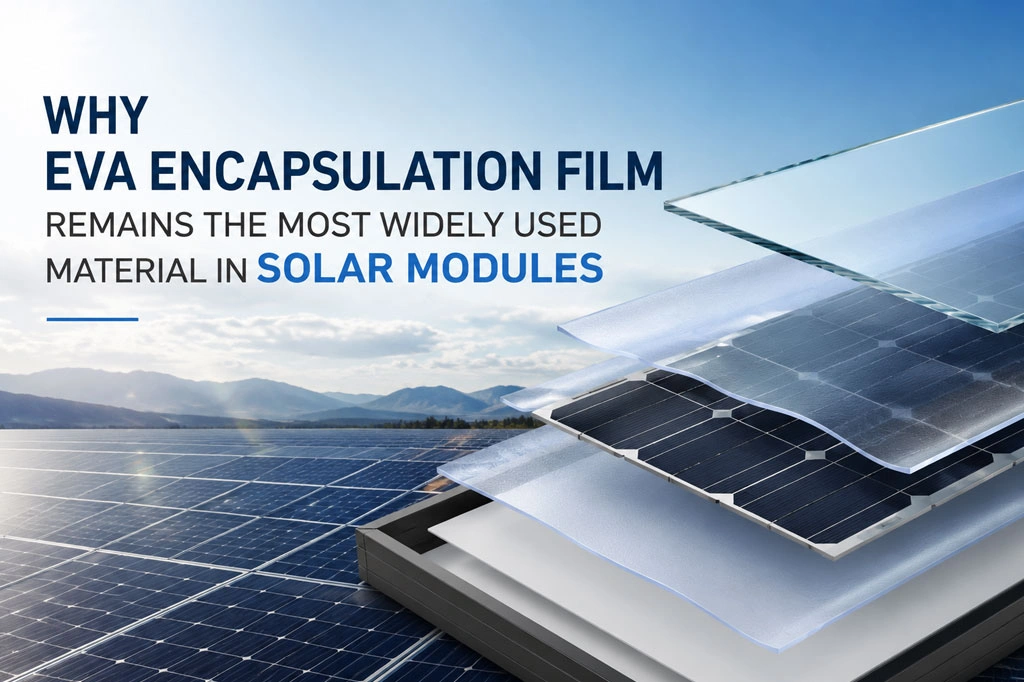
Glass → Encapsulation Film → Solar Cell → Encapsulation Film → Backsheet/Glass
The interface between these layers determines long-term reliability.
EVA provides strong bonding with:
- Glass
- Solar cells
- Backsheets
- Glass substrates
Good adhesion prevents:
- Delamination
- Moisture penetration pathways
- Mechanical damage during thermal cycling
A solar module may contain advanced cells, but without reliable encapsulation, its lifetime can be significantly reduced.
2.3 Mature Cross-Linking Technology and Manufacturing Stability
Solar module production requires extremely high consistency.
A typical module factory produces thousands of modules every day. Encapsulation materials must perform consistently during:
- Lamination
- Heating
- Cooling
- Transportation
- Long-term operation
EVA has a major advantage because its lamination process is highly mature.
Manufacturers already understand:
- Optimal lamination temperature
- Cross-linking conditions
- Process windows
- Quality control methods
This reduces:
- Production risks
- Equipment adjustments
- Yield losses
For mass production, process stability is often as important as material performance.
3. EVA vs. New Generation Encapsulation Materials: Why EVA Still Wins
New encapsulation materials have emerged because PV technology is becoming more demanding.
For example:
- TOPCon requires better PID resistance
- HJT requires lower moisture transmission
- BC cells require improved barrier performance
- Tandem solar cells require advanced chemical stability
Materials such as POE and EPE provide advantages in specific applications.
However, EVA remains competitive because of its balanced performance.
| Performance Factor | EVA | POE | EPE |
|---|---|---|---|
| Optical performance | ★★★★★ | ★★★★ | ★★★★★ |
| Moisture resistance | ★★★★ | ★★★★★ | ★★★★★ |
| PID resistance | ★★★★ | ★★★★★ | ★★★★★ |
| Manufacturing maturity | ★★★★★ | ★★★★ | ★★★★ |
| Cost competitiveness | ★★★★★ | ★★★ | ★★★★ |
| Supply chain availability | ★★★★★ | ★★★★ | ★★★★ |
The comparison reveals an important point:
EVA does not always achieve the highest score in every category, but it delivers the most balanced overall solution.
4. Cost Advantage: The Hidden Reason Behind EVA’s Market Leadership
Solar manufacturing is ultimately a scale-driven industry.
Even a small material cost difference can have a significant impact when producing gigawatts of modules.
For module manufacturers, encapsulation material selection affects:
- Bill of materials (BOM)
- Production efficiency
- Equipment utilization
- Yield rate
- Supply stability
EVA benefits from:
Large-scale production capacity
Decades of market adoption have created:
- Mature raw material supply chains
- Multiple global suppliers
- Stable production technologies
Lower processing risk
Manufacturers do not need to significantly modify existing production lines.
Competitive pricing
Compared with higher-performance encapsulation materials, EVA provides excellent reliability at a lower cost.
This is especially important in markets where reducing levelized cost of electricity (LCOE) remains the primary objective.
5. Reliability Balance: The Real Reason Manufacturers Choose EVA
A common misconception is:
“The best PV material should have the highest technical specifications.”
However, module engineering is about balancing multiple factors.
A solar module must achieve:
High efficiency + long lifetime + low manufacturing cost + stable production
A material with slightly better laboratory performance may not always create better commercial value.
For example:
A premium encapsulation material may improve moisture resistance by a certain percentage, but if it significantly increases module cost, the overall economic benefit may decrease.
EVA succeeds because it provides:
- Reliable protection
- Proven outdoor durability
- High production efficiency
- Competitive cost
This balance explains why many manufacturers continue using EVA for mainstream PV modules.
Conclusion
After more than 40 years, EVA remains the most widely used encapsulation film in solar modules because it solves the most important industrial challenge:
How to deliver reliable solar energy at the lowest possible lifetime cost.
Its success is not based on being the most advanced material in every technical category.
Instead, EVA represents the perfect balance between:
- Proven reliability
- Optical performance
- Adhesion strength
- Manufacturing maturity
- Global availability
- Cost competitiveness
As photovoltaic technology continues evolving, encapsulation materials will become more specialized. However, EVA’s combination of performance and economics ensures that it will remain a fundamental material in the solar industry for years to come.