
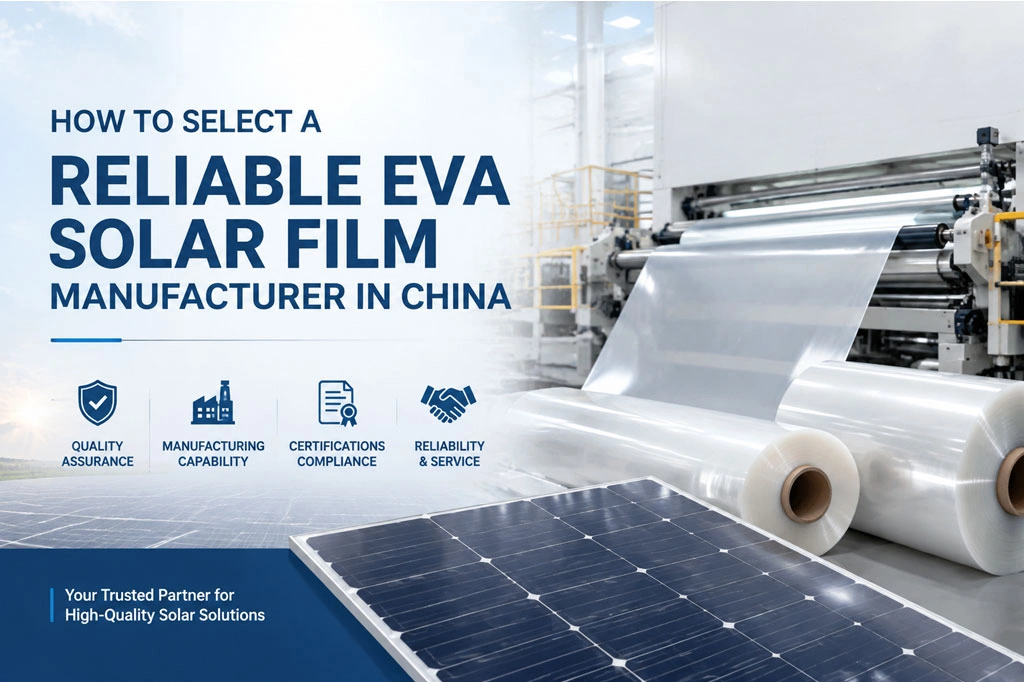
As global solar module production continues to expand, EVA solar film remains one of the most widely used encapsulation materials due to its excellent balance of optical performance, reliability, cost efficiency, and manufacturing compatibility.
However, not all EVA solar film manufacturers in China provide the same level of quality, technical support, and long-term reliability. For module manufacturers, EPC companies, and global solar supply chain partners, selecting the right EVA supplier is not simply a price comparison—it is a strategic decision that directly impacts:
- Module shelf life
- Power output stability
- Production yield
- Warranty risk
- Long-term project profitability
A reliable EVA solar film manufacturer should have strong production capabilities, internationally recognized certifications, advanced R&D resources, and responsive customer support.
This article explains the key factors global buyers should evaluate when selecting an EVA solar film supplier in China.
1. Evaluate Production Capacity and Manufacturing Reliability
1.1 Large-Scale Production Capacity Ensures Supply Stability
Solar module manufacturing requires consistent and large-volume material supply. A qualified EVA solar film manufacturer should have sufficient production capacity to support:
- Long-term supply agreements
- Emergency demand fluctuations
- Global project requirements
Manufacturers with limited capacity may struggle with:
- Delivery delays
- Batch-to-batch variations
- Production interruptions during peak demand periods
For global customers, production capacity is not only about output volume—it represents supply chain security.
A professional EVA film supplier should be able to demonstrate:
- Annual production capacity (GW equivalent)
- Number of production lines
- Manufacturing locations
- Automation level
- Quality control processes
- After-sales disposal ability
For example, manufacturers serving global PV leaders typically establish multiple production bases to reduce supply risks and improve regional responsiveness.
1.2 Advanced Manufacturing Equipment Improves Product Consistency
EVA solar film production requires precise control of:
- Polymer formulation
- Extrusion temperature
- Film thickness
- Crosslinking performance
- Optical properties
Advanced production lines help maintain:
- Uniform thickness
- Stable gel content
- Low shrinkage
- Consistent peel strength
- Excellent optical performance
When evaluating suppliers, buyers should ask:
- Are production lines fully automated?
- What quality inspection systems are used?
- How are raw materials managed?
A reliable manufacturer should have strict incoming material inspection, online monitoring, and final product testing.
2. Verify Certifications and Quality Standards
2.1 Certifications Reflect Manufacturing Discipline
Certifications do not automatically guarantee product quality, but they demonstrate whether a manufacturer has established systematic quality management.
Important certifications to review include:
ISO 9001 Quality Management System
This verifies that the manufacturer has standardized processes for:
- Production control
- Quality inspection
- Continuous improvement
ISO 14001 Environmental Management System
This demonstrates commitment to:
- Environmental compliance
- Sustainable manufacturing
- Waste management
2.2 Laboratory Capability Is More Important Than Certificates
Beyond certificates, buyers should evaluate whether the manufacturer owns professional testing facilities.
A strong EVA solar film manufacturer should be capable of conducting:
| Testing Item | Purpose |
|---|---|
| Gel Content Test | Evaluate crosslinking degree |
| Peel Strength Test | Measure adhesion reliability |
| UV Aging Test | Assess long-term weather resistance |
| Damp Heat Test | Evaluate moisture durability |
| Optical Transmittance Test | Verify light transmission |
| Shrinkage Test | Ensure module processing stability |
A supplier with in-house testing capability can identify issues faster and provide more reliable technical solutions.
3. Assess R&D Capability and Technical Innovation
3.1 EVA Technology Continues to Evolve
Although EVA has been used in photovoltaic modules for more than 40 years, modern PV technologies continue to create new requirements.
Advanced solar modules—including:
- TOPCon
- BC (Back Contact)
- HJT
- Perovskite tandem modules
require encapsulation materials with improved:
- UV resistance
- PID resistance
- Moisture barrier performance
- Adhesion reliability
- Low degradation rates
Therefore, choosing an EVA supplier with strong R&D capability is critical.
3.2 Evaluate the Manufacturer’s Technical Development Ability
A reliable EVA solar film manufacturer should have:
Material Formulation Expertise
Ability to optimize:
- EVA resin selection
- Additive systems
- Crosslinking agents
- UV stabilizers
- Anti-aging components
Customized Product Development
Different customers may require customized EVA solutions based on:
- Climate conditions
- Module design
- Production processes
- Performance targets
For example:
- High UV resistance EVA for desert PV projects
- High transparency EVA for high-efficiency modules
- Low shrinkage EVA for advanced module manufacturing
A manufacturer that only provides standard products may not be able to support future technology upgrades.
4. Examine Customer Support and Global Service Capability
4.1 Technical Support Is Critical for PV Material Suppliers
EVA solar film is not an independent component—it interacts with:
- Solar cells
- Glass
- Backsheets
- Frames
- Ribbons
- Module lamination processes
During mass production, customers may encounter issues such as:
- Poor adhesion
- Bubble formation
- Delamination
- Insufficient curing
- Optical defects
A reliable supplier should provide:
- Application engineers
- Process optimization support
- Failure analysis
- On-site technical assistance
4.2 Global Service Network Provides Long-Term Value
For international buyers, communication efficiency and local support are important.
A strong Chinese EVA solar film manufacturer should have:
- International sales teams
- Overseas service capability
- Multilingual communication
- Stable logistics solutions
Manufacturers with global production or service networks can better support customers in different regions.
For example, a supplier with manufacturing bases across multiple countries can reduce:
- Transportation risks
- Delivery uncertainty
- Regional supply chain disruptions
5. Compare Total Value, Not Just Product Price
Many buyers initially focus on EVA film pricing. However, the lowest-cost supplier may create higher long-term costs through:
- Higher module failure rates
- Production downtime
- Warranty risks
- Quality complaints
A better evaluation approach is to consider:
| Evaluation Factor | Importance |
|---|---|
| Production Capacity | Ensures supply stability |
| Product Quality | Determines module reliability |
| R&D Capability | Supports future technologies |
| Technical Support | Reduces production risks |
| Certifications | Demonstrates process control |
| Price | Affects short-term cost |
The best EVA supplier is not necessarily the cheapest—it is the partner that provides the highest long-term value.
6. Questions to Ask Before Selecting an EVA Solar Film Supplier
Before signing a supply agreement, buyers should ask:
Manufacturing
- What is your annual EVA film production capacity?
- How many production bases do you operate?
- What is your monthly supply capability?
Quality
- What certifications do your products have?
- What reliability tests are performed?
- Can you provide test reports?
Technology
- Do you support TOPCon, BC, HJT, or tandem PV technologies?
- Can you customize EVA formulations?
- Do you have an internal R&D team?
Service
- Do you provide technical support during module production?
- Can engineers support overseas customers?
- How do you handle quality issues?
These questions help distinguish experienced manufacturers from simple trading companies.
Conclusion
Selecting the right partner requires evaluating more than product pricing.
A reliable EVA solar film manufacturer should demonstrate:
✅ Strong production capacity
✅ International certifications and quality systems
✅ Continuous R&D innovation
✅ Professional technical support
✅ Global customer service capability
As photovoltaic technologies continue to evolve, encapsulation materials will play an increasingly important role in module reliability and lifetime energy yield.
Betterial is an experienced EVA solar film manufacturer. Choose us to build a stronger foundation for long-term solar success.