
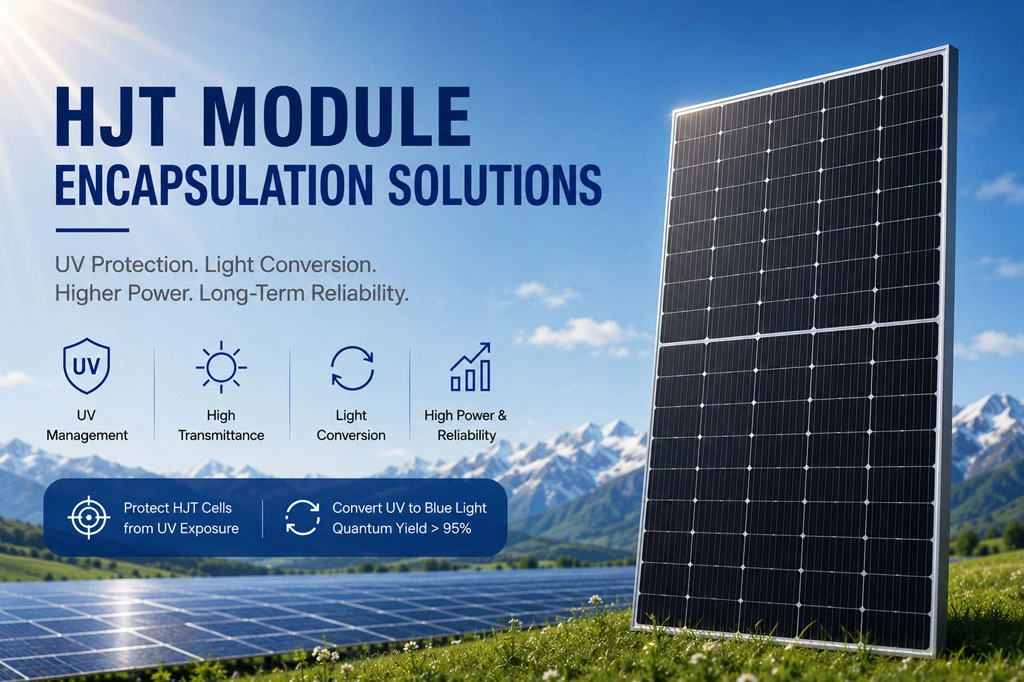
Heterojunction (HJT) solar technology is gaining increasing attention in the photovoltaic industry due to its high conversion efficiency, excellent temperature coefficient, strong bifacial performance, and potential for further efficiency improvement.
For HJT modules, the encapsulation system must protect sensitive cell structures while maintaining high optical transmission and minimizing potential power loss.
This creates an important challenge for module manufacturers: how can HJT cells be protected from harmful ultraviolet radiation without sacrificing the sunlight needed for power generation?
Advanced light-conversion encapsulation technology provides a new approach to solving this problem.
1. Why HJT Modules Require Advanced Encapsulation Materials
HJT cells combine crystalline silicon wafers with thin amorphous silicon thin film to achieve excellent surface passivation and high conversion efficiency.
While this structure provides important performance advantages, it also places higher demands on the materials surrounding the cell.
UV-Induced Performance Degradation
Photovoltaic modules operate outdoors for decades and are continuously exposed to ultraviolet radiation.
Long-term UV exposure can affect sensitive materials and interfaces within high-efficiency cell structures, potentially contributing to passivation degradation and power loss.
For HJT modules, simply maximizing the UV transmittance of the encapsulation film is therefore not always the ideal solution.
At the same time, completely blocking UV radiation introduces another problem: part of the solar spectrum is prevented from reaching the cell, which can reduce the module’s initial power output.
This creates a fundamental trade-off:
More UV transmission → potentially higher initial power, but greater UV exposure.
More UV blocking → better protection, but possible optical and power losses.
The ideal HJT encapsulation solution should therefore manage UV energy rather than simply choosing between transmission and blocking.
2. Light-Conversion Technology: Turning UV Into Usable Light
Betterial’s HJT module encapsulation solution takes a different approach by using a light-conversion film on the front side of the module.
Instead of only blocking ultraviolet radiation, the functional encapsulation material absorbs UV light and converts it into blue fluorescence.
This allows part of the potentially harmful UV energy to be transformed into longer-wavelength light that can contribute more effectively to photovoltaic power generation.
The light-conversion film offers several important optical characteristics:
- Strong absorption within the UV spectrum
- High overall light transmittance
- Minimal fluorescence efficiency decay
- Quantum yield of more than 95%
This approach helps establish a balance between UV protection for HJT cells and initial module power performance.
Rather than treating UV radiation entirely as unwanted energy, light-conversion technology provides an opportunity to manage the spectrum more intelligently.
3. Betterial’s HJT Module Encapsulation Solution
An effective HJT encapsulation solution should consider the different functional requirements of the front and rear sides of the module.
Betterial therefore uses a differentiated encapsulation architecture.
Front Side: HC806 Light-Conversion Film
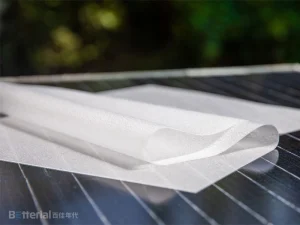
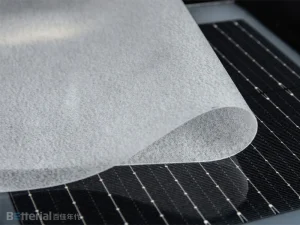
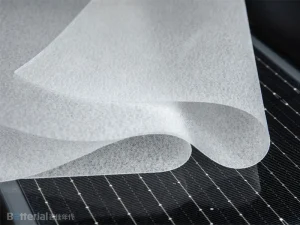
On the light-facing side, Betterial recommends HC806 light-conversion encapsulation film.
Its primary role is optical management.
When UV radiation enters the module, the functional material absorbs part of the UV energy and converts it into blue fluorescence. This helps reduce direct UV exposure to sensitive HJT cell structures while maintaining effective utilization of incident solar energy.
The solution is designed to combine:
UV management + high transmittance + light conversion + power retention
This makes the front encapsulation film an active optical component rather than simply a transparent adhesive layer.
Rear Side: B602M EPE or B601HP High-Transmittance EVA
Different module designs and manufacturing requirements may require different rear-side encapsulation strategies.
Betterial’s HJT solution therefore provides two options:
B602M co-extruded EPE encapsulation film
or
B601HP high-transmittance EVA encapsulation film
The EPE option combines the characteristics of EVA and POE materials through a multilayer co-extruded structure, providing a practical balance between processing performance, protection, and module reliability.
High-transmittance EVA, meanwhile, can be selected for module configurations requiring mature processing characteristics and excellent optical performance.
This flexible material combination allows module manufacturers to optimize encapsulation structures according to module architecture, production processes, reliability targets, and cost requirements.
Conclusion
By converting absorbed UV radiation into blue fluorescence, Betterial’s HJT module encapsulation solution provides a way to combine cell protection with efficient light utilization. Its front-side HC806 light-conversion film, together with flexible rear-side B602M EPE or B601HP high-transmittance EVA options, provides a targeted encapsulation architecture for HJT module manufacturing.
As HJT efficiencies continue to increase, advanced functional encapsulation materials will become increasingly important in translating high laboratory cell efficiency into reliable, high-energy-yield photovoltaic modules operating for decades in real-world environments.