
As photovoltaic cell technologies continue to advance, improving module performance is no longer only about increasing cell conversion efficiency. How effectively a module manages the solar spectrum—and how well sensitive cells are protected from long-term ultraviolet (UV) exposure—has become increasingly important.
This is where light conversion film offers a new approach.
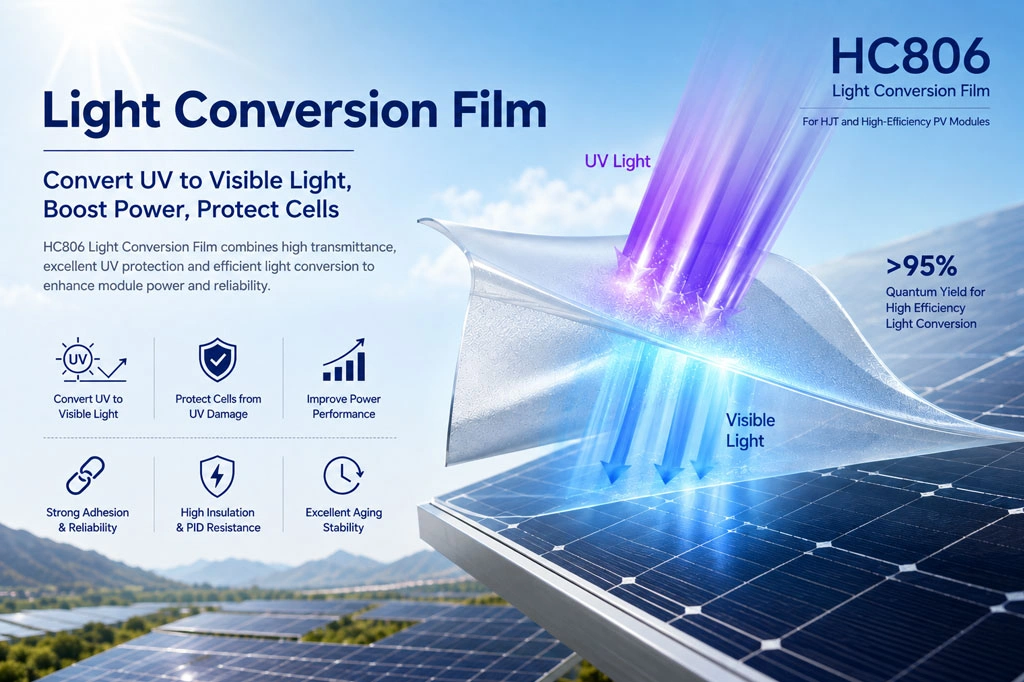
Unlike conventional encapsulation films that mainly transmit incoming sunlight and protect solar cells from environmental stresses, light conversion film provides an additional optical function: it absorbs part of the ultraviolet spectrum and converts it into visible light that can be more effectively utilized by solar cells.
This combination of UV protection, spectral conversion, and encapsulation makes light conversion film particularly attractive for high-efficiency photovoltaic technologies such as HJT modules.
1. What Is Light Conversion Film?
Light Conversion Film is a functional PV encapsulation material designed to modify the spectrum of incoming sunlight.
Conventional high-transmittance encapsulation films aim to allow as much sunlight as possible to reach the solar cell. However, not every wavelength contributes equally to power generation. Short-wavelength ultraviolet radiation can also accelerate degradation in certain cell and module materials.
Light conversion technology takes a different approach.
Instead of simply transmitting or blocking UV radiation, specially designed light conversion materials absorb UV photons and re-emit part of that energy at longer visible wavelengths.
The basic process can be summarized as:
UV Light → Absorption by Light Conversion Material → Visible Fluorescence → Solar Cell
This process is also commonly described as down-conversion or wavelength conversion.
For photovoltaic modules, this creates two potential benefits simultaneously:
- Reducing the amount of harmful UV radiation reaching UV-sensitive materials and cells
- Converting part of that UV energy into usable visible light instead of simply filtering it out
The result is an encapsulation material that can contribute not only to module protection but also to optical performance.
2. Why Do High-Efficiency PV Modules Need Better UV Management?
As the PV industry moves toward increasingly sophisticated cell structures, encapsulation materials must perform more functions than before.
Heterojunction (HJT) cells, for example, use advanced passivation and conductive layers to achieve high conversion efficiency. Maintaining the stability of these interfaces during decades of outdoor operation is essential.
Long-term UV exposure can contribute to material aging and performance degradation. In high-UV environments—such as deserts, plateaus, and high-altitude solar projects—the challenge becomes even more significant.
A conventional solution is to use UV-cutoff encapsulation materials.
These materials reduce UV transmission and therefore help protect the cell. However, the blocked portion of the solar spectrum contributes little or nothing to power generation.
Light conversion film introduces another possibility:
Instead of only blocking UV radiation, why not convert part of it into wavelengths the cell can use?
This is one of the key advantages of light conversion encapsulation technology.
3. How Does Light Conversion Film Work?
The core principle of light conversion film is spectral transformation.
Functional light-conversion components are incorporated into the encapsulation material. When ultraviolet photons enter the module, these components absorb short-wavelength radiation and subsequently emit photons at longer wavelengths, typically within the visible spectrum.
For HJT applications, Betterial’s encapsulation solution converts absorbed UV light into blue fluorescence.
The light conversion film therefore performs several roles within the module:
First, UV absorption.
Part of the high-energy UV radiation is absorbed before reaching sensitive cell structures.
Second, wavelength conversion.
The absorbed energy is converted into longer-wavelength visible light.
Third, optical utilization.
The converted visible light can potentially be utilized by the solar cell for electricity generation.
Fourth, encapsulation protection.
The film continues to perform the essential functions expected from an encapsulation material, including adhesion, insulation, and environmental protection.
This means light conversion technology can combine cell protection and power enhancement within the same functional film.
4. Betterial HC806 Light Conversion Film
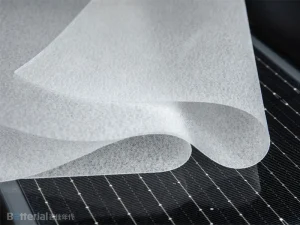
Betterial developed HC806 Light Conversion Film for high-efficiency PV module encapsulation applications requiring both UV protection and improved optical utilization.
HC806 converts UV light into visible light while maintaining high transmission across the main solar response spectrum.
Its key technical properties include:
| Technical Property | HC806 Performance |
|---|---|
| Light Transmittance, 280–380 nm | <30% |
| Light Transmittance, 380–1100 nm | >91% |
| Glass Peel Strength | >80 N/cm |
| Solar Cell Peel Strength | >60 N/cm |
| Pre-crosslinking Degree | >75% |
| Volume Resistivity | >1 × 10¹⁵ Ω·cm |
| MD Shrinkage Ratio | <3.0% |
| TD Shrinkage Ratio | <1.5% |
| PCT 48 h Yellowness Index Change | <3.0 ΔYI |
| UV Aging Yellowness Index Change | <3.0 ΔYI |
These properties allow HC806 to combine optical functionality with the adhesion, electrical insulation, dimensional stability, and aging resistance required for reliable module encapsulation.
5. Application in HJT Module Encapsulation
HJT is one of the most important application scenarios for HC806.
As the HJT surface is harder to bond, and the surface (TCO thin film) of the HJT is different from that of the traditional TOPCon cell. So the adhesive also needs enhancement.
That’s why we added the solar cell peel strength testing item specifically.
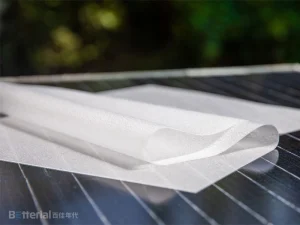
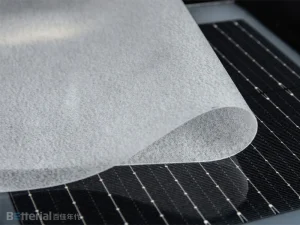
Betterial’s HJT module encapsulation solution uses:
- Front Side: HC806 Light Conversion Film
- Rear Side: B602M Co-extruded Film / B601HP High-Transmittance EVA Film
Placing the light conversion film on the front side enables it to interact with incoming solar radiation before the light reaches the HJT cell.
The solution combines strong UV absorption, high light transmittance, high fluorescence conversion efficiency, and encapsulation reliability.