
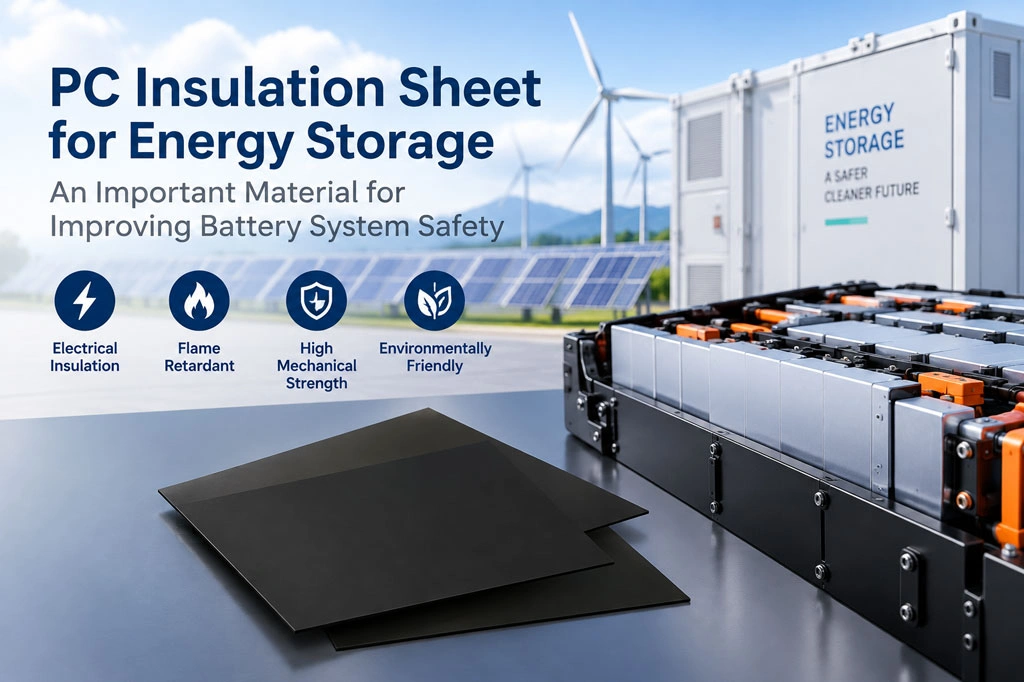
As electrochemical energy storage systems continue to evolve toward higher capacity, higher voltage, and greater integration, electrical safety and flame-retardant protection inside battery modules are becoming increasingly important. In addition to battery cells, battery management systems (BMS), and thermal management systems, insulation materials are also a key factor affecting the safety and long-term reliability of energy storage systems.
With good electrical insulation, flame retardancy, mechanical strength, and processing adaptability, PC insulation sheets for energy storage are widely used for insulation protection in battery cells, modules, and battery packs.
What Is a PC Insulation Sheet for Energy Storage?
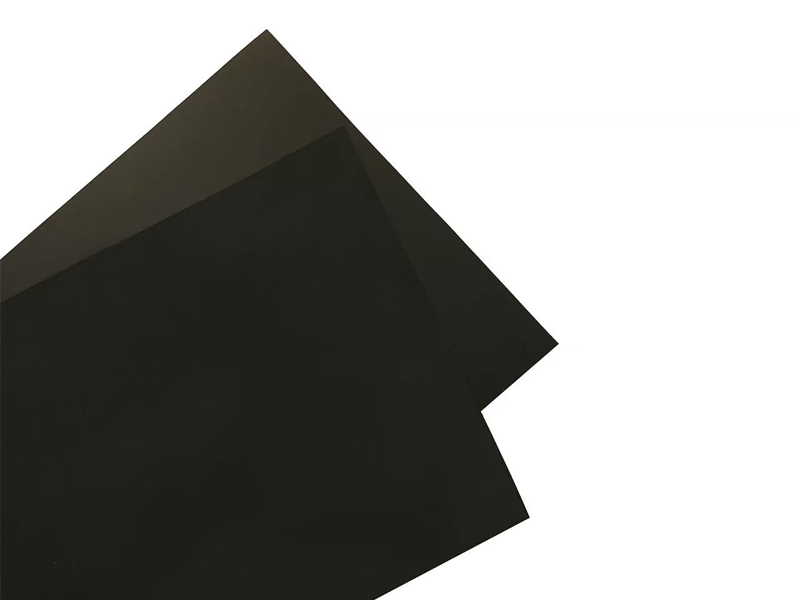
A PC insulation sheet for energy storage is a functional insulation material made primarily from polycarbonate (PC) through flame-retardant modification and sheet-processing technologies.
Compared with ordinary PC sheets, PC insulation sheets designed for energy storage applications place greater emphasis on electrical insulation, flame-retardant rating, thermal dimensional stability, environmental compliance, and precision processing capabilities.
In energy storage battery systems, PC insulation sheets can be installed between electrically live components to help isolate different electrical potentials and reduce the risks of short circuits, electrical arcing, and leakage current. At the same time, their flame-retardant properties can reduce the likelihood of sustained combustion after ignition, providing an additional safety barrier for battery modules.
Why Do Energy Storage Systems Need PC Insulation Sheets?
Energy storage battery packs typically contain a large number of battery cells, busbars, wiring harnesses, BMS components, and metal structural parts. Without reliable insulation between electrically live components and metal enclosures, the risks of short circuits, electrical arcing, or localized overheating may increase.
PC insulation sheets for energy storage mainly perform the following functions:
- Isolate electrically live components from metal structures to reduce the risk of unintended electrical conduction;
- Establish insulation barriers between battery cells, modules, and battery packs;
- Help suppress sustained combustion through flame-retardant properties;
- Prevent direct contact or friction between structural components during assembly;
- Adapt to complex spaces through precision die-cutting, improving assembly efficiency;
- Maintain good dimensional stability under changing temperature conditions.
Key Properties of PC Insulation Sheets for Energy Storage
1. Electrical Insulation Performance
Energy storage systems contain electrically live components such as battery cell terminals, busbars, connectors, and high-voltage wiring harnesses.
PC insulation sheets can provide reliable electrical isolation between these components and metal enclosures, structural parts, or other conductive areas, helping reduce the risk of short circuits caused by assembly deviations, vibration and friction, or damage to insulation layers.
2. V-0 Flame-Retardant Performance
Flame retardancy is an important performance indicator for insulation materials used in energy storage systems.
Betterial PC flame-retardant insulation sheets for energy storage achieve a V-0 flame-retardant rating, helping limit sustained flame propagation when the material is exposed to an open flame and supporting module-level safety design.
It should be noted that flame-retardant ratings are generally related to material thickness and testing conditions. During actual material selection, the rating should therefore be confirmed according to the target product thickness, application location, and overall system safety requirements.
3. Good Dimensional Stability
Batteries experience temperature changes during charging and discharging. If an insulation sheet shrinks or warps significantly after being exposed to heat, its insulation coverage may become insufficient and affect required safety clearances.
Betterial PC flame-retardant insulation sheets are available in thicknesses ranging from 0.05 to 1.0 mm.
- For thicknesses of 0.175 mm or less, the longitudinal thermal shrinkage rate is no more than 1.5%, while the transverse thermal shrinkage rate is no more than 0.5%.
- For thicknesses above 0.175 mm, the longitudinal thermal shrinkage rate is no more than 1.0%, while the transverse thermal shrinkage rate is no more than 0.5%.
Low thermal shrinkage helps the insulation sheet maintain its original dimensions and coverage position after temperature changes.
4. Mechanical Strength and Processing Adaptability
PC material offers good strength, elongation, and impact resistance, making it less susceptible to brittle cracking during assembly, transportation, and long-term vibration.
The sheets can also be precision die-cut, perforated, and customized according to the structural design of battery modules, making them suitable for insulation components with complex shapes and limited installation space.
Their thin design also makes it possible to provide effective insulation protection within the limited space of a battery pack while reducing the impact of insulation structures on overall system energy density.
5. Environmental and Material Compliance
Betterial PC insulation sheets for energy storage meet the following environmental specifications:
- Lead content: < 1,000 ppm
- Cadmium content: < 100 ppm
- Mercury content: < 1,000 ppm
- Bromine content: < 50 ppm
These specifications help meet the environmental compliance and supply chain management requirements of energy storage products.
Typical Applications of PC Insulation Sheets in Energy Storage Systems
Depending on the structural design of the energy storage system, PC insulation sheets can be used in the following areas:
- Insulation around battery cell terminals and connection areas;
- Isolation between busbars and metal structural components;
- Insulation on the top, bottom, or sides of battery modules;
- Electrical isolation between battery modules and battery pack enclosures;
- Protection around BMS components, electrical connectors, and high-voltage components;
- Insulation for internal wiring harnesses, terminals, and metal brackets within battery packs;
- Flame-retardant insulation components in energy storage cabinets and electric vehicle battery systems.
PC insulation sheets primarily provide electrical isolation and flame-retardant protection. If a project also requires protection against the propagation of battery cell thermal runaway, PC insulation sheets should generally be combined with aerogel thermal insulation pads, ceramifiable silicone foam, or other specialized thermal insulation materials as part of a comprehensive system design.
Conclusion
PC insulation sheets combine electrical insulation, flame-retardant protection, mechanical strength, lightweight construction, and easy processing, making them an important basic material for the safety design of energy storage battery modules.
Selecting the appropriate material thickness, flame-retardant rating, and processing method can help reduce the risks of short circuits and flame propagation while improving the overall safety and operational reliability of energy storage systems.
Betterial provides V-0 flame-retardant PC insulation sheets for energy storage in thicknesses ranging from 0.05 to 1.0 mm, with support for customized processing and precision die-cutting.
For more product information, please visit the Betterial PC Flame-Retardant Insulation Sheet for Energy Storage product page.