
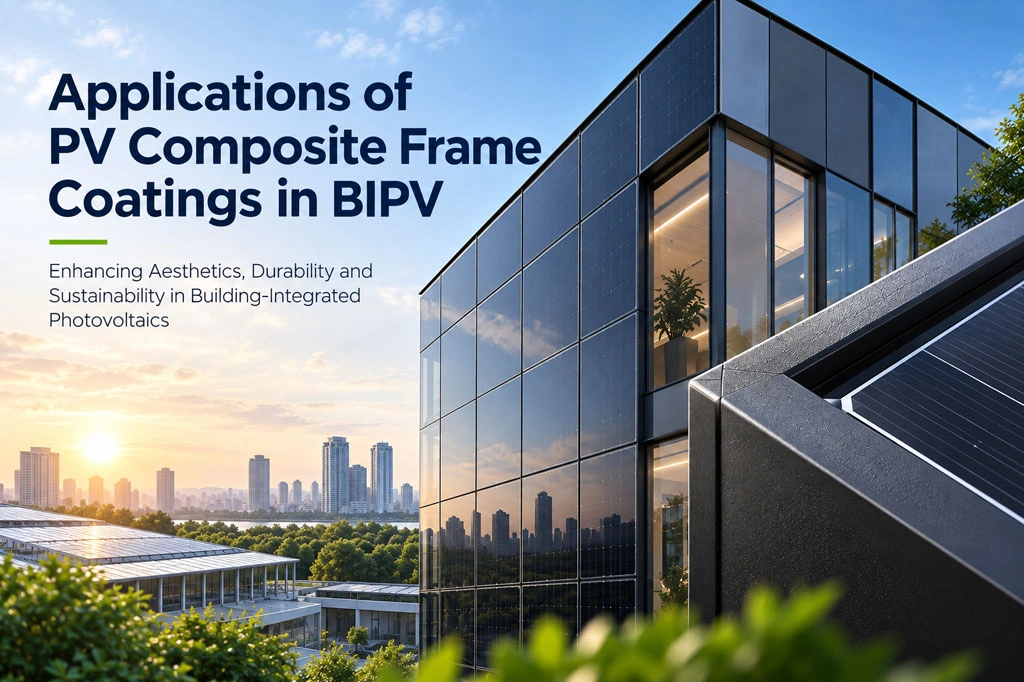
As photovoltaic technology becomes increasingly integrated with architectural design, BIPV (Building-Integrated Photovoltaics) is expanding beyond conventional rooftop solar systems into building façades, skylights, shading systems, balcony façades, and other parts of the building envelope.
Unlike conventional ground-mounted PV power plants, BIPV modules not only generate electricity but may also serve as part of a building façade or envelope system. As a result, BIPV places higher requirements on the appearance consistency, structural reliability, weather resistance, and long-term stability of photovoltaic modules.
Against this background, PV module frames are no longer simply structural support components. As new frame materials such as glass fiber-reinforced composites are increasingly adopted, surface coatings have become an important factor affecting both the appearance and environmental durability of PV composite frames.
Why Does BIPV Place Greater Emphasis on PV Frame Surface Performance?
Conventional photovoltaic power plants generally focus on power generation efficiency, module reliability, and levelized cost of electricity. BIPV, however, has a much stronger architectural dimension.
For example, in commercial building façades, public building exteriors, and high-end residential BIPV projects, photovoltaic modules often form a visible part of the building itself. The module glass, frames, joints, and curtain wall structures therefore need to create a coordinated and consistent appearance.
This means BIPV module frames usually need to meet several key requirements.
1. Higher Appearance Consistency
Building curtain walls may consist of dozens or even hundreds of photovoltaic modules.
If obvious color differences, gloss variations, or surface defects exist between frames, the visual appearance of the entire façade may be affected even when module power generation remains unchanged.
Coatings used for BIPV composite frames therefore need to provide good color consistency and stable surface appearance so that frames produced in large volumes maintain a relatively uniform visual effect.
This is particularly important for increasingly common black BIPV modules, all-black modules, and dark-colored building façades, where the frame usually needs to coordinate with the overall module color.
2. Long-Term Outdoor Weather Resistance
BIPV modules are typically exposed to outdoor environments over extended periods.
Depending on the building location, PV frames may continuously face:
- UV radiation;
- High- and low-temperature cycling;
- Rain and high-humidity environments;
- Wind-blown sand and dust;
- Industrial pollution;
- High humidity and salt spray in coastal areas.
At the same time, because BIPV modules are more closely integrated into the building envelope, certain installation configurations may provide less rear ventilation than conventional open-rack PV systems. This can result in higher operating temperatures and more complex long-term aging conditions. Related studies have also indicated that reduced rear ventilation in BIPV systems may increase module operating temperatures, creating additional challenges for long-term material reliability.
For this reason, coatings applied to composite frames need to provide strong outdoor weather resistance and stable surface protection for the underlying frame material.
3. Compatibility with Composite Substrates
As the photovoltaic industry continues to pursue lighter module structures and material innovation, glass fiber-reinforced composites are emerging as a new option for PV module frames.
Compared with traditional metallic materials, composite materials differ significantly in surface condition, wettability, and coating requirements.
Therefore, not all conventional coatings developed for metal substrates can be directly applied to PV composite frames.
Specialized coatings for composite frames need to take several factors into consideration, including:
- Adhesion between the coating and composite substrate;
- Substrate surface pretreatment requirements;
- Spray application performance;
- Curing conditions;
- Coating hardness;
- Surface smoothness;
- Color difference and gloss control.
Only when the coating system is properly matched with the composite frame substrate, primer, and manufacturing process can consistent performance be achieved in mass production.
4. Meeting the Architectural Aesthetic Requirements of BIPV
One of the biggest differences between BIPV and conventional photovoltaics is the importance of architectural design.
Traditional PV modules generally aim for a standardized industrial appearance, while BIPV modules may need to be customized in terms of size, color, texture, and overall visual effect according to the architectural design.
For example, a black BIPV curtain wall may require low-gloss black frames to minimize unwanted reflections. Other building projects may place greater emphasis on visual coordination between the module frames, glass, and curtain wall support structures.
As a result, PV composite frame coatings not only provide material protection but are also becoming part of the overall BIPV appearance design system.
By controlling color, gloss, and surface quality, composite frames can be integrated more naturally into the architectural façade.
Main Functions of PV Composite Frame Coatings in BIPV
From a practical application perspective, composite frame coatings mainly perform the following functions in BIPV modules.
Improving Composite Frame Surface Quality
After molding, composite materials may exhibit visible fiber patterns, slight surface irregularities, or other surface characteristics.
Through appropriate primer application, sanding, and topcoat processes, the uniformity and visual quality of composite frame surfaces can be improved, making them more suitable for BIPV projects with higher aesthetic requirements.
Providing Long-Term Surface Protection
The coating forms a protective layer between the composite substrate and the external environment, helping reduce the direct effects of ultraviolet radiation, moisture, and other environmental factors on the substrate surface.
For BIPV projects located in coastal regions, industrial areas, or high-humidity environments, the salt spray resistance, damp heat resistance, and corrosion resistance of the coating system should also be further verified according to the actual project conditions.
Enhancing the Overall Appearance of PV Modules
For all-black modules, black curtain wall modules, and similar BIPV products, the frame color is an important part of the overall module appearance.
When the glass, cell area, and frame create a consistent dark-colored visual effect, the visual segmentation caused by the frame can be reduced, allowing the photovoltaic modules to integrate more naturally into the building design.
Improving Consistency in Mass Production
BIPV projects often require large numbers of modules to form a continuous building façade, making color and gloss consistency between production batches especially important.
Stable coating formulations and spray processes help control frame color differences and surface quality, improving consistency during large-volume module delivery.
Betterial WSD-3102 PV Composite Frame Coating
In line with the development trends of BIPV modules, Betterial WSD-3102 PV Composite Frame Coating can be applied in a variety of building-integrated photovoltaic applications, including:
BIPV Building Façades
Building façades are among the most appearance-sensitive photovoltaic applications. Black composite frames can coordinate with dark photovoltaic glass and curtain wall systems to create a more consistent overall visual effect.
BIPV Roofs
Industrial, commercial, and public building roofs are increasingly adopting building-integrated photovoltaic designs. Surface coating of composite frames can further improve their surface stability under long-term outdoor exposure.
Photovoltaic Skylights
Photovoltaic skylights used in airports, railway stations, commercial centers, and public buildings often emphasize both architectural design and clean energy generation. The color and surface quality of module frames can directly influence the overall appearance.
Photovoltaic Shading Systems
Photovoltaic louvers, canopies, carports, and other architectural shading structures are often installed in highly visible locations. As a result, they also place high requirements on frame appearance consistency and weather resistance.
Final Words
As BIPV continues to develop, photovoltaic modules are gradually evolving from conventional power-generating equipment installed on buildings into genuine building materials.
This means photovoltaic modules must not only deliver reliable power generation performance but also meet architectural requirements for structural safety, durability, appearance, and environmental adaptability.
The same trend applies to photovoltaic module frames.
Future BIPV frames will need to achieve a better balance between lightweight design, mechanical performance, weather resistance, and architectural aesthetics. New materials such as glass fiber-reinforced composite frames provide additional possibilities for module lightweighting and material innovation, while specialized coatings designed for these materials play an important role in improving surface quality, providing environmental protection, and achieving consistent visual appearance.