
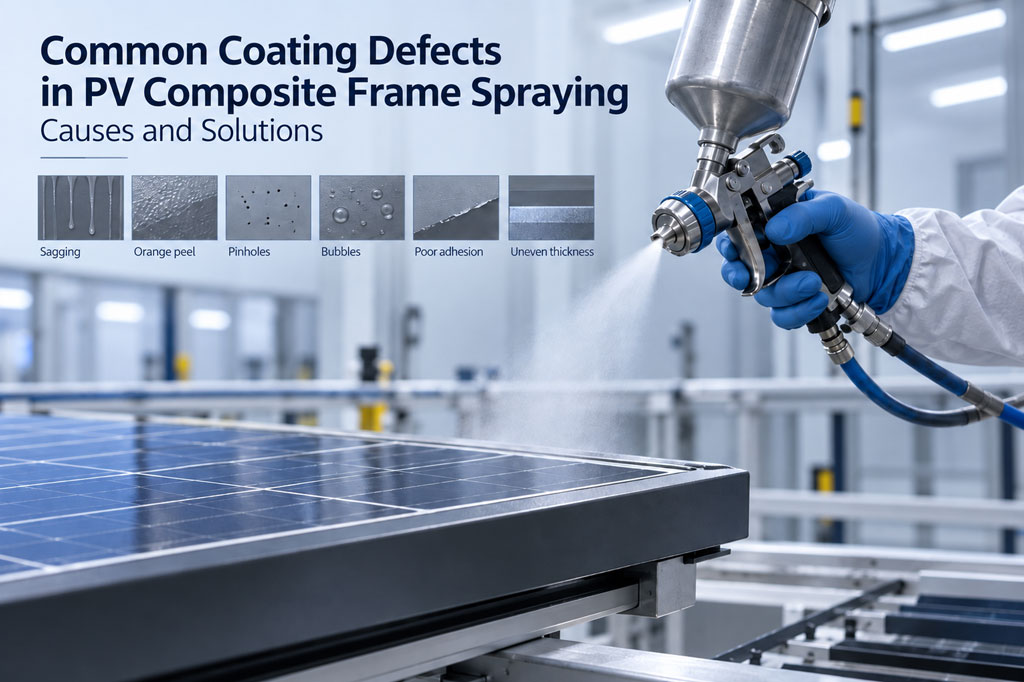
To improve the weather resistance, protective performance, surface appearance, and long-term reliability of PV composite frames, coatings are typically applied to the frame surface by spraying.
However, the surface characteristics of composite materials, coating viscosity, spraying parameters, application environment, and curing conditions can all affect the final coating quality. If the process is not properly controlled, defects such as sagging, orange peel, pinholes, bubbles, poor adhesion, and color variation may occur.
This article summarizes some of the most common coating defects encountered during PV composite frame spraying, analyzes their possible causes, and provides corresponding solutions.
1. Coating Sagging
1.1 Defect Appearance
After spraying, the coating flows downward under the influence of gravity, forming visible streaks, waves, or tear-shaped marks on vertical surfaces, corners, or localized areas of the frame.
Sagging not only affects appearance but may also result in excessive local film thickness, which can further affect coating curing and overall performance.
1.2 Common Causes
Possible causes include:
- Excessive film thickness in a single spray pass;
- Spray gun positioned too close to the workpiece;
- Spray gun movement speed too slow;
- Coating viscosity too low;
- Excessive addition of thinner;
- Improper spray pressure or coating output settings;
- Insufficient flash-off time between coats;
- Low application temperature, resulting in slower solvent evaporation.
1.3 Solutions
The amount of coating applied in each pass should be carefully controlled. Multiple thin coats are generally preferable to one heavy coat.
Coating viscosity, spray gun distance, gun movement speed, and material output should also be adjusted according to the recommended application parameters. Sufficient leveling and flash-off time should be provided between spray passes.
For composite frames with complex profiles, particular attention should be paid to vertical surfaces, corners, and grooves to prevent the spray gun from remaining in one area for too long.
2. Orange Peel
2.1 Defect Appearance
The sprayed coating surface appears uneven, with a fine textured pattern resembling the surface of an orange peel, reducing surface smoothness and visual consistency.
Minor orange peel may not significantly affect protective performance, but severe orange peel can noticeably reduce the appearance quality of the finished frame.
2.2 Common Causes
Typical causes include:
- Coating viscosity is too high;
- Insufficient coating atomization;
- Spray gun is positioned too far from the workpiece;
- Improper spray pressure;
- Insufficient coating application;
- Solvent evaporates too quickly;
- Application temperature is too high;
- Insufficient leveling time after spraying.
2.3 Solutions
First, the coating viscosity should be adjusted according to the recommended application requirements to ensure suitable sprayability.
Air pressure, spray nozzle size, spray gun distance, and spraying speed should also be optimized to improve atomization uniformity.
If the application temperature is relatively high, excessively fast-evaporating solvents should be avoided, and sufficient leveling time should be provided.
3. Pinholes and Craters
3.1 Defect Appearance
Small pin-sized holes appear on the coating surface, or localized circular or crater-shaped depressions develop.
Severe pinholes and craters can interrupt coating continuity and expose the composite substrate locally, reducing the overall protective effectiveness of the coating.
3.2 Common Causes
Possible causes include:
- Oil, release agents, silicone contaminants, or other residues on the substrate surface;
- Dust or other contaminants not completely removed;
- Excessive coating thickness in a single application;
- Air or volatile substances escaping from the underlying layer during curing;
- High porosity of the composite substrate;
- Insufficient defoaming performance of the coating;
- Contaminated coating, solvent, or compressed air.
For composite material frames, microscopic pores within or on the surface of the substrate may also be an important cause of pinhole formation.
3.3 Solutions
Before spraying, the composite frame surface should be thoroughly cleaned to remove oil, release agents, dust, and other contaminants.
For substrates with relatively high porosity, a sealing primer, suitable undercoat, or multiple thin spray passes may be used depending on the actual process requirements.
The film thickness of each coat should also be controlled, sufficient flash-off should be ensured, and the compressed air supply should be checked to make sure it is clean and dry.
4. Bubbles
4.1 Defect Appearance
Circular raised areas of different sizes appear on the coating surface. Some bubbles may rupture during curing, subsequently forming pinholes or depressions.
4.2 Common Causes
Common causes include:
- Moisture on or within the substrate;
- Excessive environmental humidity;
- Excessive coating thickness;
- Air trapped in the underlying layer;
- Curing temperature rises too quickly;
- Excessive air introduced into the coating during mixing;
- Insufficient flash-off time.
4.3 Solutions
The substrate should be completely dry before coating, and the temperature and humidity of the spraying area should be properly controlled.
After mixing, the coating should be allowed to stand for an appropriate period or undergo necessary deaeration to minimize entrapped air.
If heated curing is used, rapid temperature increases should be avoided. Proper flash-off and gradual heating can help reduce bubble formation.
5. Poor Coating Adhesion
5.1 Defect Appearance
The coating peels or flakes off easily, or delamination occurs during cross-cut testing, tape testing, mechanical impact, or subsequent processing.
For PV modules exposed to outdoor environments over long periods, coating adhesion is one of the most important fundamental performance requirements for composite frames.
5.2 Common Causes
Possible causes include:
- Dust, oil, or release agents remaining on the substrate surface;
- Low surface energy;
- Excessively smooth substrate surface;
- Insufficient surface pretreatment;
- Poor compatibility between the coating and composite substrate;
- Incomplete curing;
- Unsuitable application temperature or humidity;
- Compatibility problems between primer and topcoat.
5.3 Solutions
Proper substrate surface preparation is essential before spraying.
Depending on the type of composite frame material, cleaning, sanding, plasma treatment, flame treatment, or a compatible primer may be used to improve surface condition and coating adhesion.
A coating system specifically developed for composite materials and offering good substrate compatibility should also be selected, and curing should be completed strictly according to the recommended conditions.
6. Uneven Coating Thickness
6.1 Defect Appearance
Significant film thickness differences appear across different areas of the frame. Some areas may be excessively thick, while others may be too thin or even insufficiently covered.
This problem is particularly common around corners, grooves, inner surfaces, and connection areas of composite frame profiles.
6.2 Common Causes
Typical causes include:
- Unstable spray gun movement speed;
- Continuous variation in the distance between the gun and workpiece;
- Inconsistent spraying angle;
- Improper spray overlap ratio;
- Poorly designed automated spraying path;
- Spray shadow areas caused by complex frame geometry;
- Worn or clogged spray nozzle.
6.3 Solutions
A stable spray gun distance, movement speed, and spraying angle should be maintained as consistently as possible.
When automated spraying equipment is used, spray gun paths, cycle times, and overlap areas can be optimized to improve film thickness consistency across the frame.
Corners, grooves, and other complex areas can be treated with targeted touch-up spraying, while avoiding excessive local film build.
7. Show-Through or Missed Areas
7.1 Defect Appearance
Certain areas are not completely covered by the coating, allowing the original color of the composite substrate to remain visible, or causing visibly lighter-colored areas.
7.2 Common Causes
Common causes include:
- Insufficient coating application;
- Inadequate overlap between spray passes;
- Structural areas blocked from the spray pattern;
- Corners and complex areas not properly touch-sprayed;
- Insufficient hiding power of the coating;
- Significant color difference between the substrate and topcoat.
7.3 Solutions
The spray path should be properly designed according to the frame geometry to ensure consistent overlap between adjacent spray patterns.
Inner corners, end surfaces, grooves, and other difficult-to-cover areas should receive targeted pre-spraying or touch-up spraying before or after the main surface is coated.
Where necessary, a compatible primer may also be used to improve overall hiding power and color consistency.
8. Particles and Rough Surface
8.1 Defect Appearance
Visible particles, raised points, or a rough texture appear on the coating surface, negatively affecting both appearance and touch.
8.2 Common Causes
Possible causes include:
- Excessive dust in the spraying environment;
- Insufficient substrate cleaning;
- Inadequate coating filtration;
- Dried coating or contaminants inside the spray gun;
- Insufficient compressed air filtration;
- Dry spray during application;
- Spray mist drying in the air and redepositing on the workpiece surface.
8.3 Solutions
The cleanliness of the spraying area should be carefully controlled, and dust should be thoroughly removed from the frame before coating.
The coating should be filtered according to process requirements before use, while spray guns, pipelines, and coating supply systems should be cleaned regularly.
Proper control of spray gun distance, ambient temperature, and airflow can also reduce surface roughness caused by dry spray.
9. Color Variation and Inconsistent Gloss
9.1 Defect Appearance
Different areas of the same composite frame, or different production batches, may show variations in color depth, gloss level, or localized uneven appearance.
These defects are particularly noticeable on black or dark-colored PV frames and on products with high appearance requirements.
9.2 Common Causes
Possible causes include:
- Insufficient coating mixing;
- Variation between coating batches;
- Uneven film thickness;
- Changes in spraying parameters;
- Differences in curing temperature or curing time;
- Variation in substrate color;
- Significant changes in the spraying environment.
9.3 Solutions
The coating should be thoroughly mixed before use, and the same raw materials and application conditions should be maintained as consistently as possible within the same production batch.
Film thickness, spray distance, spraying speed, and curing conditions should also remain stable.
For products with strict color requirements, standard color samples, gloss standards, and batch inspection procedures can be established.
10. Coating Cracking
10.1 Defect Appearance
Fine cracks or obvious fractures appear on the coating surface. They may develop immediately after curing or gradually appear after thermal cycling or long-term outdoor exposure.
10.2 Common Causes
Possible causes include:
- Excessive film thickness in a single coat;
- Insufficient coating flexibility;
- Over-curing;
- Mismatch between the thermal expansion characteristics of the coating and substrate;
- Deformation of the composite frame;
- Incompatibility between primer and topcoat systems.
10.3 Solutions
An appropriate film thickness should be maintained, and a coating system with good flexibility, weather resistance, and compatibility with the composite substrate should be selected.
For PV composite frames intended for long-term outdoor use, the coating system should also be validated through reliability testing such as thermal cycling, damp heat, and UV aging, rather than evaluating only its initial appearance.
11. Insufficient Curing or Tackiness
11.1 Defect Appearance
After the specified curing period, the coating remains soft or tacky, easily attracts dust, develops pressure marks, or interferes with packaging and subsequent assembly.
11.2 Common Causes
Possible causes include:
- Insufficient curing time;
- Curing temperature is too low;
- Incorrect mixing ratio in a two-component coating system;
- Excessive coating thickness;
- Low ambient temperature or high humidity;
- Coating has exceeded its pot life;
- Insufficient mixing of coating components.
11.3 Solutions
During application, the recommended mixing ratio, mixing procedure, induction time, pot life, and curing conditions should be strictly controlled.
For baking or heat-curing processes, attention should be paid to the actual temperature of the workpiece rather than relying only on the air temperature displayed by the curing equipment.
Recording curing temperature, curing time, and production cycle parameters can help improve consistency between different production batches.
Conclusion
The spraying quality of PV composite frames is not determined by a single parameter. Instead, it results from the combined effects of the substrate, coating material, spraying equipment, application environment, and process conditions.
Common defects such as sagging, orange peel, pinholes, bubbles, poor adhesion, uneven film thickness, color variation, and cracking can usually be significantly reduced through proper substrate pretreatment, stable coating preparation, optimized spraying parameters, and controlled flash-off and curing conditions.
For mass production of PV composite frames, combining a suitable coating system with a stable and repeatable spraying process is essential to reducing coating defects, improving appearance consistency, and increasing overall production yield.