
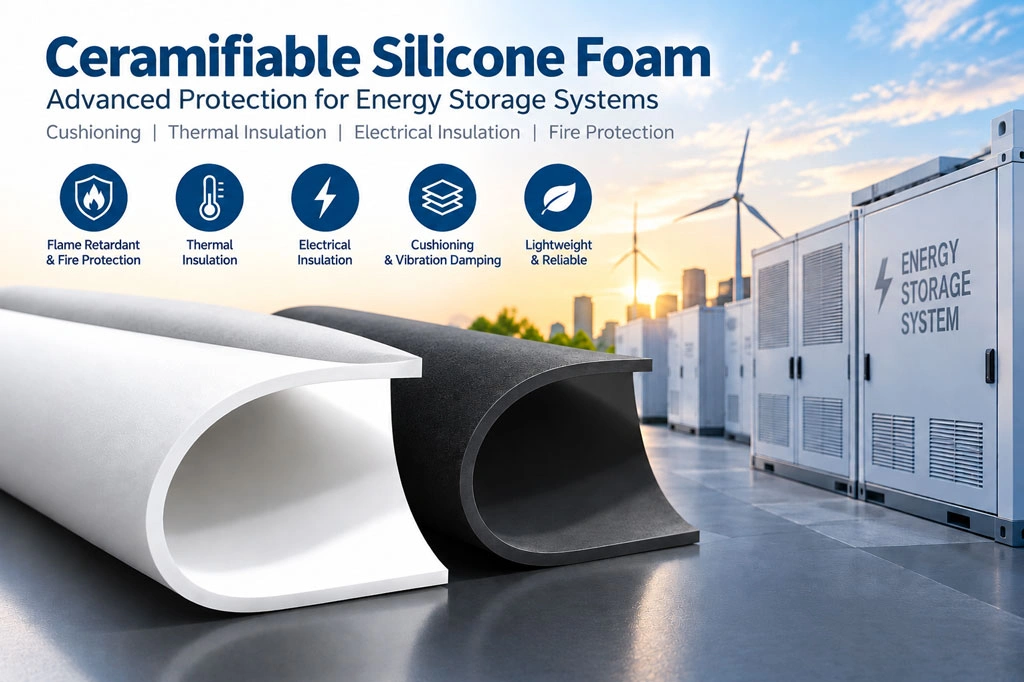
As lithium-ion battery energy storage systems continue to evolve toward higher energy density, larger capacity, and greater system integration, thermal safety inside battery systems is receiving increasing attention. When an individual cell experiences abnormal temperature rise or even thermal runaway, high temperatures, flames, and heat may propagate to adjacent cells and other components, increasing the safety risks of the entire battery module or battery pack.
Therefore, in addition to electrical safety and thermal management design, energy storage systems require a passive safety protection system built with flame-retardant, thermal insulation, cushioning, and electrical insulation materials.
Ceramifiable silicone foam is an important functional material for this purpose. It combines the flexible cushioning, thermal insulation, and electrical insulation properties of silicone foam with fire protection capabilities under high-temperature conditions. It can be used for sealing, cushioning, vibration damping, fire and thermal insulation, and electrical insulation in energy storage batteries and new energy vehicle power battery systems.
What Is Ceramifiable Silicone Foam?
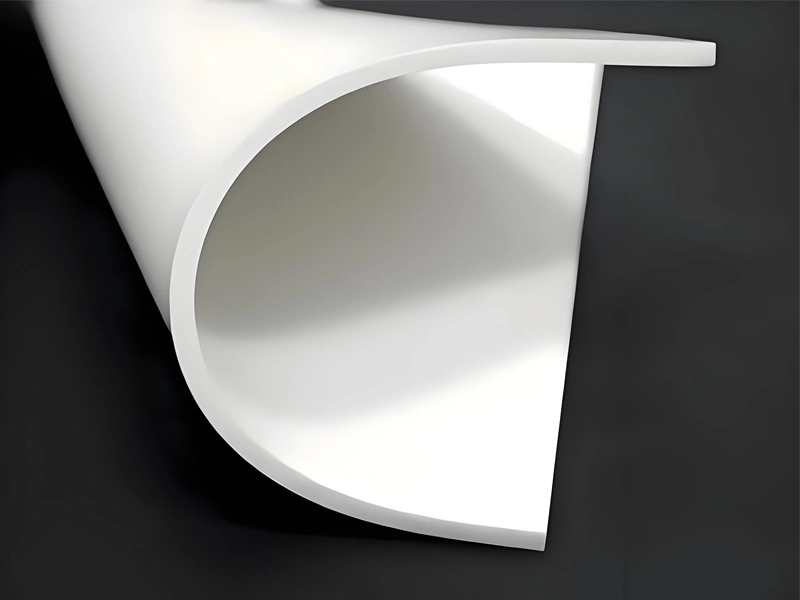
Ceramifiable silicone foam is a functional foam material developed based on a silicone rubber system.
Under normal operating conditions, it maintains the flexibility and elasticity of a foam material. Through compression and deformation, it can accommodate assembly gaps inside battery systems while providing cushioning, vibration damping, sealing, and thermal insulation.
An important characteristic of ceramifiable silicone foam is that, when exposed to abnormal high temperatures or flames, it can provide additional fire resistance and thermal insulation protection, helping reduce the risk of heat and flame spreading to surrounding areas.
Compared with conventional foam materials that perform only a single cushioning or sealing function, ceramifiable silicone foam can provide multiple safety protection functions simultaneously. This makes it particularly suitable for battery systems with demanding requirements for fire protection, thermal insulation, electrical insulation, and long-term reliability.
Why Do Energy Storage Systems Need Ceramifiable Silicone Foam?
Large-scale energy storage systems typically consist of numerous battery cells that are further integrated into modules, packs, and energy storage cabinets.
As system integration increases, more cells are arranged within a limited space. If a cell experiences an internal short circuit, overcharging, mechanical damage, or another abnormal condition that leads to thermal runaway, the resulting high temperatures may affect nearby cells and structural components.
One important objective of energy storage safety design is to minimize the possibility of a localized abnormal event developing into a larger-scale incident.
This means that battery protection materials must not only meet the requirements of normal operation but also perform effectively under extreme conditions.
Under normal operating conditions, materials should provide:
- Good compression and recovery performance;
- Cushioning and vibration damping;
- Thermal insulation;
- Electrical insulation;
- Low long-term compression set;
- Stable environmental adaptability.
Under abnormal high-temperature conditions, materials are also expected to provide additional flame-retardant, fire-resistant, and thermal insulation protection.
Ceramifiable silicone foam is designed specifically to meet this requirement: structural protection under normal operating conditions and enhanced safety protection under abnormal conditions.
Key Properties of Ceramifiable Silicone Foam
1. Flame Retardancy and Fire Protection
Energy storage batteries contain numerous electrical components and high-energy-density cells, making the flame-retardant properties of materials particularly important.
Betterial ceramifiable silicone foam achieves a UL 94 V-0 flame-retardant rating, making it suitable for power battery and energy storage systems with demanding flame-retardancy requirements.
When abnormal high temperatures occur inside a battery system, the material can serve as part of the system’s passive fire protection design, helping reduce the risk of flames and high temperatures spreading to surrounding areas.
2. Good Thermal Insulation Performance
In addition to flames themselves, heat propagation is another critical factor that must be controlled during the spread of battery thermal runaway.
Betterial ceramifiable silicone foam has a thermal conductivity of ≤0.12 W/(m·K), allowing it to create a thermal barrier between different battery structures.
By properly positioning thermal insulation materials, direct heat transfer between different areas can be reduced, providing an additional thermal safety barrier for energy storage battery systems.
3. Electrical Insulation Performance
Energy storage systems must not only control heat transfer but also prevent unnecessary electrical contact between different conductive components.
Betterial ceramifiable silicone foam provides a volume resistivity of ≥1.0 × 10¹⁴ Ω·cm and a dielectric breakdown strength of ≥2.0 kV/mm.
As a result, the material can provide mechanical cushioning and thermal insulation while also meeting electrical insulation requirements. This can help reduce the complexity associated with adding multiple materials for different functions within a battery system.
4. Cushioning and Vibration Damping
Energy storage batteries may experience vibration, impact, and structural stress during manufacturing, transportation, installation, and long-term operation.
Silicone foam has inherent compressibility, allowing it to fill gaps between battery structures and absorb part of the mechanical stress through material deformation.
Betterial’s product provides a compression force deflection of 120 ± 30 kPa at 25% compression and a tensile strength of ≥280 kPa.
Therefore, it is not only a fire-resistant and thermal insulation material but can also provide structural cushioning and vibration damping.
5. Low Compression Set
For energy storage systems designed for long-term operation, good initial material performance alone is not sufficient. More importantly, the material must retain the necessary support and sealing capabilities after prolonged use.
Betterial ceramifiable silicone foam has a compression set of ≤5.0% under conditions of 100°C, 50% compression, and 22 hours.
A low compression set helps the material maintain structural stability over time, reducing the risk of functional degradation caused by significant collapse after prolonged compression.
6. Lightweight Design
Adding safety materials inside a battery system often means adding extra weight, so an appropriate balance must be achieved between safety performance and lightweight design.
Betterial ceramifiable silicone foam has a specific gravity of 0.37 ± 0.04. Its foam structure helps reduce material weight while simultaneously providing cushioning, thermal insulation, electrical insulation, and flame retardancy.
This offers practical benefits for new energy vehicle power batteries and energy storage equipment where system weight and space utilization are important considerations.
Main Functions of Ceramifiable Silicone Foam in Energy Storage Systems
From a functional perspective, ceramifiable silicone foam is not simply a “fireproof material.” Instead, it is a multifunctional battery protection material.
In practical energy storage systems, it can perform the following functions:
- Cushioning and vibration damping: The foam structure absorbs vibration and mechanical impact, reducing mechanical stress on battery components.
- Sealing and gap filling: It fills gaps between different structural components and accommodates dimensional tolerances through compression and deformation.
- Thermal insulation: It reduces heat transfer between cells, modules, or different structural areas.
- Flame retardancy and fire protection: It provides additional passive safety protection under abnormal high-temperature or flame conditions.
- Electrical insulation: It isolates different electrical components and reduces the risk of unintended conductive contact.
- Noise reduction: The cushioning characteristics of the foam material help reduce certain types of structural vibration and noise.
By enabling a single material to perform multiple functions, ceramifiable silicone foam can help battery system designers achieve a better balance among safety performance, structural space, material quantity, and assembly complexity.
Where Can Ceramifiable Silicone Foam Be Used?
Ceramifiable silicone foam can be cut and designed according to different battery structures and used at the cell, module, and pack levels, as well as in other locations requiring fire protection, thermal insulation, and cushioning.
Typical applications in energy storage systems include:
- Thermal insulation and cushioning between battery modules;
- Sealing and gap filling between structural components inside battery packs;
- Cushioning between battery covers and internal components;
- Electrical insulation protection around electrical components;
- Structural areas requiring flame retardancy, thermal insulation, and vibration damping;
- Thermal safety protection structures for energy storage batteries.
In addition to energy storage systems, this type of material can also be used in new energy vehicle power batteries, electronic equipment, rail transportation, and other applications with demanding requirements for flame retardancy, thermal insulation, and electrical insulation.
Betterial Ceramifiable Silicone Foam
To address the safety protection requirements of power batteries and energy storage systems, Betterial offers CSF-040C Ceramifiable Silicone Foam.
The product is available in black and white, with a thickness range of 1–6 mm. It can be used for sealing, vibration damping, fire and thermal insulation, electrical insulation, and noise reduction in battery systems.
The product achieves a UL 94 V-0 flame-retardant rating and complies with RoHS 2.0 requirements.
Key Technical Specifications
| Property | Specification |
|---|---|
| Color | Black, White |
| Thickness | 1–6 mm |
| Specific Gravity | 0.37 ± 0.04 |
| Water Absorption | ≤5.0% |
| 25% Compression Force Deflection | 120 ± 30 kPa |
| Tensile Strength | ≥280 kPa |
| Elongation at Break | ≥20% |
| Compression Set | ≤5.0% |
| Flame-Retardant Rating | UL 94 V-0 |
| Environmental Standard | RoHS 2.0 |
| Volume Resistivity | ≥1.0 × 10¹⁴ Ω·cm |
| Dielectric Breakdown Strength | ≥2.0 kV/mm |
| Thermal Conductivity | ≤0.12 W/(m·K) |
Conclusion
As energy storage batteries continue to develop toward higher energy density and greater system integration, battery safety materials are expected to perform an increasing number of functions.
Traditional materials may address only one requirement, such as cushioning, electrical insulation, or thermal insulation. However, next-generation energy storage safety design increasingly requires materials to combine mechanical cushioning, thermal management, electrical insulation, flame retardancy, fire protection, and long-term reliability.
By combining a flexible foam structure with fire-resistant and thermal insulation properties, ceramifiable silicone foam can provide cushioning, sealing, thermal insulation, and electrical insulation during normal operation while offering additional safety protection under abnormal high-temperature conditions.
For large-scale energy storage systems and new energy vehicle power batteries, this multifunctional material can contribute to a multi-layer safety protection system covering both normal operation and abnormal operating conditions.