
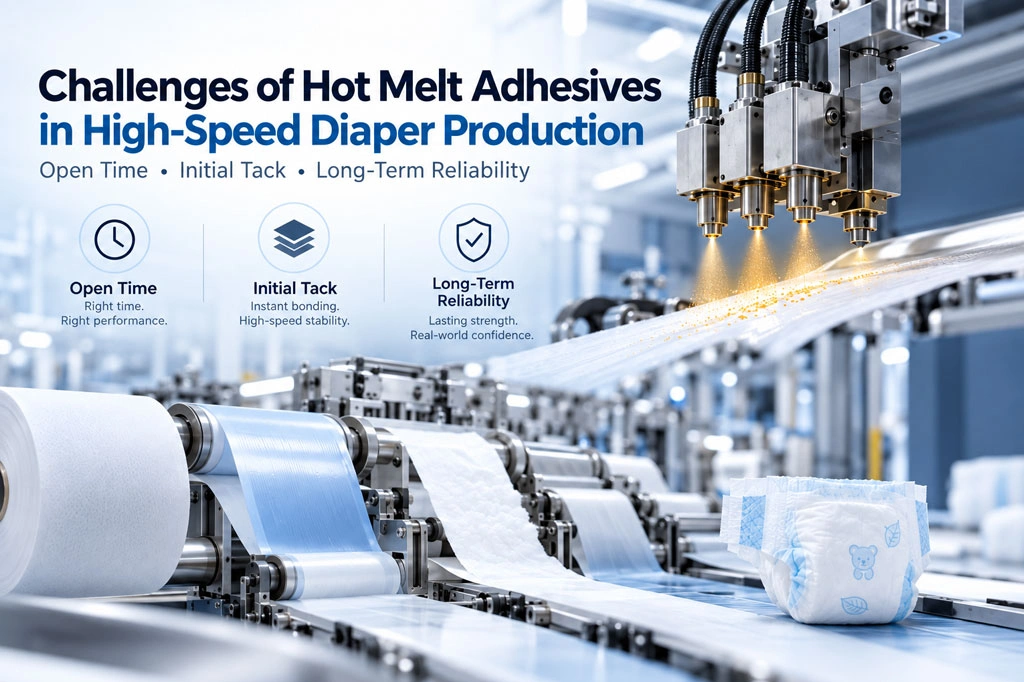
Modern diaper manufacturing is moving toward higher production speeds, thinner product structures, and greater levels of automation. On a high-speed production line, nonwoven fabrics, breathable PE films, absorbent cores, elastic materials, and other components must go through unwinding, adhesive application, laminating, pressing, cutting, and packaging within a very short period of time.
As production speeds increase, the seemingly simple process of “bonding” becomes much more demanding.
For hygiene hot melt adhesives, high bonding strength alone is no longer sufficient for high-speed diaper manufacturing. The adhesive must also quickly wet the substrate and form an effective bond within a limited processing window while maintaining a suitable balance among open time, initial tack, long-term reliability, and stable continuous spraying performance.
Among these factors, open time, initial tack, and long-term reliability are three particularly important considerations in high-speed diaper production.
1. Why Does High-Speed Production Place Higher Demands on Diaper Hot Melt Adhesives?
In diaper manufacturing, hot melt adhesives are commonly used in several areas, including:
- Structural bonding between nonwoven fabrics and backsheet films;
- Fixation of absorbent cores and other structural layers;
- Bonding of elastic materials used in waistbands and leg cuffs;
- Other areas requiring positioning, lamination, or structural stabilization.
At relatively low production speeds, there is generally a wider processing window between adhesive application and the point at which two materials are fully laminated together.
However, as line speeds increase, this available time window becomes significantly shorter.
After leaving the nozzle, the hot melt adhesive may pass through the following stages:
Molten adhesive spraying → contact with the first substrate → conveying → lamination with the second substrate → pressing → cooling and solidification
The entire process may take place within a very short period of time.
If the adhesive cools too quickly, it may lose sufficient wetting ability before the second substrate is laminated. If initial tack develops too slowly, the materials may shift during subsequent high-speed conveying. On the other hand, if the formulation focuses only on rapid initial bonding while neglecting aged bonding performance, the structural stability of the diaper during storage and actual use may be compromised.
Therefore, high-speed production requires a well-balanced adhesive system rather than simply maximizing a single performance parameter.
Challenge 1: Open Time Must Match the High-Speed Lamination Window
Open time can generally be understood as the period after the hot melt adhesive has been applied during which it can still form an effective bond with another substrate.
This parameter is especially important in high-speed diaper production.
After being sprayed onto a nonwoven fabric, PE film, or other substrate, the adhesive does not maintain the same flow and wetting characteristics indefinitely. As its temperature decreases, its viscosity gradually increases until it no longer has sufficient ability to wet the bonding interface.
If the effective open time is too short while there is a certain distance between the adhesive application point and the lamination point, several problems may occur:
- The adhesive layer cools too early before lamination;
- Insufficient wetting of the second substrate;
- Reduced effective bonding area;
- Localized weak bonding;
- Subsequent delamination, lifting, or adhesive failure.
However, a longer open time is not always better.
If the adhesive remains excessively tacky for too long, it may interfere with downstream material conveying, lamination, and processing. Therefore, the key is to match the open time with the actual line speed, adhesive application position, lamination distance, ambient temperature, and substrate characteristics.
High-Speed Production Further Narrows the Processing Window
For example, with the same distance between the adhesive application point and the pressing point, changes in production speed will directly affect the actual time available before lamination.
Therefore, when selecting a hygiene hot melt adhesive, open time should not simply be evaluated as “long” or “short” independently of production conditions. Instead, manufacturers should consider:
Can the adhesive maintain suitable wetting and bonding performance within the actual lamination time window of the production line?
This is the real significance of open time in high-speed diaper manufacturing.
Challenge 2: Initial Tack Determines Whether Materials Can Be Fixed Immediately
If open time determines whether there is still enough time to create a bond, initial tack addresses another important question:
Once the materials come into contact, can they be fixed in position immediately?
A high-speed diaper production line does not stop after lamination to wait for the adhesive to cool completely or reach its final bond strength.
Once the materials have been pressed together, they immediately move into subsequent conveying, folding, cutting, or other processing stages. Therefore, the adhesive needs to develop sufficient initial bonding strength very quickly.
What Problems Can Insufficient Initial Tack Cause?
If initial tack is too low, the materials may already be in contact but can still shift relative to each other when exposed to high-speed tension, variations in web tension, or subsequent mechanical forces.
Potential issues include:
- Local displacement between the nonwoven fabric and backsheet film;
- Lifting at material edges;
- Movement of the intended bonding position;
- Unstable fixation of elastic materials;
- Reduced consistency of the finished product structure.
In a conventional structural bonding application, this may appear to be only a minor adhesion issue. However, on a high-speed continuous production line, small bonding instabilities can develop into large-scale quality problems when production continues over time.
Higher Initial Tack Is Not Always Better
Hot melt adhesive formulations need to balance initial tack with open time, cohesive strength, heat resistance, and final bonding performance.
Excessive emphasis on one property may compromise another.
For this reason, high-speed diaper manufacturing does not simply require a “high-tack hot melt adhesive.” What is needed is an adhesive system that can rapidly develop sufficient initial fixation under the target line speed and actual processing conditions.
Challenge 3: The Bond Must Remain Reliable Long After High-Speed Production
An adhesive bond that performs well on the production line does not necessarily maintain the same performance after several months of storage.
From manufacturing to final consumer use, diapers typically pass through warehousing, transportation, retail distribution, and household storage.
During this period, the adhesive structure may be exposed to:
- Different storage temperatures;
- High-temperature transportation conditions;
- Continuous internal stresses within the product;
- Long-term retraction forces from elastic materials;
- Differences in surface properties among nonwovens, PE films, and other substrates;
- Aging of the adhesive itself.
Therefore, hygiene hot melt adhesives also need to provide good long-term reliability.
1. Aging Resistance
Over time, the properties of the hot melt adhesive may gradually change. A well-designed hygiene hot melt adhesive should maintain stable bonding performance under appropriate storage and use conditions, helping reduce the risk of bond strength loss caused by adhesive aging.
2. Thermal Stability
Diapers may experience relatively high ambient temperatures during logistics and warehousing.
If the adhesive has insufficient heat resistance, the adhesive layer may soften, cohesive strength may decrease, or overall bonding stability may deteriorate.
Therefore, adhesive evaluation should not focus only on bonding performance immediately after production at room temperature. The effects of temperature variations under actual application conditions should also be considered.
3. Holding Power and Creep Resistance
In areas subject to continuous stress, the adhesive layer must do more than simply “hold the materials together.” It must also resist gradual displacement caused by prolonged loading.
This is particularly important in structures involving elastic materials, where continuous retraction forces are applied to the bonding interface. If the adhesive lacks sufficient cohesive strength and creep resistance, gradual movement or structural changes may occur over time.
Conclusion
High-speed diaper manufacturing has raised the requirements for hot melt adhesives from simply “bonding securely” to achieving a more comprehensive balance of performance.
After application, the adhesive needs to maintain an appropriate open time so that materials can still be effectively laminated while moving at high speed. Once the substrates come into contact, it must quickly develop sufficient initial tack to prevent displacement during downstream conveying and processing. After the finished product leaves the production line, good heat resistance, aging resistance, and creep resistance are also required to maintain long-term bonding reliability.
Therefore, for high-speed diaper manufacturing, the real requirement for hygiene hot melt adhesives is to achieve an effective balance among:
Suitable open time, rapid initial tack, long-term bonding reliability, stable spraying performance, and efficient processing.
Betterial provides hygiene hot melt adhesive solutions for diapers and other disposable hygiene products. According to different nonwoven fabrics, PE films, elastic materials, and production processes, the processing and bonding performance of the adhesive can be matched to specific application requirements, helping support stable and efficient high-speed continuous production.