
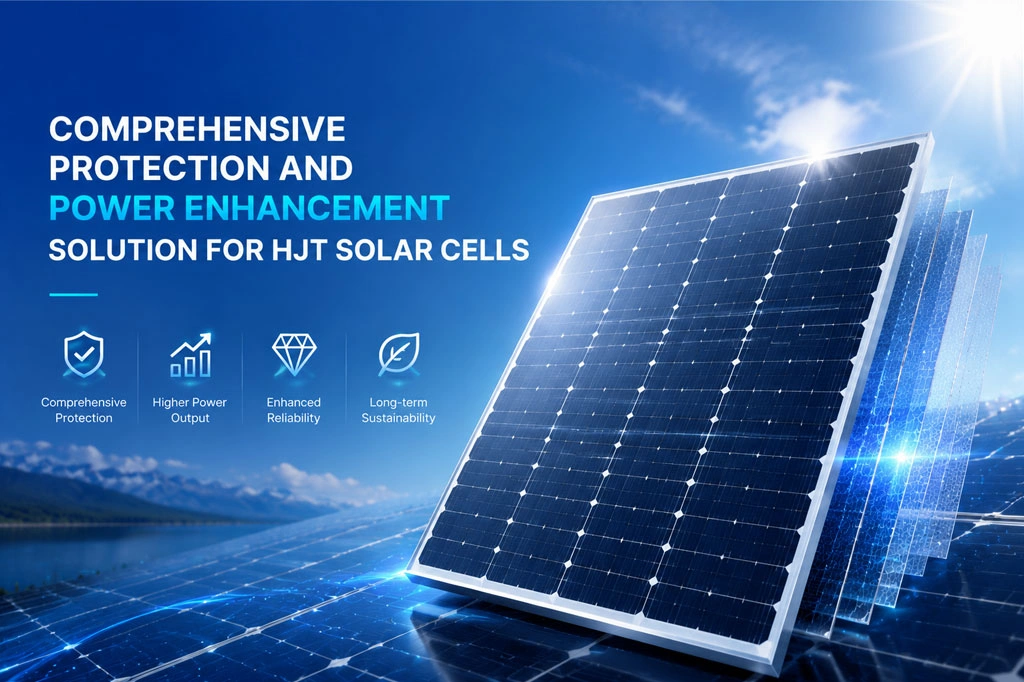
As photovoltaic technology continues to evolve, Heterojunction (HJT) solar cells have emerged as one of the most promising next-generation technologies due to their outstanding conversion efficiency, excellent temperature coefficient, and strong weak-light performance.
However, higher cell efficiency also brings new challenges. Unlike traditional PERC cells, HJT cells feature a unique structure combining crystalline silicon with amorphous silicon thin films, making them more sensitive to:
- Moisture penetration
- UV radiation
- Interface degradation
- Thermal stress
- Material compatibility issues
While most industry discussions focus on improving HJT cell structures and production processes, the role of advanced encapsulation materials is becoming increasingly critical.
Among these materials, light conversion and moisture barrier encapsulation films represent two important innovation directions. By improving photon utilization and strengthening environmental protection, these functional films provide HJT modules with a more comprehensive reliability solution while contributing to higher energy output.
1. HJT Solar Cells: High Efficiency Comes With Higher Protection Requirements
HJT technology achieves high efficiency through a low-defect interface structure and excellent passivation performance.
A typical HJT cell consists of:
- Crystalline silicon wafer
- Intrinsic amorphous silicon layer
- Doped amorphous silicon layer
- Transparent conductive oxide (TCO) layer
- Metal electrode
This structure provides several advantages:
Higher Conversion Efficiency
HJT cells can achieve:
- Low recombination losses
- Excellent carrier mobility
- High open-circuit voltage
Better Temperature Performance
Compared with conventional technologies, HJT modules maintain higher output under high-temperature conditions due to a lower temperature coefficient.
Superior Bifacial Capability
The symmetrical structure enables excellent rear-side power generation.
However, these advantages also create stricter requirements for encapsulation materials. The encapsulation layer is no longer simply a protective layer. It has become a key component.
2. Light Conversion Films: Transfer the Non-absorbed Photons Into Valuable Energy
2.1 The Challenge of Solar Spectrum Utilization
Although silicon solar cells can efficiently convert visible light into electricity, not all sunlight reaching the module can be effectively utilized.
Some wavelengths may contribute less to electrical generation and can even accelerate material aging.
This creates an opportunity for light conversion technology.
2.2 How Light Conversion Films Improve HJT Module Performance
Light conversion films incorporate special optical materials that can modify the incoming solar spectrum.
The basic principle:
High-energy photons → Converted photons → More usable wavelengths
Through photoluminescence or down-conversion mechanisms, light conversion materials can transfer high-energy UV photons into wavelengths that silicon cells utilize more effectively.
The benefits include:
Improved Photon Utilization
By increasing the amount of effective light reaching the HJT cell, light conversion films help improve:
- Short-circuit current (Isc)
- Quantum efficiency
- Module power output
Reduced UV Damage
HJT modules are particularly sensitive to UV exposure because long-term UV radiation can affect:
- Passivation layers
- TCO layers
- Interface stability
Light conversion films can reduce harmful UV exposure by converting part of the UV spectrum into beneficial light.
Enhanced Module Stability
By controlling high-energy photon transmission, light conversion films help improve:
- Polymer aging
- Interface degradation
- Encapsulant yellowing
This contributes to better long-term power retention.
3. Moisture Barrier Encapsulation Films: Building a Protective Shield for HJT Cells
3.1 Why Moisture Protection Is Critical for HJT
Moisture is one of the most serious threats to photovoltaic module reliability.
Water vapor entering the module can cause:
- TCO layer degradation
- Metal corrosion
- Reduced carrier migration
- Increased leakage current
- Power degradation
For HJT technology, moisture control is especially important because the cell relies heavily on thin-film interfaces.
3.2 Advanced Water Vapor Barrier Films for HJT Protection
Next-generation encapsulation materials are designed with enhanced barrier properties to minimize moisture penetration.
Key technologies include:
Low Water Vapor Transmission Rate (WVTR)
A high-performance barrier film provides:
- Lower moisture diffusion
- Better edge protection
- Longer module shelf-life
Improved Ion Blocking Capability
Moisture can accelerate ion migration, including:
- Sodium ions
- Metallic contaminants
Advanced barrier films help suppress ion movement and reduce reliability risks.
Strong Adhesion Performance
Reliable encapsulation requires strong bonding between:
- Glass
- Film
- Cell
- Back sheet
Improved adhesion reduces:
- Delamination
- Moisture channels
- Mechanical stress concentration
4. Synergy Between Light Conversion Films and Moisture Barrier Films
The future of HJT module encapsulation is not based on a single-function material.
Instead, multifunctional encapsulation solutions combine:
Optical Enhancement + Environmental Protection
| Function | Light Conversion Film | Moisture Barrier Film |
|---|---|---|
| Increase usable light | ✓ | |
| Improve power output | ✓ | ✓ |
| Reduce UV damage | ✓ | ✓ |
| Prevent moisture ingress | ✓ | |
| Improve shelf-life | ✓ | |
| Enhance energy yield | ✓ | ✓ |
Together, these materials create a comprehensive protection system.
5. Improving HJT Module Energy Yield Beyond Initial Efficiency
A common misconception is that module performance depends only on initial power rating.
However, real-world energy production depends on:
Initial Efficiency × Reliability × Degradation Rate
A slightly higher initial efficiency does not always guarantee better shelf-life energy generation.
For example:
A module with excellent initial efficiency but poor moisture resistance may experience accelerated degradation.
Advanced encapsulation materials help maintain:
- Higher output after years of operation
- Lower annual degradation
- Better investment returns
Conclusion
The development of HJT solar technology is not only a competition between cell efficiencies. It is also a competition in material engineering and long-term reliability.
Light conversion films improve photon utilization and help unlock additional power generation potential, while moisture barrier encapsulation films provide essential protection against environmental degradation.
Together, these advanced encapsulation solutions enable HJT modules to achieve:
- Higher energy output
- Longer service life
- Improved return on investment
As photovoltaic technology advances toward higher efficiency and longer shelf-life, encapsulation materials will play an increasingly important role in defining the next generation of solar module performance.