
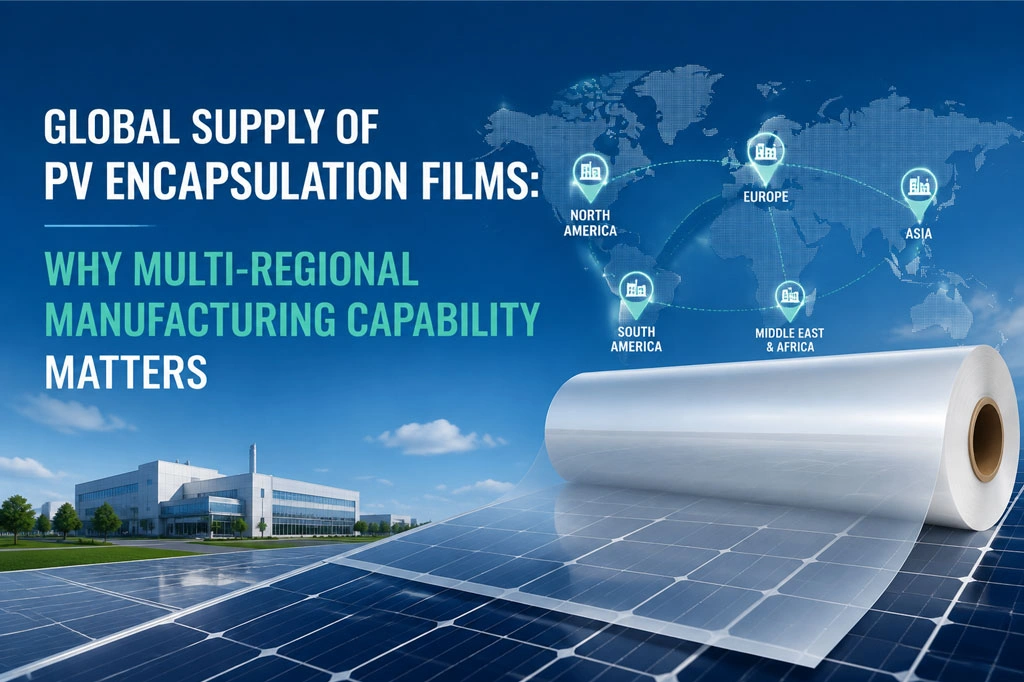
As solar deployment expands across continents, the traditional supply chain model centered around a single manufacturing region is becoming insufficient.
Multi-regional manufacturing capability has evolved from a production advantage into a strategic necessity for ensuring supply security, improving responsiveness, and supporting the global clean energy transition.
1. Why PV Encapsulation Film Supply Chains Need Global Manufacturing Networks
In the early development of the solar industry, manufacturing concentration helped reduce costs and accelerate large-scale PV adoption.
However, today’s PV market has entered a new phase. Solar module manufacturers are facing increasingly complex challenges:
- Rapid growth of PV installations across different regions
- Increasing demand for localized supply chains
- Trade policy uncertainty
- Transportation disruptions
- Shorter delivery expectations
- Higher reliability requirements for advanced PV technologies
These changes have transformed customer expectations.
Solar module manufacturers are no longer asking only:
“Can you provide high-quality encapsulation films?”
They are also asking:
“Can you provide consistent, reliable, and localized supply wherever our production facilities and projects are located?”
This is why leading PV material suppliers are investing in global manufacturing networks.
2. Multi-Regional Manufacturing Reduces Supply Chain Risks
Avoiding Single-Region Dependency
A highly concentrated supply chain creates potential vulnerabilities.
Unexpected events—including logistics interruptions, regional supply constraints, energy shortages, or market fluctuations—can affect material availability and production schedules.
For PV module manufacturers, any delay in PV encapsulation film supply can impact:
- Module production capacity
- Delivery commitments
- Project timelines
- Customer confidence
A multi-regional manufacturing network provides greater flexibility by allowing production capacity to be allocated closer to customer demand.
Instead of relying on a single production hub, companies can establish a distributed supply ecosystem that improves:
- Supply continuity
- Delivery efficiency
- Regional responsiveness
- Risk management
3. Betterial’s Global Manufacturing Network
As the PV industry becomes increasingly globalized, Betterial has developed a manufacturing and service network designed to support customers worldwide.
Betterial has established eight manufacturing bases across Jiangsu, Anhui, and Shaanxi in China, as well as Vietnam and Turkey, creating an integrated global and local operation system. Each manufacturing base is supported by local teams to provide closer customer service, faster technical communication, and more flexible supply solutions.
This global manufacturing layout enables Betterial to:
- Support customers in different geographic markets
- Shorten logistics distances and delivery cycles
- Improve supply chain flexibility
- Provide localized technical support
- Respond quickly to regional market demands
Rather than operating as a single-location supplier, Betterial works as a global partner capable of supporting PV manufacturers throughout different stages of growth.
4. Regional Manufacturing Enables Faster Response to Market Needs
The PV industry is highly dynamic.
Module manufacturers are continuously upgrading their technologies and expanding production capacity in different regions. A supplier with localized manufacturing capabilities can respond more effectively to these changes.
For example:
Asia-Pacific PV Manufacturing
Asia remains one of the world’s largest PV manufacturing centers, requiring large-scale and stable supply of EVA, POE, EPE, and other encapsulation materials.
Localized production helps support:
- High-volume manufacturing
- Faster delivery
- Efficient production coordination
European Solar Market
Europe is accelerating renewable energy deployment while emphasizing supply chain transparency and sustainability.
Regional support helps customers achieve:
- More predictable logistics
- Reduced transportation complexity
- Better project execution efficiency
Emerging Markets
Solar growth is accelerating in regions such as Southeast Asia, the Middle East, Africa, and Latin America.
A global manufacturing network allows suppliers to provide:
- Quick response to global policy changes and regional risks
- Reliable material availability
- Regional technical support
- Customized solutions for different climates
5. Multi-Regional Manufacturing Also Supports Sustainable Development
A sustainable solar industry requires sustainability throughout the entire value chain.
Regional production contributes to greener supply chains by:
- Reducing Transportation Emissions: Manufacturing closer to customers reduces unnecessary long-distance transportation.
- Improving Resource Efficiency: Regional production planning helps optimize inventory and reduce waste.
- Supporting Local Energy Transition: Localized supply networks strengthen renewable energy development in different regions.
The future of clean energy depends not only on producing renewable power but also on building a sustainable manufacturing ecosystem.
Final Words
The future of solar energy will depend not only on higher-efficiency cells but also on stronger, more resilient supply chains that ensure reliable materials are available wherever solar power is being developed.
Multi-regional manufacturing is no longer just a supply chain strategy—it is the foundation for building a more reliable and sustainable global solar industry.
Betterial’s integrated manufacturing and service network—with eight production bases across China, Vietnam, and Turkey—represents this new generation of PV material supply capability.