
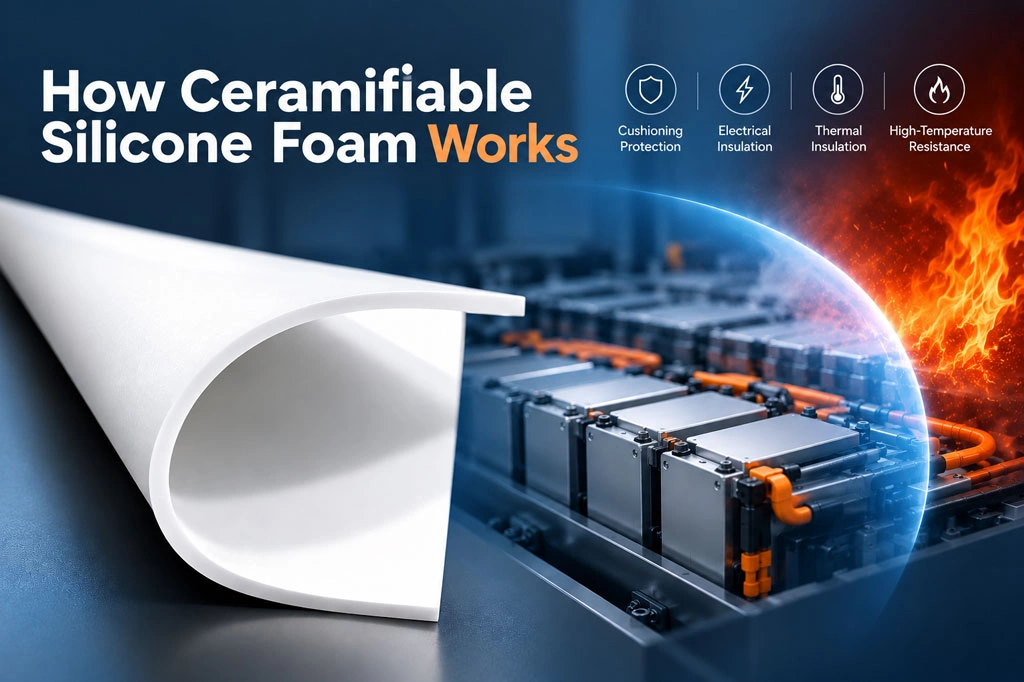
Protective materials used inside energy storage batteries must not only provide cushioning, electrical insulation, and thermal insulation under normal operating conditions, but also maintain a certain degree of structural integrity and thermal protection under extreme high-temperature conditions.
Ceramifiable silicone foam is a functional material developed specifically to meet these requirements.
Unlike conventional foam materials, ceramifiable silicone foam has a unique working mechanism: it remains flexible under normal temperatures but gradually undergoes a ceramification process when exposed to high temperatures or flames, forming a more stable inorganic ceramic-like protective layer. This creates a secondary high-temperature protection barrier.
How Does Ceramifiable Silicone Foam Work?
The working principle of ceramifiable silicone foam is not simply based on “flame retardancy.” Instead, the material performs different functions as temperature and operating conditions change.
Stage 1: Normal Operating Conditions — Flexible Cushioning and Electrical Insulation
During normal charging and discharging, energy storage batteries can be affected by assembly tolerances, cell expansion, vibration, and temperature fluctuations.
At this stage, ceramifiable silicone foam primarily behaves like a conventional functional silicone foam.
Its porous and elastic structure allows it to compress under pressure, absorbing part of the mechanical stress through deformation while filling gaps between battery components.
Therefore, under normal operating conditions, it can simultaneously provide:
Cushioning
It absorbs vibrations and impacts generated during battery module assembly, transportation, and operation, helping reduce the risk of mechanical damage caused by direct contact between rigid components.
Gap Compensation
Its compressibility allows the material to accommodate structural tolerances and dimensional changes that may occur during battery operation.
Electrical Insulation
The silicone system itself provides good electrical insulation properties, helping reduce the risk of unintended electrical conduction between different conductive components.
Basic Thermal Insulation
The foam contains numerous microscopic pores that reduce heat conduction through the material, creating a basic thermal resistance barrier between battery cells.
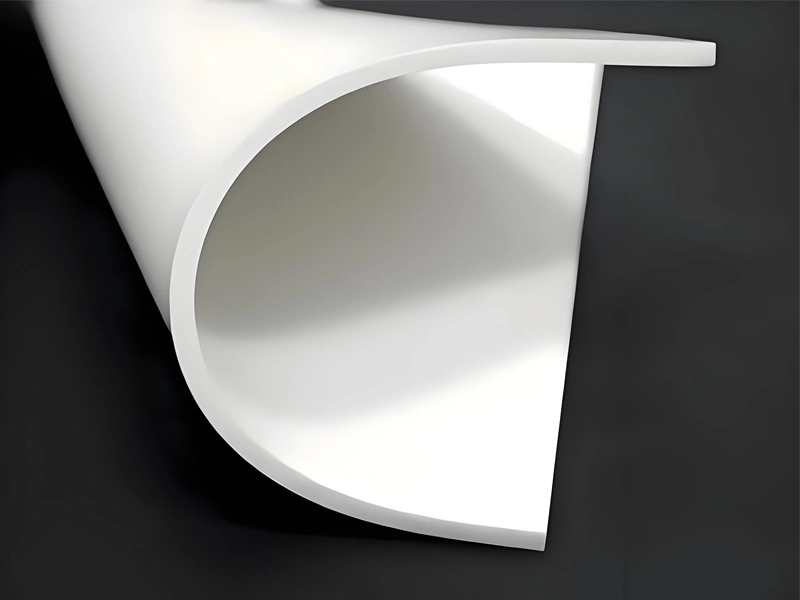
For example, Betterial’s CSF-040C Ceramifiable Silicone Foam has a thermal conductivity of ≤0.12 W/(m·K), a volume resistivity of ≥1.0 × 10¹⁴ Ω·cm, and a dielectric breakdown strength of ≥2.0 kV/mm.
In addition, its compression set is ≤5.0% after 22 hours at 100°C and 50% compression, enabling the material to provide thermal insulation, electrical insulation, and long-term compression stability.
Stage 2: Abnormal Temperature Rise — Flame Retardancy and Delayed Heat Propagation
When a battery cell begins to experience an abnormal temperature rise, ceramifiable silicone foam first provides flame-retardant and thermal-insulation protection.
Its low thermal conductivity helps reduce the rate at which heat is rapidly transferred through solid materials to adjacent areas, thereby helping slow heat propagation.
At the same time, the material itself provides good flame-retardant performance.
This stage is particularly important because safety protection in energy storage systems requires more than simply ensuring that the protective material itself is difficult to ignite. It is also necessary to minimize the possibility of the material becoming a pathway for further heat and flame propagation.
Therefore, one of the key functions of ceramifiable silicone foam is to use its flame-retardant and low-thermal-conductivity properties to slow heat propagation before thermal runaway develops into an extreme high-temperature event.
Stage 3: High Temperature or Flame Exposure — Ceramification Begins
This is the key characteristic that distinguishes ceramifiable silicone foam from conventional silicone foam.
As the temperature continues to rise and reaches the conditions required for significant thermal transformation, the organic components within the silicone system gradually undergo thermal decomposition, while high-temperature-resistant inorganic fillers and ceramifiable components begin to participate in structural reorganization.
As the temperature increases further, more complex physical and chemical changes occur within the material.
The original structure, which is primarily based on a flexible polymer network, gradually transforms into a structure dominated by inorganic components.
In simple terms, the process can be described as:
Flexible silicone foam → High-temperature thermal decomposition and structural transformation → Sintering/bonding of inorganic components → Ceramic-like protective layer
This transformation is the origin of the term “ceramifiable.”
It is important to note that ceramification does not mean that the material becomes a dense ceramic like conventional ceramics fired in a kiln. Instead, it means that under high-temperature conditions, the material forms a ceramic-like residual structure with a certain degree of mechanical integrity and high-temperature resistance.
Why Can the Material Continue Protecting the Battery After Ceramification?
Conventional organic foam materials may undergo significant softening, decomposition, or structural failure when continuously exposed to high temperatures or flames.
Once the material loses its structural integrity, the original thermal insulation space may be compromised, allowing high-temperature gases, flames, and heat to spread more easily to surrounding areas.
Ceramifiable silicone foam uses a different protection mechanism.
After ceramification, the inorganic ceramic-like structure that forms can remain in the original protective position and continue functioning as a physical barrier.
This barrier mainly provides three functions.
1. Maintaining Structural Integrity
Even after the original polymer structure has been damaged by high temperatures, the ceramic-like residue can still maintain a certain degree of coverage over the original protected area, helping prevent the protective material from rapidly and completely losing its function.
2. Forming a High-Temperature Isolation Layer
The inorganic structure formed after ceramification can continue to help block flames, high-temperature gases, and heat from directly affecting adjacent areas, thereby increasing the heat propagation path.
3. Delaying Thermal Runaway Propagation
One of the important objectives of safety design in energy storage systems is to delay thermal runaway propagation from a single cell to neighboring cells, modules, and eventually the entire battery pack.
Therefore, the value of ceramifiable silicone foam is not that it “prevents thermal runaway from occurring.” Rather, once an abnormal event occurs, it helps delay the further propagation of heat and flames, adding another material-based barrier to system-level thermal runaway protection.
Why Not Use Conventional Flame-Retardant Foam Instead?
“Flame retardancy” and “ceramification” address two different levels of protection.
Conventional flame-retardant foam primarily addresses the following question:
Will the material continue burning easily after exposure to fire?
Ceramifiable materials go one step further by addressing another question:
When the material is exposed to extreme temperatures or sustained flames and its original polymer structure is damaged, can it still leave behind an effective protective structure?
Ceramifiable silicone foam therefore provides a more comprehensive temperature-responsive protection mechanism:
- Normal conditions: Flexible cushioning + sealing + electrical insulation
- Abnormal temperature rise: Low thermal conductivity + flame retardancy to slow heat propagation
- Extreme high temperatures: Ceramification to form a high-temperature-resistant physical barrier
- Continuous thermal exposure: Ceramic-like residual structure continues providing thermal insulation and flame protection
This is also why ceramifiable materials are receiving increasing attention in the safety design of new energy vehicle batteries and energy storage systems.
Applications of Ceramifiable Silicone Foam in Energy Storage Systems
In energy storage battery systems, ceramifiable silicone foam can be used in locations within cells, modules, and battery packs where cushioning, electrical insulation, thermal insulation, and fire protection are required simultaneously, depending on the battery pack design.
Typical applications include:
- Cushioning and thermal isolation between battery cells
- Fire and thermal insulation areas between battery modules
- Gap filling inside battery packs
- Sealing and cushioning between battery covers and other structural components
- Electrical insulation protection near high-voltage components
- Areas requiring a combination of vibration reduction, noise reduction, and fire protection
The specific material thickness, compression ratio, and installation position should be determined according to the cell structure, module design, thermal runaway protection requirements, and available space within the battery pack.
Conclusion
The core working principle of ceramifiable silicone foam for energy storage applications can be summarized as:
“Flexible at normal temperatures, protective barrier at high temperatures.”
During normal operation of an energy storage system, the material uses the elasticity, porous structure, and electrical insulation properties of silicone foam to provide cushioning, vibration reduction, sealing, electrical insulation, and basic thermal insulation.
When a battery cell experiences an abnormal temperature rise, its low thermal conductivity and flame-retardant properties help slow the propagation of heat and flames.
When exposed to more extreme temperatures or direct flame impact, the material undergoes further ceramification, gradually transforming from a flexible polymer foam into an inorganic ceramic-like protective layer with a certain degree of structural integrity.
Through this temperature-responsive mechanism, ceramifiable silicone foam can provide different levels of protection under normal operating, abnormal heating, and extreme high-temperature conditions, making it an important functional safety material for energy storage battery systems.