
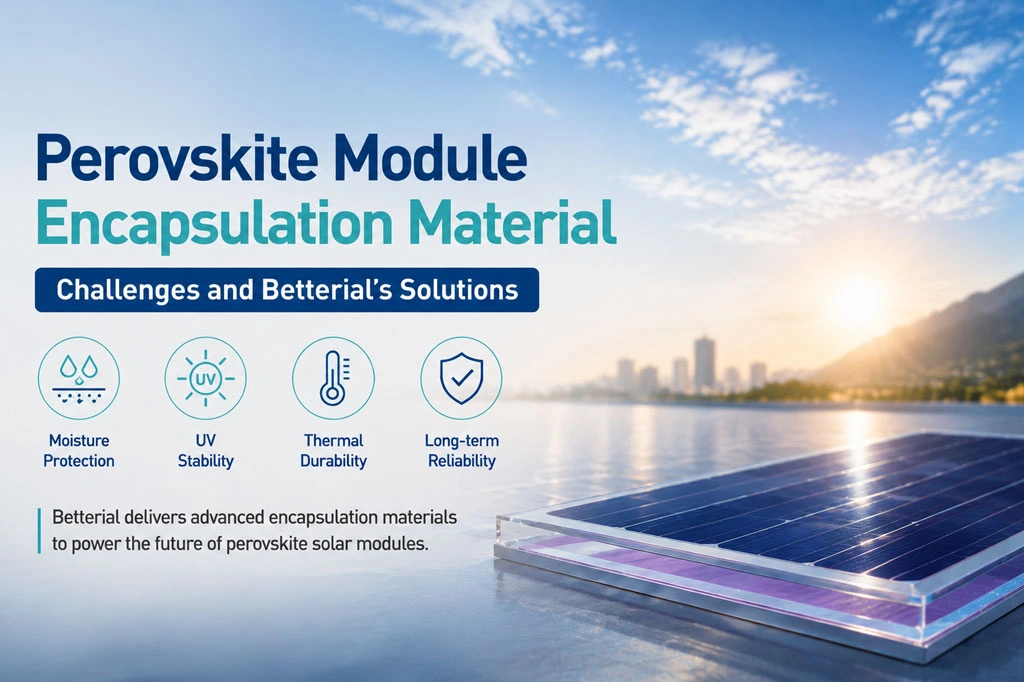
Perovskite solar technology has attracted global attention due to its outstanding photovoltaic performance, low-temperature manufacturing potential, and compatibility with tandem structures. Compared with traditional silicon-based photovoltaics, perovskite solar cells offer unique advantages, including high absorption coefficients, tunable bandgaps, and excellent potential for next-generation tandem modules.
However, moving perovskite photovoltaics from laboratory achievements to large-scale commercial deployment requires overcoming one critical challenge: long-term stability.
Unlike conventional crystalline silicon cells, perovskite materials are highly sensitive to environmental factors. Moisture, oxygen, ultraviolet radiation, thermal stress, and chemical interactions can accelerate degradation and reduce module lifetime.
Therefore, encapsulation is no longer simply a protective layer—it has become one of the most important technologies determining whether perovskite modules can achieve long-term reliability.
As a professional provider of PV encapsulation materials, Betterial focuses on developing advanced encapsulation solutions specifically designed for emerging photovoltaic technologies, including perovskite modules. By combining material innovation, process optimization, and reliability testing, Betterial provides solutions to address the unique challenges of perovskite encapsulation.
1. Why Perovskite Modules Require More Advanced Encapsulation Materials
Traditional crystalline silicon modules typically rely on encapsulation films to provide mechanical protection and environmental isolation.
However, perovskite modules introduce new requirements because their active layers are more vulnerable.
1.1 Moisture Sensitivity: The Biggest Challenge
Perovskite materials are highly sensitive to moisture.
When moisture penetrates into the module, it can trigger:
- Perovskite decomposition
- Ion migration
- Interface degradation
- Loss of photovoltaic performance
The chemical instability caused by humidity makes water vapor barrier performance a critical requirement for encapsulation materials.
For perovskite applications, encapsulation films must provide:
- Extremely low water vapor transmission rate (WVTR)
- Strong sealing performance
- Long-term moisture resistance
1.2 Thermal Stability Under Real-World Operating Conditions
Solar modules operate under continuous temperature fluctuations:
- Daytime heating
- Nighttime cooling
- Seasonal temperature changes
These thermal cycles generate mechanical stress inside the module.
For perovskite modules, excessive thermal stress may lead to:
- Interface cracking
- Layer separation
- Accelerated degradation
Therefore, encapsulation materials must provide:
- Excellent thermal stability
- Low thermal expansion mismatch
- Effective stress buffering capability
1.3 UV-Induced Degradation
Although sunlight is essential for photovoltaic operation, ultraviolet radiation can accelerate degradation of perovskite materials and surrounding interfaces.
UV exposure may cause:
- Organic component degradation
- Interface instability
- Reduced charge transport efficiency
Advanced encapsulation materials must balance:
- High optical transmission
- UV protection
- Long-term weather resistance
1.4 No Additive Release During Shelfife
Encapsulation films typically contain functional additives, including reactive peroxides, reducing agents, and other chemically active molecules.
Such interactions may cause:
- Perovskite composition changes
- Interfacial chemical reactions
- Accelerated material degradation
- Reduced long-term stability
If these substances migrate or are released from the film during storage, they may react with sensitive perovskite materials and affect their chemical stability.
2. The Challenge of Low-Temperature Encapsulation Processes
One of the major advantages of perovskite technology is its compatibility with low-temperature manufacturing.
However, conventional photovoltaic module encapsulation processes are mainly developed for silicon modules, where higher lamination temperatures are acceptable.
For perovskite modules, excessive heat during lamination may negatively affect:
- Perovskite crystal structure
- Functional layers
- Interface properties
Therefore, encapsulation materials need to achieve:
- Lower lamination temperature
- Shorter processing time
This requires a completely different approach to encapsulation material design.
3. Betterial’s Solution
To address the unique challenges of perovskite and perovskite-based tandem modules, Betterial has developed advanced Perovskite module encapsulation solutions based on innovative polymer technologies.
Through polymer grafting and nano-interconnection technologies, Betterial’s solution enables:
- Low-temperature and rapid lamination, reducing thermal stress on sensitive photovoltaic layers
- High interlayer peel strength, improving module durability and preventing delamination
- Reduced impact from residual polar small molecules, enhancing long-term material stability
- Improved resistance to storage degradation, supporting reliable module performance over time
- Excellent creep resistance maintains dimensional and structural stability under sustained heat and mechanical stress.
By providing stronger interface protection and enhanced encapsulation stability, Betterial has developed the formulation of the product; the solution helps improve the reliability and commercialization potential of next-generation perovskite and perovskite-based tandem solar modules.
Final Words
Perovskite solar technology represents one of the most promising directions for the future photovoltaic industry. However, achieving commercial success requires solving critical reliability challenges, especially those related to encapsulation.
With expertise in PV encapsulation materials, Betterial is committed to developing advanced solutions that address the demanding requirements of emerging photovoltaic technologies.