
As photovoltaic technology continues to evolve toward higher efficiency, lower silver consumption, and reduced levelized cost of electricity (LCOE), 0BB (Zero Busbar) solar cell technology is becoming an important development direction for next-generation PV modules.
By eliminating conventional busbars and optimizing the current collection structure, 0BB technology offers opportunities to reduce metallization costs, decrease optical shading, and improve module power output. However, the transition from conventional busbar designs to 0BB structures also creates new requirements for module encapsulation.
The encapsulation system must not only protect the cells against environmental stresses but also help maintain reliable interconnection, stable lamination quality, and long-term electrical performance.
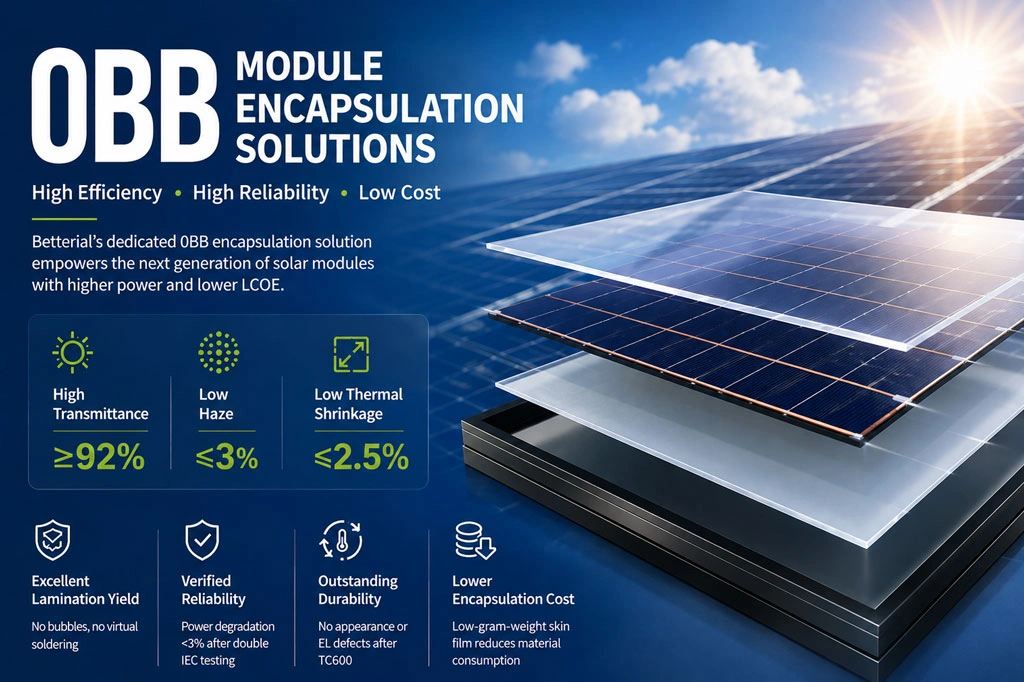
To address these requirements, Betterial has developed a dedicated 0BB encapsulation solution combining high-performance encapsulation films with a low-grammage EVA skin film.
1. Why 0BB Modules Require Specialized Encapsulation
In conventional photovoltaic cells, busbars collect current from the fingers and transmit it through the module interconnection system. As cell technologies continue to advance, manufacturers are increasingly exploring busbar-free architectures to reduce silver consumption and minimize shading losses.
0BB technology changes the relationship between cells, interconnection materials, and encapsulation films.
Because the interconnection structure becomes more dependent on precise contact and mechanical stability during module lamination, several challenges become increasingly important.
Interconnection Stability
The encapsulation material must help maintain stable contact between the cell and interconnection structure throughout lamination and subsequent operation.
Excessive movement or uneven pressure during processing can potentially affect electrical contact, making dimensional stability and controlled film behavior particularly important.
Lamination Quality
0BB modules require excellent process compatibility during lamination. Problems such as bubbles, displacement, uneven encapsulation, or poor contact may negatively affect module appearance and EL performance.
The encapsulation film therefore needs an appropriate combination of flow behavior, adhesion, shrinkage control, and processing stability.
Optical Performance
Reducing shading is one of the important advantages of advanced interconnection designs. The encapsulation system should complement this advantage rather than introduce additional optical losses.
Long-Term Reliability
Like other high-efficiency PV technologies, 0BB modules must withstand decades of outdoor exposure involving humidity, temperature changes, UV radiation, mechanical stress, and electrical loading.
Encapsulation materials play an essential role in protecting the module structure and maintaining stable power generation throughout its operating life.
2. Betterial’s 0BB Skin Film Encapsulation Solution
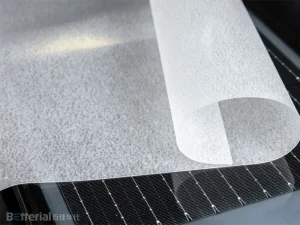
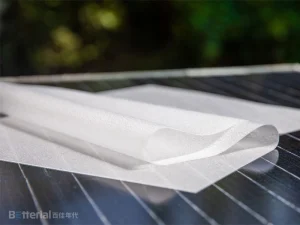
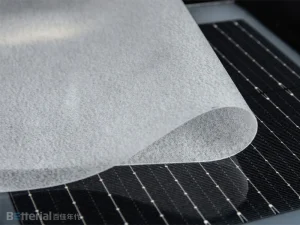
To meet these challenges, Betterial has developed a specialized 0BB skin film encapsulation solution based on a low-grammage EVA skin film.
The solution is designed to provide stable material performance while supporting the specific manufacturing and reliability requirements of 0BB modules.
The skin film delivers:
- Light transmittance ≥92%
- Haze ≤3%
- Thermal shrinkage ≤2.5%
High transmittance helps minimize optical losses, while low haze supports efficient light transmission through the encapsulation layer. Controlled thermal shrinkage is particularly valuable during lamination and lay-out processes because it helps maintain the position and stability of the module’s internal structure.
Together, these properties provide a balanced encapsulation platform for high-efficiency 0BB module manufacturing.
3. Excellent Lamination Yield and Manufacturing Compatibility
Commercializing a new cell or interconnection technology requires more than achieving high laboratory efficiency. It must also deliver stable production yields at industrial scale.
This is where encapsulation material selection becomes particularly important.
Betterial’s dedicated 0BB encapsulation solution is engineered to provide excellent lamination performance. After lamination, modules demonstrate good appearance and EL performance without defects such as virtual soldering or air bubbles.
This process stability can help manufacturers reduce production losses associated with encapsulation and interconnection defects.
For large-scale PV module production, even small improvements in manufacturing yield can translate into meaningful reductions in module manufacturing cost.
4. Encapsulation Solutions for 0BB Modules
Betterial provides a flexible material combination that allows module manufacturers to select encapsulation materials according to their module architecture, reliability targets, and production requirements.
Front-side encapsulation:
Co-extruded EPE film B602M or high-transmittance EVA film B601HP + B601HP 0BB skin film.
Rear-side encapsulation:
Co-extruded EPE film B602M or high-transmittance EVA film B601HP + B601HP 0BB skin film.
This configuration combines the advantages of established PV encapsulation materials with a skin film specifically adapted to 0BB module structures.
The use of EPE provides manufacturers with a combination of processing performance and barrier characteristics, while high-transmittance EVA offers mature lamination compatibility and strong optical performance.
The dedicated 0BB skin film further supports the interconnection structure during module manufacturing.
5. Verified Long-Term Reliability
For 0BB technology to achieve widespread commercial adoption, module manufacturers must demonstrate that improvements in efficiency and material utilization do not compromise long-term reliability.
Betterial’s dedicated 0BB encapsulation solution has therefore been evaluated under accelerated reliability testing.
After double IEC testing, module power degradation remains below 3%.
In addition, after TC600 thermal cycling testing, modules show no appearance or EL defects.
These results demonstrate the ability of the encapsulation system to maintain structural and electrical stability under demanding accelerated aging conditions.
Such performance is particularly important for advanced PV modules because the economic value of higher initial module efficiency can only be fully realized when that performance is maintained throughout long-term operation.
6. Reducing Encapsulation Cost Through Low-grammage Skin Film
Cost down is another major driver behind the development of 0BB technology.
The PV industry has continuously reduced the consumption of precious materials while improving cell and module efficiency. Eliminating traditional busbars can contribute to lower silver consumption, but further cost optimization is required across the complete module BOM.
Betterial’s low-grammage EVA skin film supports this objective by reducing encapsulation material consumption while maintaining the performance required by the 0BB interconnection structure.
Instead of simply increasing encapsulant thickness to provide mechanical support, the dedicated solution aims to place material where it provides the greatest functional value.
This creates an opportunity to reduce encapsulation costs without sacrificing lamination quality or module reliability.
Conclusion
0BB technology represents an important pathway toward higher module efficiency, reduced silver consumption, and lower PV manufacturing costs. However, successful commercialization requires an encapsulation system specifically adapted to the mechanical, optical, processing, and reliability requirements of busbar-free module structures.
Betterial’s 0BB Module Encapsulation Solution combines co-extruded EPE or high-transmittance EVA encapsulation films with a dedicated low-gram-weight EVA skin film.
With light transmittance ≥92%, haze ≤3%, thermal shrinkage ≤2.5%, power degradation below 3% after double IEC testing, and no appearance or EL defects after TC600, the solution provides a balanced approach to module power, manufacturing yield, reliability, and encapsulation cost.