
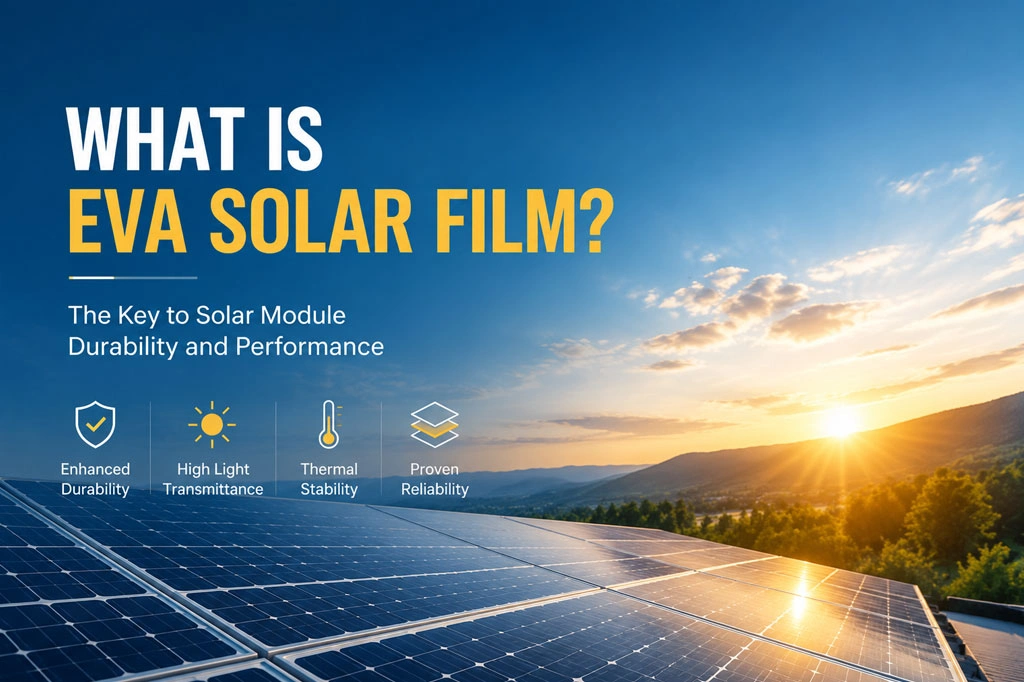
When people discuss solar module performance, attention is usually focused on solar cells and glass. However, one of the most critical components inside a photovoltaic (PV) module is often overlooked: EVA solar film.
EVA (Ethylene Vinyl Acetate) solar film is an advanced polymer encapsulation material used to protect solar cells from environmental stress while maintaining optical performance and long-term module reliability.
Although EVA film does not generate electricity directly, it plays a decisive role in determining:
- How efficiently sunlight reaches solar cells
- How well modules resist moisture and UV exposure
- How long modules maintain power output
- Whether a solar module can achieve 25–30 years of reliable operation
In other words:
Solar cells determine the initial efficiency of a module, but encapsulation materials determine how much of that efficiency survives over decades.
1. What Is EVA Solar Film?
EVA solar film is a transparent polymer encapsulation material made primarily from ethylene vinyl acetate copolymer (EVA).
During solar module manufacturing, EVA film is placed between:
- Glass and solar cells (front encapsulation)
- Solar cells and glass (rear encapsulation)
- Ribbons
Through a lamination process, EVA melts and crosslinks to form a protective layer that permanently bonds different module components together.
A typical solar module structure:
Glass

↓

EVA Encapsulation Film

↓

Solar Cells

↓

EVA Encapsulation Film

↓

Backsheet / Glass
After lamination, EVA becomes a highly transparent, durable protective layer that provides:
- Mechanical support
- Electrical insulation
- Moisture protection
- UV resistance
- Adhesion between components
2. Why Is EVA Film Important in Solar Modules?
Many people consider EVA simply as a “bonding layer.” However, this understanding underestimates its engineering importance.
Modern EVA solar film performs three critical functions:
2.1 Maximizing Solar Energy Capture
The first responsibility of EVA film is allowing maximum sunlight transmission.
High-quality EVA film requires:
- High light transmittance
- Low haze after lamination
- Excellent optical stability
For example, Betterial EVA solar film provides:
- Light transmittance ≥91%
- Low optical loss
- Stable performance during long-term operation
A small reduction in optical performance can directly influence module power output over millions of operating hours.
Therefore, EVA is not only a protective layer—it is also an optical component.
2.2 Protection Against Environmental Degradation
Solar modules operate outdoors for decades and face extreme conditions:
- UV radiation
- Temperature cycling
- Humidity
- Rain
- Snow
- Salt mist
Without effective encapsulation, moisture and oxygen can penetrate the module and cause:
- Cell corrosion
- Metal electrode degradation
- Delamination
- Power loss
EVA creates a protective barrier that reduces these risks.
2.3 Mechanical Stress Management
Solar modules experience continuous expansion and contraction due to temperature changes.
For example:
A desert PV module may experience:
- Daytime temperatures above 70°C
- Night temperatures close to freezing
These thermal cycles create mechanical stress between:
- Glass
- Silicon cells
- Metal ribbons
EVA acts as a flexible buffer layer, absorbing stress and reducing the possibility of:
- Cell cracks
- Ribbon breakage
- Internal failures
3. How Does EVA Solar Film Work During Module Manufacturing?
The EVA lamination process is one of the most important steps in PV module production.
The process typically includes:
Step 1: Material Preparation
EVA film is positioned between module layers:
Glass → EVA → Cells → EVA → Backsheet or Glass
Step 2: Heating and Melting
During lamination:
- EVA softens
- Bubbles are removed
- Material flows around solar cells
Step 3: Crosslinking
Chemical crosslinking occurs, transforming EVA into a stable three-dimensional polymer network.
This provides:
- Strong adhesion
- Thermal stability
- Long-term durability
Step 4: Final Module Protection
The finished EVA layer securely encapsulates solar cells and protects them throughout the module lifetime.
4. Key Performance Parameters of High-Quality EVA Solar Film
Not all EVA films provide the same performance.
For solar module manufacturers, several parameters are critical.
| Performance Parameter | Why It Matters |
|---|---|
| Light Transmittance | Determines sunlight utilization |
| Gel Content | Reflects crosslinking quality |
| Shrinkage Rate | Influences lamination stability |
| Peel Strength | Prevents delamination |
| UV Resistance | Improves outdoor durability |
| Moisture Resistance | Protects against corrosion |
A professional EVA manufacturer must optimize these properties together.
Improving one parameter while sacrificing another may negatively impact overall module reliability.
5. Betterial EVA Solar Film: Designed for Reliable PV Performance
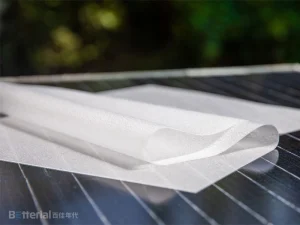
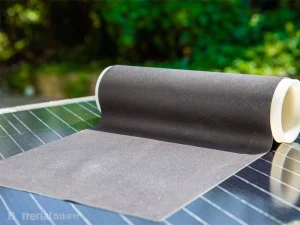
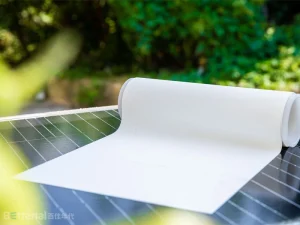
As a professional PV encapsulation material manufacturer, Betterial develops EVA solar films designed to meet the evolving requirements of modern photovoltaic modules.
Betterial EVA films feature:
- High optical transparency
- Excellent reflectivity performance for specified modules
- Stable crosslinking performance
- Excellent adhesion
- Reliable weather resistance
- Compatibility with advanced PV technologies
Through continuous material innovation, Betterial supports solar manufacturers in developing modules with:
- Higher energy yield
- Longer service life
- Improved reliability
Conclusion
EVA solar film may represent only a small percentage of a solar module’s total cost, but its impact on lifetime performance is significant.
A high-quality EVA encapsulation solution helps solar modules:
- Maintain power output
- Resist environmental degradation
- Reduce failure risks
- Achieve long-term reliability
As photovoltaic technology continues moving toward higher efficiency and longer warranties, encapsulation materials will become increasingly important.
The future of solar energy depends not only on better solar cells—but also on better protection materials behind them.