
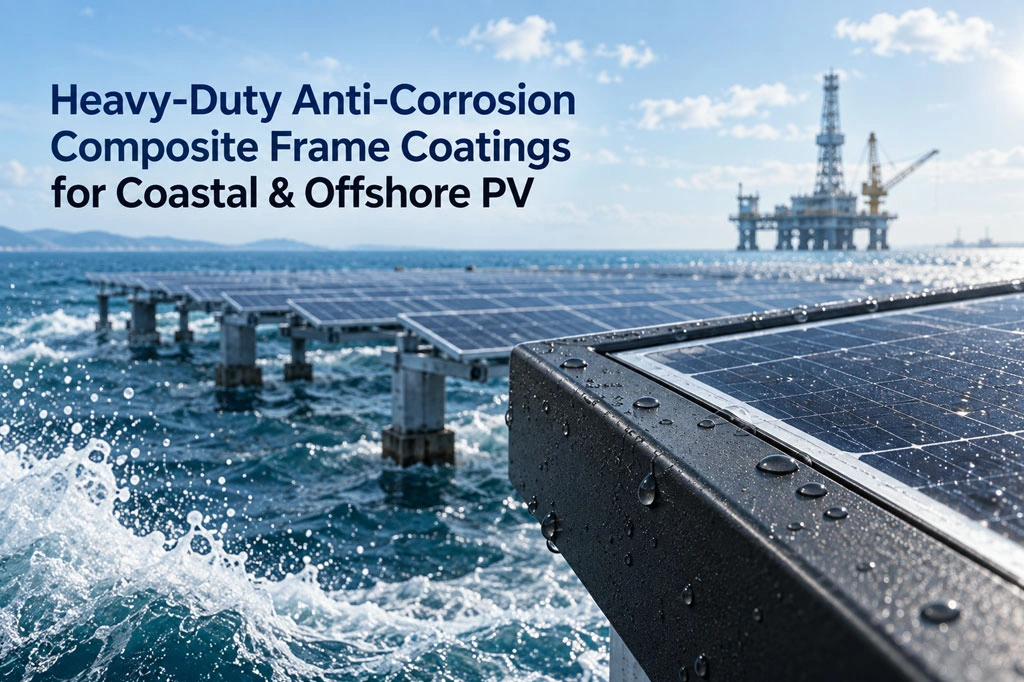
As photovoltaic applications continue to expand, solar power plants are moving beyond traditional land-based installations and commercial and industrial rooftops into coastal tidal flats, water surfaces, nearshore areas, and offshore environments.
Compared with conventional land-based PV projects, coastal and offshore photovoltaic systems are continuously exposed to high humidity, high salt concentrations, strong ultraviolet radiation, sea winds, and other harsh environmental conditions. These factors place significantly higher demands on the long-term reliability of PV module materials.
Among these materials, photovoltaic module frames are continuously exposed to the external environment. In addition to providing structural fixation, installation support, and edge protection, frames are also among the components most directly exposed to salt spray, moisture, and ultraviolet radiation.
As composite material frames are increasingly adopted in photovoltaic modules, applying protective surface coatings to further improve their weather resistance, corrosion resistance, and surface durability is becoming an important consideration in the material design of coastal and offshore PV modules.
Why Is Corrosion Protection More Important for Coastal and Offshore Photovoltaics?
One of the major differences between marine environments and typical inland environments is the high concentration of chloride-containing salts in the air.
Sea waves, sea winds, and water evaporation generate microscopic droplets and salt spray containing NaCl and other salts, which can gradually deposit on photovoltaic module surfaces. When these salts interact with high humidity, they can form conductive and corrosive surface electrolytes, increasing the risk of corrosion and material degradation within module structures.
IEC 61701 specifically establishes salt mist corrosion testing methods for photovoltaic modules and is used to evaluate their corrosion resistance under humid environments containing high concentrations of salt.
For offshore photovoltaic systems, however, environmental challenges usually involve more than salt spray alone. Multiple factors often act simultaneously, including:
- Continuous high humidity and salt spray: increasing the risk of surface corrosion and interfacial aging;
- Strong ultraviolet exposure: accelerating aging, discoloration, and performance degradation of certain polymers and surface materials;
- Wet-dry cycling: causing salts to repeatedly dissolve and crystallize as environmental conditions change;
- Sea wind and particle erosion: creating long-term mechanical impact on module surfaces and edges;
- Combined effects of high temperature, high humidity, and salt: further increasing the requirements for long-term module weatherability and reliability.
Research into marine photovoltaic systems has also shown that high-humidity and high-salinity environments can create more severe corrosion challenges for PV structures and modules. Salt spray may affect external components such as module frames, making corrosion protection an important consideration from the early stages of offshore PV material design.
Why Do Composite Frames Still Need Surface Coatings?
Compared with conventional metal frames, glass-fiber-reinforced composites and other composite frame materials offer several advantages, including lower weight, good corrosion resistance, and excellent electrical insulation properties. As a result, they are becoming an increasingly attractive alternative for photovoltaic module frames.
However, the fact that composite materials are not susceptible to traditional electrochemical corrosion in the same way as metals does not mean they require no surface protection.
Offshore photovoltaic modules are generally expected to operate for many years. Under continuous exposure to ultraviolet radiation, high humidity, salt spray, and temperature fluctuations, the surface resin of the composite, the fiber-resin interface, and the overall appearance of the frame still require long-term protection.
Applying a functional coating with strong adhesion and weather resistance to the surface of a composite frame can therefore create an additional protective barrier over the substrate.
Its primary functions include the following.
1. Isolating Salt and the External Environment
A continuous and uniform coating film can reduce direct contact between salts, moisture, contaminants, and the composite material surface, providing an additional environmental barrier for the substrate.
For coastal and offshore photovoltaic applications, this isolation effect is particularly important.
2. Improving Long-Term Weather Resistance
Photovoltaic modules typically need to withstand years of solar radiation, temperature changes, humidity fluctuations, and repeated climatic cycles.
A highly weather-resistant coating can reduce the direct impact of environmental conditions on the composite frame substrate and help maintain stable surface performance over long-term outdoor operation.
3. Providing UV Protection
Offshore areas often have little surrounding shelter, leaving module frames continuously exposed to solar radiation.
Therefore, in addition to corrosion resistance, composite frame coatings should provide strong resistance to ultraviolet aging so that the frame can maintain relatively stable surface properties over extended outdoor service.
4. Improving Surface Hardness and Scratch Resistance
Photovoltaic modules inevitably experience handling, contact, packaging, transportation, and installation during production and deployment.
A coating with suitable surface hardness can help reduce the impact of normal abrasion and scratching on both the appearance and surface integrity of the frame.
5. Improving Module Appearance Consistency
For black modules, all-black modules, and other products with demanding appearance requirements, the color, gloss, and uniformity of the composite frame surface are also important.
Surface coatings can provide environmental protection while simultaneously creating a more uniform and stable appearance for composite material frames.
What Performance Characteristics Should Coastal and Offshore PV Composite Frame Coatings Have?
For conventional photovoltaic modules, frame coatings already need to provide reliable weather resistance. In coastal and offshore environments, even greater attention should be paid to long-term corrosion resistance and environmental durability.
When selecting coatings for composite PV frames, several performance factors should be carefully evaluated.
First, Adhesion Between the Coating and Composite Substrate
If adhesion is insufficient, long-term temperature and humidity fluctuations, sea winds, and mechanical stresses may cause localized peeling or delamination.
Once the integrity of the coating film is compromised, environmental contaminants can more easily come into direct contact with the underlying substrate.
Second, Salt Spray and Corrosion Resistance
For coastal photovoltaic projects, salt spray testing and reliability validation programs should be established according to the actual operating environment of the modules rather than relying solely on general outdoor weathering performance.
Third, Damp Heat Resistance
Offshore environments typically have high atmospheric humidity.
The coating must therefore withstand long-term moisture penetration and temperature fluctuations while maintaining good film integrity and adhesion after damp heat aging.
Fourth, UV Aging Resistance
The coating should provide strong long-term outdoor weatherability and reduce the risk of chalking, cracking, discoloration, and performance deterioration caused by continuous ultraviolet exposure.
Fifth, Mechanical Properties and Surface Hardness
The frame is both a structural component and a part that undergoes repeated handling during module manufacturing and installation.
The coating therefore needs to balance weather resistance with adequate surface mechanical properties.
It can therefore be seen that so-called heavy-duty corrosion protection for offshore photovoltaic systems is not simply a matter of applying a thicker coating.
Instead, a complete protection system should be established through coating formulation, substrate adhesion, film thickness control, curing processes, and reliability testing involving salt spray, damp heat, UV exposure, and combined environmental cycling.
Betterial WSD-3102 PV Composite Frame Coating
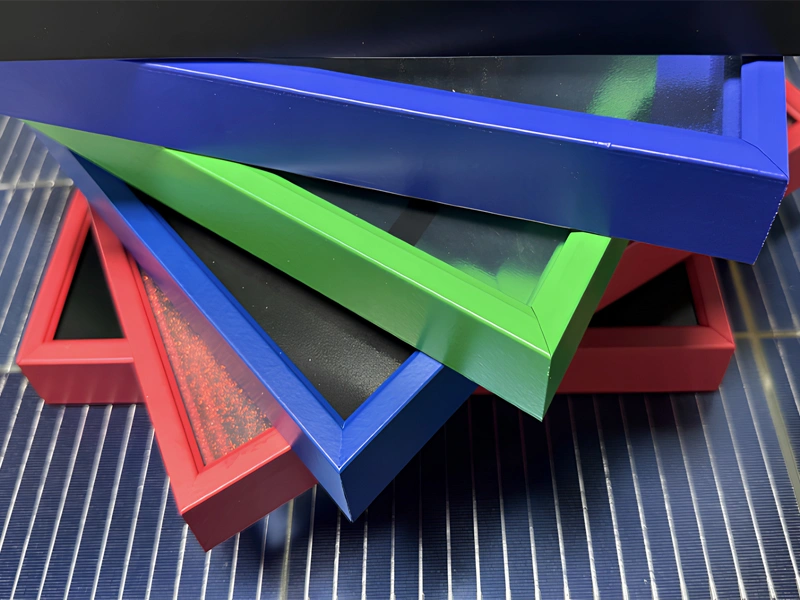
To meet the surface protection requirements of photovoltaic composite frames and similar materials, Betterial has developed WSD-3102 PV Composite Frame Coating.
WSD-3102 is a two-component, water-based acrylic weather-resistant coating consisting of Components A and B. Component A uses a water-based coating system, while Component B uses a polyisocyanate adduct as the curing agent.
The product is suitable for weather-resistant coating applications on glass-fiber-reinforced composite materials as well as metal components.
Within Betterial’s photovoltaic auxiliary material portfolio, WSD-3102 is primarily designed to provide composite frames with protection against UV radiation, corrosion, and long-term outdoor weathering.
According to currently available technical specifications, WSD-3102 offers the following characteristics:
- Black coating film suitable for black composite frame appearance requirements;
- Grade 0 adhesion in a 1 mm cross-cut test;
- Hardness of ≥2H;
- 60° gloss of 25–30;
- Recommended dry film thickness of 30 ± 5 μm;
- Recommended Component A to Component B mass ratio of 100:25;
- Suitable for application by air spraying.
Under forced-baking conditions, the coating may first be allowed to level at 40 ± 5°C for 20–40 minutes after spraying, followed by baking at 80 ± 5°C for approximately 1 hour.
These processing characteristics allow WSD-3102 to integrate with industrial surface treatment processes for photovoltaic composite frames, creating a black surface finish while adding an additional weather-resistant and corrosion-protective layer to the substrate.
For coastal and offshore photovoltaic applications, the coating system can be further evaluated through salt spray, damp heat, UV aging, and multi-factor cyclic reliability testing based on the specific environmental conditions of each project.
This helps determine the most appropriate coating process for the module structure and its intended operating environment.
Conclusion
Offshore photovoltaics are introducing PV module materials into environments that are significantly more demanding than conventional land-based installations.
Composite frames can reduce some of the corrosion issues associated with traditional metallic materials, while highly weather-resistant and anti-corrosion surface coatings can further improve the ability of composite frames to withstand salt spray, high humidity, ultraviolet radiation, and prolonged outdoor exposure.
As photovoltaic power plants continue to expand into coastal areas, tidal flats, nearshore locations, and offshore environments, requirements for lightweight construction, electrical insulation, corrosion resistance, and long-term reliability will continue to increase.
The combined use of composite frames and high-performance weather-resistant anti-corrosion coatings is therefore expected to become an important material strategy for improving the long-term environmental durability of offshore photovoltaic modules.