
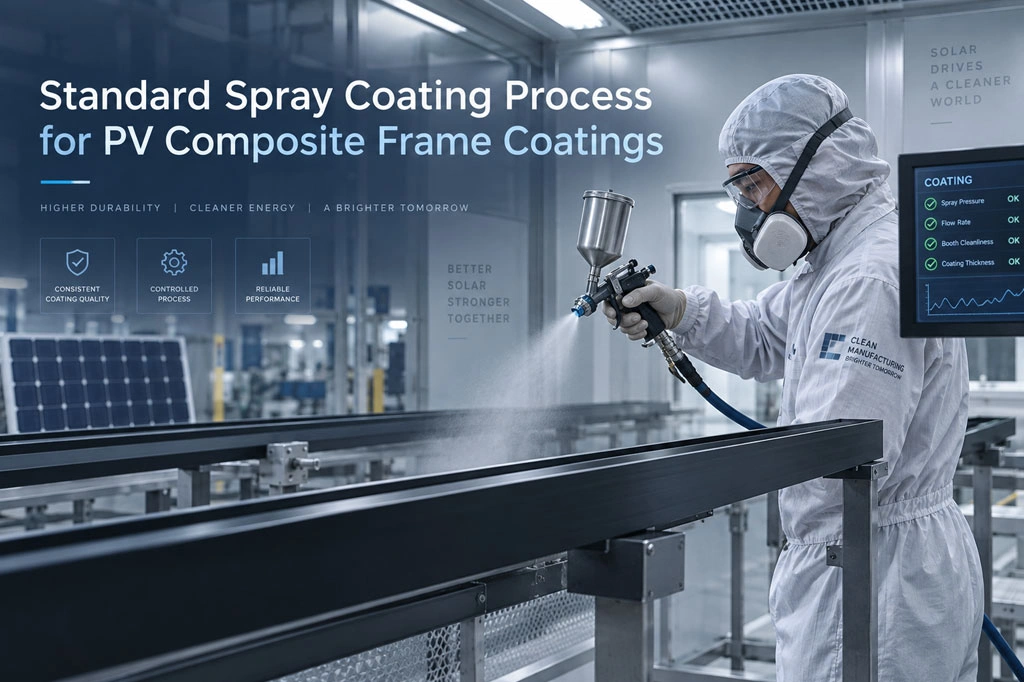
PV composite frame coatings form a continuous protective layer on the substrate surface, helping improve the appearance of photovoltaic module frames while enhancing their long-term resistance to outdoor environmental conditions.
However, coating performance itself is only one factor that determines the final coating quality. Substrate preparation, two-component mixing ratio, application viscosity, spray pressure, film thickness, and curing conditions can all directly affect coating adhesion, appearance, hardness, and consistency.
Therefore, in the mass production of PV composite frames, it is important to establish a stable and repeatable standard spray coating process.
Why Does the Spray Coating Process Matter So Much for PV Composite Frames?
Compared with conventional metal frames, glass-fiber-reinforced composite materials may show greater variation in surface condition, roughness, and consistency between different batches.
If surface pretreatment or application parameters are not properly controlled, common problems may include:
- Insufficient coating adhesion in localized areas;
- Visible surface particles or fiber patterns;
- Uneven film thickness;
- Sagging or orange peel;
- Pinholes or bubbles;
- Variations in gloss;
- Incomplete curing;
- Cracking or delamination during long-term use.
Therefore, a reliable coating process for composite frames should not focus only on “getting the coating onto the surface.” Instead, it should establish a complete and controlled process window covering:
substrate preparation → coating preparation → filtration → spraying → leveling → curing → inspection.
2. Spray Coating Process for PV Composite Frame Coatings
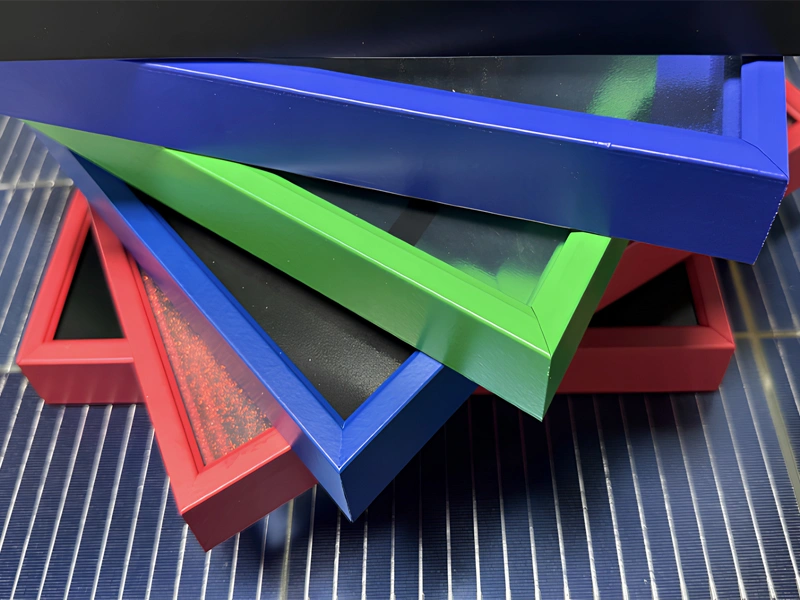
The following application parameters are based on Betterial WSD-3102 PV Composite Frame Coating.
WSD-3102 is a two-component, water-based acrylic weather-resistant coating. Component A is the water-based weather-resistant coating, while Component B uses a polyisocyanate adduct as the curing agent.
1. Substrate Surface Preparation
Before spraying, the composite frame surface should be clean, smooth, and properly prepared to provide a suitable surface condition for coating adhesion.
For WSD-3102, the recommended process is:
Primer application → sanding → dust removal → topcoat spraying
The product application instructions specify that the workpiece surface should first be coated with primer, followed by sanding and thorough dust removal.
Three issues require particular attention during this stage.
The surface must be free from visible dust
Fine dust can easily be generated when composite materials are sanded. If the dust is not completely removed, particles and surface roughness may appear after spraying, while the effective contact area between the coating and substrate may also be reduced.
The surface must be free from significant oil contamination
Contaminants may be introduced during mold release, transportation, processing, or manual handling. Severe contamination may cause cratering or localized adhesion failure.
Sanding should be uniform
Excessive sanding may damage the substrate surface, while insufficient sanding may negatively affect coating adhesion. A stable sanding process should therefore be established according to the specific substrate condition.
2. Pre-Mixing Component A
Before combining the two coating components, Component A should first be stirred thoroughly until uniform.
For WSD-3102, the recommended methods are:
- Manual stirring;
- Or low-speed mechanical stirring.
High-speed stirring should be avoided because excessive agitation can introduce large amounts of air into the coating, increasing the risk of bubbles and pinholes during subsequent spraying.
3. Mix Components A and B at the Correct Ratio
For two-component coatings, the mixing ratio is a critical process parameter.
The recommended mixing ratio for WSD-3102 is:
A : B = 100 : 25 by weight
In actual production, the ratio should not be estimated by experience. Reliable weighing equipment should be used.
Significant deviations in curing-agent dosage may affect:
- Curing speed;
- Coating hardness;
- Adhesion performance;
- Surface condition;
- Long-term durability.
For mass production, standardized weighing procedures and batch-mixing records should therefore be established.
4. Mix Thoroughly and Adjust the Application Viscosity
After Components A and B have been added, they should be thoroughly mixed manually or with low-speed mechanical stirring until the system becomes uniform.
Depending on the spraying equipment, spray gun nozzle size, and production environment, an appropriate amount of deionized water may be added to adjust the application viscosity.
The recommended spray viscosity for WSD-3102 is:
40–100 seconds using a Ford Cup No. 4
The specific value can be further adjusted according to actual spraying performance.
It should be noted that lower viscosity is not always better.
If the viscosity is too high, it may lead to:
- Poor atomization;
- Orange peel;
- Rough surfaces.
If the viscosity is too low, it may result in:
- Sagging;
- Excessive coating buildup around edges and corners;
- Difficulty controlling film thickness in a single spray pass.
A stable viscosity window should therefore be established based on the equipment, environmental conditions, and actual coating results.
5. Filter Before Spraying
After the coating has been prepared, it should be filtered before entering the spray gun.
For WSD-3102, the recommended filtration is:
200-mesh or 300-mesh filter
Filtration can effectively reduce the risk of the following entering the spray gun or becoming embedded in the coating surface:
- Undispersed particles;
- Contaminants introduced during packaging;
- Cured coating residue;
- Other foreign matter.
For black PV frames with high appearance requirements, even very small particles can be relatively visible. Therefore, proper filtration and spray booth cleanliness are particularly important.
6. Control the Pot Life After Mixing
Once the curing agent is added to a two-component coating, the chemical reaction begins. Therefore, the mixed coating has a limited pot life.
For WSD-3102:
- At ambient temperatures of ≤30°C, the coating should preferably be used within 4 hours;
- At ambient temperatures of ≥30°C, the coating should preferably be used within 3 hours.
Coating that has exceeded its recommended pot life should not continue to be used simply because it still “looks sprayable” in the container.
As the reaction progresses, the rheology, atomization behavior, and leveling performance of the coating may gradually change, increasing the risk of particles, orange peel, and inconsistent appearance.
For this reason, a small-batch, frequent-mixing approach is recommended for production.
7. Control the Spray Environment
The recommended application environment for WSD-3102 is:
- Temperature: 20–30°C
- Relative humidity: 45%–65% RH
- Air velocity: 0.2–0.5 m/s
For water-based coatings, ambient temperature and humidity directly affect the rate of water evaporation and the leveling process of the wet coating film.
Excessively high humidity may slow water evaporation, while overly dry conditions or excessive temperatures may cause the coating surface to lose water too quickly, reducing its ability to level properly.
For large-scale production, continuous monitoring of spray booth temperature, relative humidity, and airflow is therefore recommended.
8. Set Appropriate Spray Gun Parameters
WSD-3102 is applied by air spraying. The recommended spray pressure is:
0.35–0.6 MPa
The recommended distance between the spray gun and the workpiece is:
20–30 cm
The spray gun should also be kept as perpendicular to the workpiece surface as possible.
During spraying, operators should also maintain:
- A stable spray gun travel speed;
- A consistent gun-to-workpiece distance;
- Uniform overlap between spray passes;
- No prolonged spraying in one position;
- Avoidance of excessive coating buildup around edges and corners.
For long, narrow PV frame profiles, automated spraying can help reduce variations in spray speed, gun distance, and spraying angle associated with manual operation.
9. Control the Dry Film Thickness
A thicker coating is not necessarily a better coating.
The recommended final dry film thickness for WSD-3102 is:
30 ± 5 μm
If the film is too thin, coverage and overall protective performance may be affected.
If the film is too thick, the risk may increase for:
- Sagging;
- Surface drying while the inner layer remains insufficiently cured;
- Bubbles;
- Uneven curing;
- Internal coating stress.
Film thickness should therefore be checked regularly using appropriate measuring instruments rather than relying solely on visual judgment by spray operators.
10. Leveling and Curing
After spraying, the coated frame should not be immediately exposed to high-temperature baking.
The recommended forced-curing process for WSD-3102 is:
Leveling / flash-off at 40 ± 5°C for 20–40 minutes → baking at 80 ± 5°C for 1 hour
The product can also be dried naturally at room temperature. However, for continuous production lines, standardized oven-curing conditions are more suitable for maintaining a stable production cycle.
One important purpose of the flash-off stage is to allow water in the wet coating film to evaporate gradually.
If a freshly sprayed coating with high moisture content is immediately exposed to a higher temperature, rapid water evaporation may increase the risk of defects such as pinholes and bubbles.
Conclusion
For large-scale PV composite frame production, key process parameters should be incorporated into a standardized SOP. Mixing ratio, application viscosity, ambient temperature and humidity, spray pressure, film thickness, and curing temperature should all be continuously monitored and recorded.
Only by shifting the spray coating process from experience-based control to parameter-based process control can manufacturers achieve greater consistency in the appearance of PV composite frame coatings and improve their long-term reliability.