
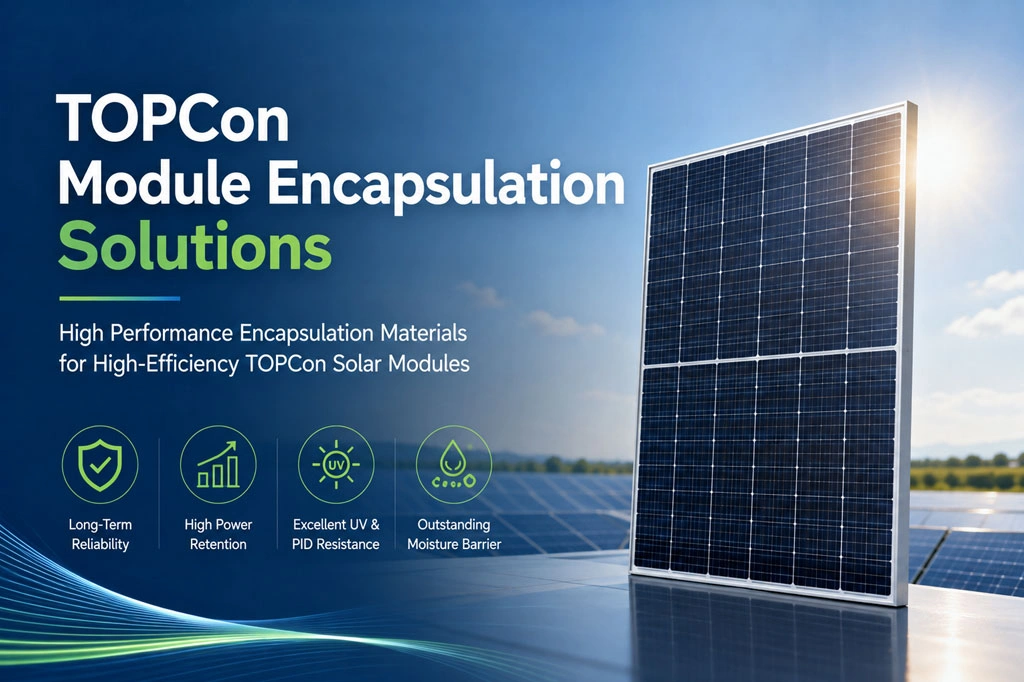
As TOPCon (Tunnel Oxide Passivated Contact) technology continues to gain adoption in the photovoltaic industry, module manufacturers are increasingly focused not only on cell efficiency but also on how to preserve that efficiency throughout decades of outdoor operation.
Higher cell efficiency alone does not guarantee higher lifetime energy yield. Moisture, heat, ultraviolet radiation, electrical potential, and material interactions can gradually affect module performance. For this reason, encapsulation materials are becoming an increasingly important part of TOPCon module design.
A well-designed TOPCon encapsulation solution must provide more than basic bonding and protection. It needs to balance optical performance, corrosion resistance, weather durability, anti-PID performance, manufacturing compatibility, and overall module cost.
Why Do TOPCon Modules Need Advanced Encapsulation Materials?
TOPCon cells use advanced passivated-contact structures to achieve high conversion efficiency. However, the long-term performance of these cells depends heavily on the surrounding module materials.
During outdoor operation, PV modules may experience high temperature and humidity, prolonged UV exposure, thermal cycling, mechanical stress, and high system voltage. Moisture penetration and ion migration can also contribute to corrosion and potential-induced degradation (PID).
Encapsulation films therefore act as a critical protective interface between the solar cells and the external environment.
For TOPCon applications, several properties are particularly important:
- High light transmittance to maximize photon utilization
- Strong resistance to damp heat and weathering
- Low risk of corrosion-related degradation
- Excellent anti-PID and anti-polarization performance
- Stable adhesion throughout long-term aging
- Compatibility with high-throughput module lamination processes
The challenge is achieving these properties without unnecessarily increasing material and manufacturing costs.
Betterial’s TOPCon Module Encapsulation Solution
Betterial has developed encapsulation solutions for both single-glass and double-glass TOPCon module structures.
Through a unique acid-resistant and anti-polarization formulation combined with advanced processing technologies, the solution is designed to improve corrosion resistance, weather durability, and resistance to polarization-related degradation.
At the same time, the solution is designed with commercial module manufacturing in mind. Through advanced material combinations, BOM costs can be reduced by approximately 25%, helping module manufacturers pursue both long-term reliability and cost competitiveness.
Encapsulation Solution for Single-Glass TOPCon Modules
Single-glass modules typically combine front glass with a polymer backsheet. Because the rear side is not protected by a second glass layer, the encapsulation and backsheet systems must work together to provide adequate environmental protection.
Betterial offers several material configurations depending on the module’s performance and cost requirements.
Front-Side Encapsulation
For the cell-facing front side, two primary options are available:
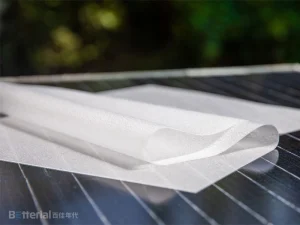
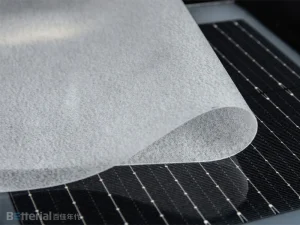
Co-extruded EPE Film – B602M
EPE combines different polymer layers within a co-extruded structure, providing a practical balance between the processing advantages of EVA and the protective characteristics required for high-efficiency modules.
High-Transmittance EVA Film – B601HP
High-transmittance EVA is designed to minimize optical losses between the front glass and TOPCon cells. Greater photon transmission supports higher initial module power and energy generation.
Selecting between EPE and high-transmittance EVA allows module manufacturers to optimize encapsulation according to reliability requirements, module architecture, and target cost.
Rear-Side Encapsulation
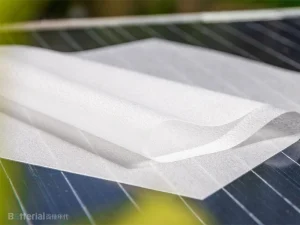
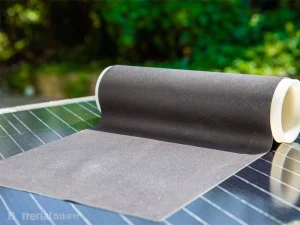
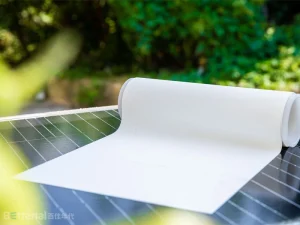
Several rear encapsulation materials can be selected:
- B601P encapsulation EVA film
- B601W white EVA encapsulation film
- B601RS black infrared-reflective encapsulation film
This flexibility makes it possible to adapt the rear-side design to different module requirements.
White encapsulation materials can improve internal light utilization through reflection, while black encapsulation films can support the aesthetic requirements of all-black residential modules. Functional infrared-reflective designs can further combine appearance requirements with optical performance.
Backsheet Options
The encapsulation system can also be paired with different backsheets, including:
- CPC backsheet
- High-barrier backsheet
- Mesh backsheet
- High-reflectivity backsheet
Rather than treating the encapsulant and backsheet as independent components, optimizing them as an integrated material system can improve the balance among moisture protection, optical performance, reliability, and cost.
Encapsulation Solution for Double-Glass TOPCon Modules
Double-glass modules replace the conventional polymer backsheet with a second glass layer, creating a different encapsulation environment.
For double-glass TOPCon modules, Betterial recommends:
Front side: Co-extruded EPE film B602M or high-transmittance EVA film B601HP
Rear side: High-transmittance EVA film B601HP
The symmetric or near-symmetric glass structure provides strong environmental protection, while the encapsulation films maintain bonding, optical performance, and protection around the cells.
This configuration is particularly relevant for projects where long-term durability and stable power generation are priorities.
Conclusion
The continued expansion of TOPCon technology is raising the performance requirements placed on PV encapsulation materials.
An effective TOPCon module encapsulation solution must simultaneously address light transmission, corrosion resistance, damp-heat durability, anti-polarization performance, manufacturing compatibility, and material cost.
Betterial provides tailored encapsulation configurations for both single-glass and double-glass TOPCon modules, combining EPE and high-transmittance EVA films with functional rear encapsulants and backsheet options.