
For many years, EVA has been the dominant encapsulation material in the solar industry. However, the rapid adoption of high-efficiency module technologies has increased demand for encapsulation films with stronger moisture resistance and better electrical reliability.
One solution that has gained significant attention is EPE solar film.
But what exactly is EPE solar film? How is it different from EVA and POE? And why are more PV module manufacturers considering EPE for high-efficiency solar modules?
1. What Is EPE Solar Film?
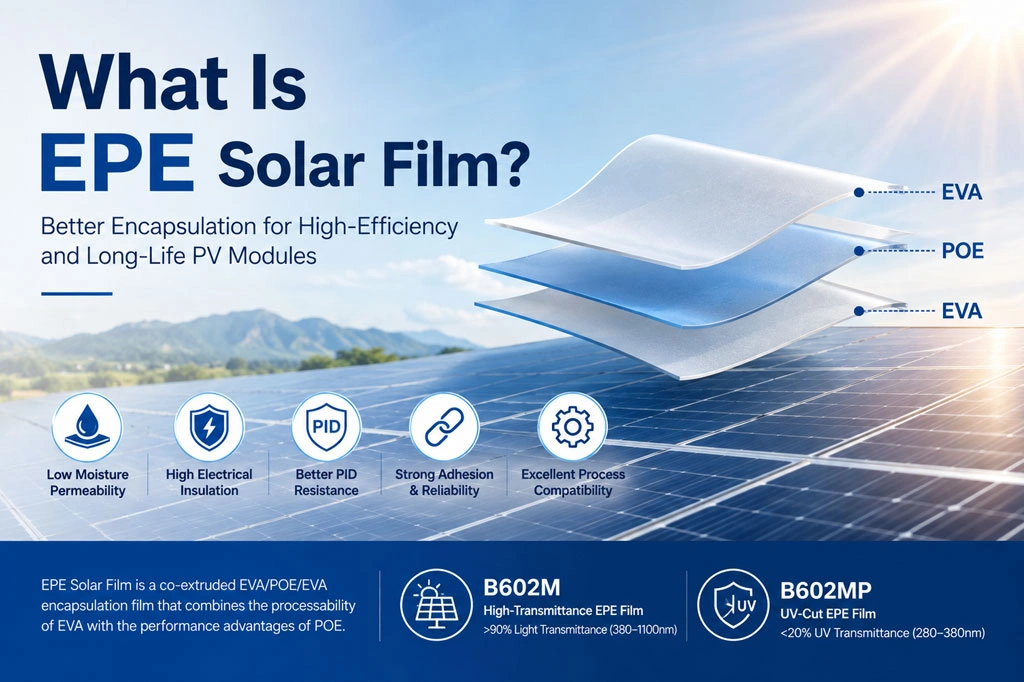
EPE solar film, also known as EPE encapsulation film, is a multilayer photovoltaic encapsulation material typically constructed as:
EVA / POE / EVA
In this structure:
- EVA layers form the outer layers of the film.
- POE (polyolefin elastomer) forms the central functional layer.
Outer EVA Layers
The EVA layers are designed to provide:
- Good adhesion to glass and other module materials
- Reliable crosslinking during lamination
- Good optical transparency
- Flexible processing
- Compatibility with established PV module production lines
Because EVA has been widely used in solar module manufacturing for decades, module manufacturers are already familiar with its processing characteristics.
Middle POE Layer
The POE core serves as an important functional barrier.
Compared with conventional EVA, POE generally offers advantages in areas such as:
- Lower water vapor transmission rate
- Higher volume resistivity
- Better electrical insulation
- Greater resistance to potential-induced degradation-related risks
- Improved stability in demanding environmental conditions
The resulting EPE structure therefore attempts to achieve a practical balance between the processing benefits of EVA and the protective properties associated with POE.
2. How Is EPE Solar Film Manufactured?
EPE solar film is generally produced through a multilayer co-extrusion process.
Instead of manufacturing separate EVA and POE films and stacking them during module assembly, the different polymer layers are combined during film production.
The process typically includes:
- Preparing EVA and POE resin formulations.
- Melting the polymer materials in separate extrusion systems.
- Feeding the materials into a multilayer co-extrusion die.
- Forming an integrated EVA/POE/EVA structure.
- Controlling film thickness and layer distribution.
- Cooling and stabilizing the film.
- Winding the finished film into rolls.
- Performing optical, dimensional, crosslinking, adhesion, and electrical performance tests.
The quality of the co-extrusion process is important because the thickness distribution and uniformity of each layer can directly influence the performance of the finished encapsulation film.
3. Key Advantages of Using EPE Film in Solar Modules
3.1 Improved Moisture Resistance
Moisture ingress is one of the long-term challenges facing photovoltaic modules.
Excessive moisture can contribute to:
- Corrosion of metal components
- Degradation of interfaces
- Reduced insulation performance
- Accelerated aging of certain module materials
The POE layer in EPE film provides stronger moisture barrier properties than conventional EVA alone.
This can make EPE particularly useful for modules designed for humid environments or long-term outdoor exposure.
3.2 Better Electrical Insulation
Modern high-power modules can operate under demanding system voltages and electrical conditions.
POE is known for its high electrical resistivity and strong insulation characteristics. Incorporating a POE core into EPE film can therefore improve the electrical protection of the module.
This characteristic is especially relevant for high-efficiency modules where long-term electrical reliability is a major design consideration.
3.3 Improved PID Resistance
Potential-Induced Degradation (PID) can cause significant power loss in PV modules under certain combinations of system voltage, temperature, humidity, and material conditions.
Encapsulation material selection can influence PID resistance.
Because the POE layer offers strong electrical insulation and low moisture permeability, EPE can help module manufacturers design encapsulation systems with improved resistance to PID-related degradation.
However, PID performance should always be evaluated at the complete module level, because glass, cells, encapsulants, frames, grounding configuration, and other components can all influence the final result.
3.4 Good Lamination Processability
One reason manufacturers continue to use EVA extensively is its mature processing behavior.
Switching completely from EVA to POE may require adjustments to production conditions depending on the film formulation and module design.
EPE retains EVA on both outer surfaces, helping preserve many of the processing characteristics manufacturers already understand.
Depending on the specific formulation, this can make EPE easier to integrate into existing module production processes while still providing some of the functional advantages associated with POE.
3.5 Balance Between Performance and Cost
Using full POE encapsulation can provide excellent performance, but material cost and production efficiency remain important considerations for high-volume module manufacturing.
EPE provides another design option.
Instead of using a homogeneous POE film, manufacturers can use a multilayer structure in which POE is concentrated in the functional core while EVA forms the outer layers.
Therefore, EPE should not simply be viewed as “cheaper POE.”
Its real value is in material engineering: placing different polymers where their respective properties provide the greatest benefit.
4. Betterial EPE Solar Films
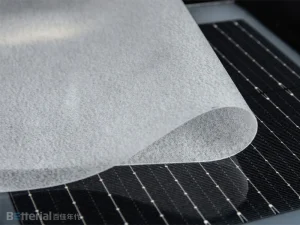
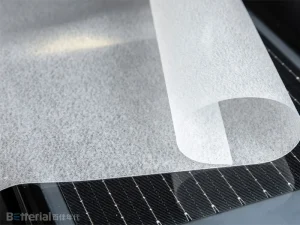
Betterial’s current EPE solar film portfolio includes B602M and B602MP.
- B602M is a high-transmittance EPE solar film developed for high-efficiency photovoltaic modules.
- B602MP is a UV-cut EPE solar film developed to reduce UV exposure to sensitive module materials.
B602M vs B602MP
| Parameter | B602M | B602MP |
|---|---|---|
| Product Positioning | High-transmittance | UV-cut |
| 280–380 nm Transmittance | >80% | <20% |
| 380–1100 nm Transmittance | >90% | >90% |
| Volume Resistivity | >1×10¹⁵ Ω·cm | >1×10¹⁵ Ω·cm |
| Crosslink Degree | >80% | >80% |
| Glass Peel Strength | ≥60 N/cm | >80 N/cm |
| Backsheet Peel Strength | ≥60 N/cm | >80 N/cm |
| Main Advantage | High light transmission | UV protection + high light transmission |
| Typical Applications | N-TOPCon, BC, HJT, 0BB and lightweight modules | Transparent backsheet and high-reliability modules |
5. The Role of EPE in Next-Generation PV Modules
The evolution from EVA toward POE and EPE reflects a broader change in photovoltaic manufacturing.
Encapsulation film is becoming an increasingly specialized functional material.
Different cell and module technologies may require different combinations of:
- Optical transmission
- UV management
- Moisture protection
- Electrical insulation
- Adhesion
- Low-temperature processing
- Anti-PID performance
- Long-term aging resistance
As TOPCon, BC, HJT, 0BB and other advanced module technologies continue to develop, the industry is unlikely to rely on a single universal encapsulation material.
Instead, encapsulation solutions will increasingly be optimized around the specific module architecture.
EPE fits into this trend by combining multiple polymers in a functional multilayer structure rather than relying on the properties of one polymer alone.
Conclusion
EPE solar film is an EVA/POE/EVA co-extruded photovoltaic encapsulation film. It combines the processing advantages and adhesion characteristics of EVA with the moisture resistance and electrical insulation benefits associated with POE.
For PV module manufacturers, its main value lies in achieving a practical balance among reliability, processability, and cost.