
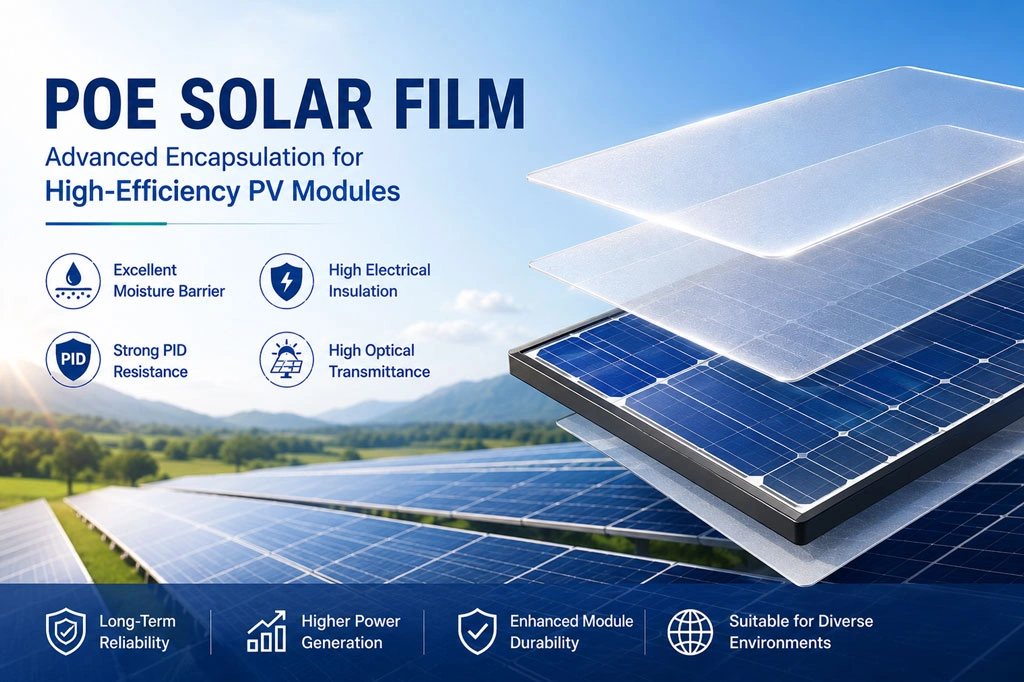
As photovoltaic technology advances toward higher-efficiency cell types such as TOPCon, HJT, BC, and other next-generation designs, module manufacturers are paying increasing attention to materials that protect solar cells throughout decades of outdoor operation.
Among these materials, POE solar film has become an important encapsulation option, particularly for modules requiring stronger moisture resistance and electrical insulation.
But what exactly is POE solar film? How does it work, and how is it different from traditional EVA solar film?
1. What Is POE Solar Film?
POE solar film, also known as POE encapsulation film or POE solar encapsulant, is a polymer film used to encapsulate photovoltaic cells inside solar modules.
POE stands for Polyolefin Elastomer, a type of thermoplastic elastomer based on polyolefin chemistry.
During solar module manufacturing, POE film is placed between the solar cells and other module layers. After lamination under controlled temperature, pressure, and vacuum conditions, the film crosslinks and bonds the different module components together.
Once laminated, the POE encapsulation material serves several functions simultaneously:
- Bonds cells to glass and rear-side materials
- Protects fragile solar cells from environmental exposure
- Provides electrical insulation
- Reduces moisture penetration
- Helps maintain long-term module reliability
- Provides optical transmission for efficient sunlight utilization
Therefore, POE film is not simply an adhesive layer. It is an important part of the module’s long-term protection system.
2. Why Is POE Film Used in Solar Modules?
For many years, EVA has been the dominant encapsulation material in the photovoltaic industry because of its mature processing technology, good optical properties, and competitive cost.
However, higher-efficiency cell technologies have created new encapsulation challenges.
One of the most important concerns is moisture and ion migration.
When moisture enters a photovoltaic module, it can contribute to corrosion and electrical degradation. In certain module structures, ion migration—particularly sodium-ion migration from glass—can also negatively affect cell performance and increase the risk of potential-induced degradation (PID).
POE provides an effective solution because of its polyolefin molecular structure.
Compared with conventional EVA, POE generally provides:
2.1 Excellent Moisture Barrier
One of the most recognizable characteristics of POE solar film is its low water vapor transmission rate.
Moisture can gradually penetrate a photovoltaic module during years of outdoor exposure. Excessive moisture ingress may contribute to:
- Cell metallization corrosion
- Ribbon and interconnection corrosion
- Encapsulant degradation
- Reduced electrical insulation
- Power degradation
Using an encapsulant with strong moisture-barrier performance provides another line of protection for sensitive components inside the module.
This becomes especially important for solar projects operating in hot and humid environments.
2.2 High Electrical Insulation
PV modules operate under increasingly demanding electrical conditions as system voltages and module power ratings increase.
POE generally provides high volume resistivity, which contributes to effective electrical insulation between cells and other components.
This property is particularly valuable when controlling leakage currents and reducing PID risk.
3.3 Strong PID Resistance
Potential-induced degradation can cause significant module power loss under certain combinations of high system voltage, temperature, humidity, and module construction.
Encapsulation material plays an important role in controlling the movement of moisture and ions through the module.
Because POE combines low moisture permeability with strong electrical insulation, it can provide improved protection against PID in suitable module designs.
3. POE vs. EVA Solar Film
POE and EVA are both widely used photovoltaic encapsulation materials, but their characteristics differ.
| Property | POE Solar Film | EVA Solar Film |
|---|---|---|
| Moisture barrier | Excellent | Good |
| Electrical insulation | Excellent | Good |
| PID resistance | Excellent | Depends on formulation |
| Optical transmittance | High | High |
| Processing maturity | High | Very high |
| Cost | Generally higher | Generally lower |
EVA remains highly competitive for many mainstream module applications because of its processing stability, optical performance, adhesion, established supply chain, and cost advantages.
POE becomes especially valuable when the module type requires stronger moisture protection, electrical insulation, and PID resistance.
The correct encapsulant therefore depends on cell technology, module structure, reliability requirements, lamination process, target market, and project environment.
4. Betterial POE Solar Films
As photovoltaic technologies continue to evolve, encapsulation requirements are becoming increasingly application-specific.
Betterial has developed POE solar films for different module types and reliability requirements.
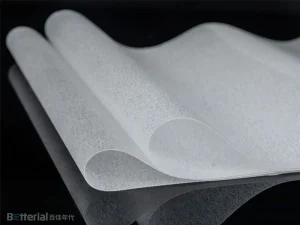
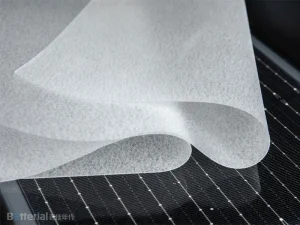
Our POE solar film portfolio includes:
- B602 POE Solar Film
- B602P POE Solar Film
| Product Model | Material / Structure | Key Features | Optical Performance | Electrical Performance | Typical Applications |
|---|---|---|---|---|---|
| B602 | Crosslinkable high-transmittance POE solar film | Excellent moisture barrier, weather resistance, PID resistance, strong peel retention | >91% transmittance (380–1100 nm) | Volume resistivity >1×10^15 Ω·cm; ΔYI <3.0 after damp-heat & UV aging | Dual-glass PV modules, lightweight PV modules |
| B602P | Fast-curing UV-cut POE solar film | Fast lamination, excellent weather resistance, PID resistance, high adhesion | <30% UV transmittance (280–380 nm); >91% transmittance (380–1100 nm) | Volume resistivity >1×10^15 Ω·cm; ΔYI <3.0 after aging | Dual-glass modules, high-reliability PV modules |
These products allow module manufacturers to select encapsulation solutions according to module structure, cell technology, processing requirements, and target reliability performance.