
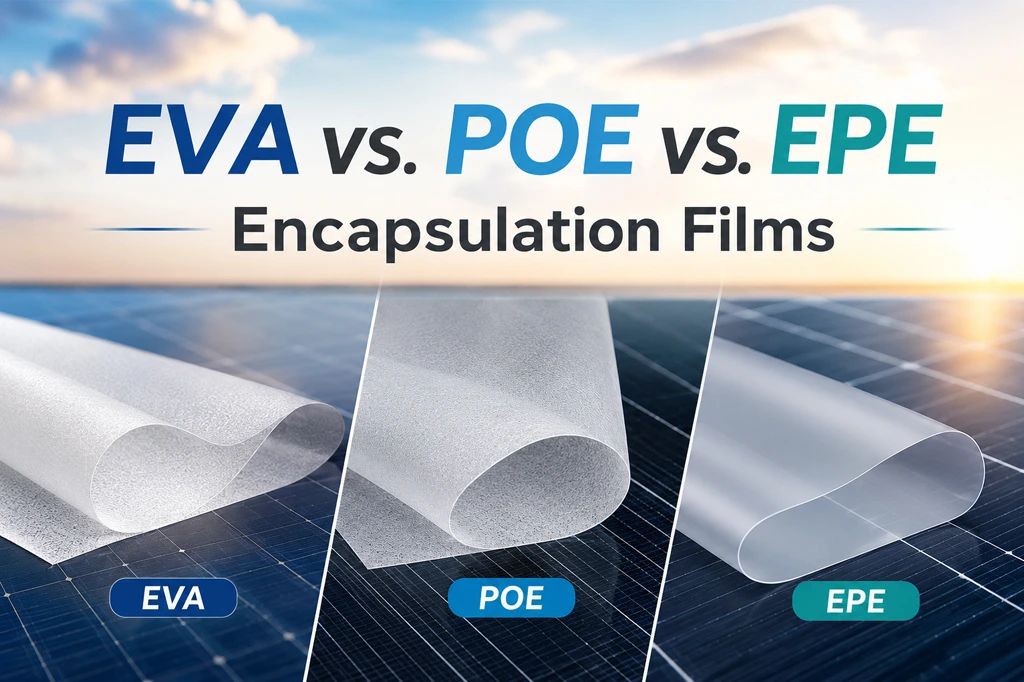
The encapsulation film is often referred to as the “silent protector” of a photovoltaic (PV) module. Although it accounts for only a small portion of the module’s overall cost, it directly influences long-term power output, durability, reliability, and product warranty performance.
As PV technology rapidly evolves toward higher power efficiency, bifacial generation, larger wafer sizes, and longer shelf lifetimes, the traditional question of “Which encapsulation film is cheaper?” has gradually shifted to “Which encapsulation film delivers the best lifetime value?”
Among today’s mainstream options, EVA, POE, and EPE encapsulation films offer unique advantages. Rather than viewing them as competing materials, manufacturers should consider them as solutions optimized for different module applications and investment priorities.
Why Encapsulation Film Selection Matters More Than Ever?
Historically, encapsulation film primarily served three functions:
- Bonding solar cells to glass and backsheet
- Protecting cells from moisture and mechanical stress
- Providing electrical insulation
However, advanced PV modules place much greater demands on encapsulation materials.
Today’s modules operate at higher voltages, larger current densities, and often remain installed for over 30 years under harsh outdoor conditions. As technologies such as TOPCon, HJT, BC (Back Contact), and perovskite tandem cells become increasingly common, encapsulation films must now provide:
- Excellent moisture barrier from the environment
- High volume resistivity
- Stable UV resistance
- Excellent PID resistance
- Minimal optical degradation
- Long-term adhesion stability
In other words, encapsulation films have evolved from passive protective layers into critical performance materials that directly affect energy yield throughout the module’s shelf life.
EVA vs. POE vs. EPE: A Quick Comparison
| Comparison Item | EVA | POE | EPE |
| Material Structure | Ethylene Vinyl Acetate | Polyolefin Elastomer | EVA + POE + EVA Co-extruded |
| Cost | ★★★★★ Lowest | ★★☆☆☆ Highest | ★★★★☆ Medium |
| Moisture Barrier | ★★☆☆☆ | ★★★★★ | ★★★★☆ |
| PID Resistance | ★★☆☆☆ | ★★★★★ | ★★★★☆ |
| Electrical Insulation | ★★★☆☆ | ★★★★★ | ★★★★☆ |
| UV & Weather Resistance | ★★★★☆ | ★★★★★ | ★★★★☆ |
| Yellowing Resistance | ★★★☆☆ | ★★★★★ | ★★★★☆ |
| Adhesion to Glass/Backsheet | ★★★★★ | ★★★★☆ | ★★★★★ |
| Lamination Processability | ★★★★★ Easy | ★★★☆☆ More Demanding | ★★★★★ Easy |
| Long-Term Reliability | ★★★☆☆ | ★★★★★ | ★★★★☆ |
EVA: The Mature Industry Standard
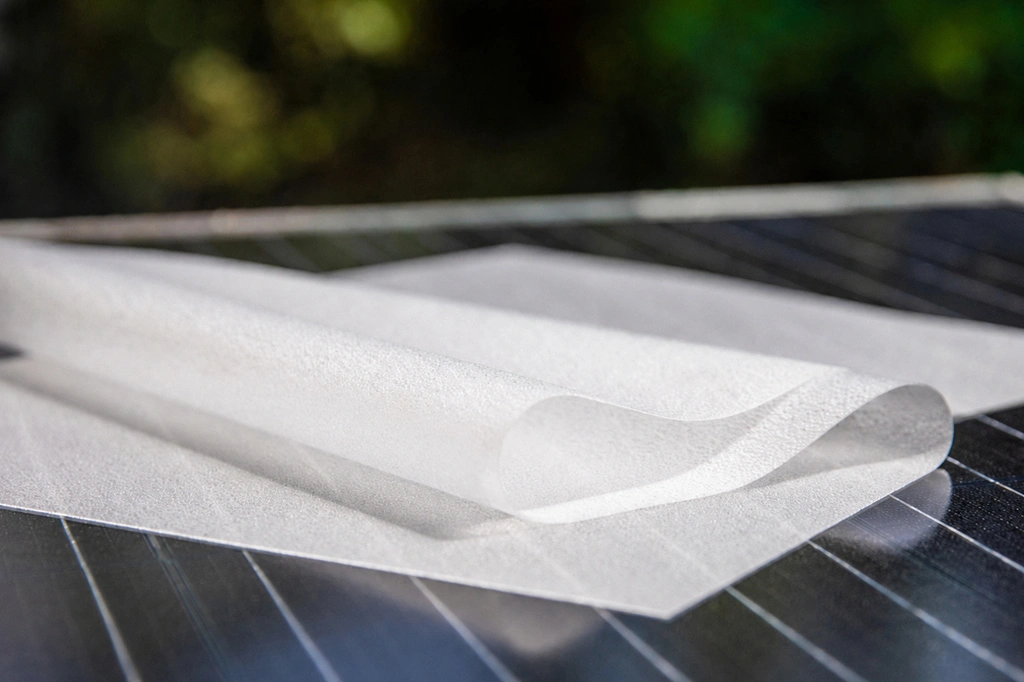
For more than two decades, EVA encapsulation film has dominated the global PV industry.
Its popularity stems from several practical advantages:
- Mature manufacturing technology
- Excellent process compatibility
- Fast lamination
- Strong adhesion to glass and backsheet
- Competitive cost
These characteristics make EVA encapsulation films the preferred option for standard mono-PERC residential and commercial modules.
However, as module efficiency continues to improve, EVA’s material limitations become more apparent.
Key Challenges of EVA Encapsulation Films
1. Higher Water Vapor Transmission
EVA’s WVTR is ten times that of POE.
Over many years of outdoor exposure, moisture penetration may accelerate:
- Cell corrosion
- Interconnection ribbon under the higher moisture surrounding
- Hydrolysis of internal materials
This becomes particularly important in tropical, coastal, or high-humidity environments.
2. Acetic Acid Releasing
Under long-term heat and humidity, EVA may generate trace amounts of acetic acid during aging.
Although optimized formulations have greatly reduced this issue, long-term acid formation may still contribute to metallic corrosion of the solar cell.
3. Moderate PID Resistance
Potential Induced Degradation (PID) becomes increasingly significant in high-voltage power station.
Compared with POE-based solutions, EVA generally provides lower electrical insulation, with the increasing application of high-power PV modules, PID effects have become increasingly critical and sensitive in photovoltaic power plant operation.
POE: Reliability-Oriented Performance Material
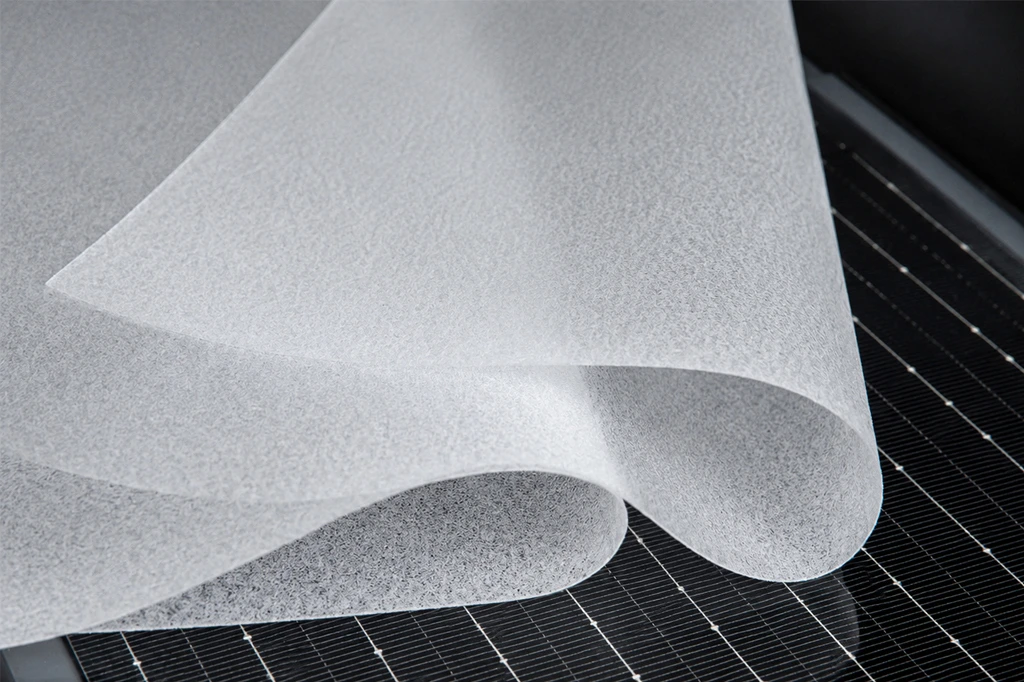
POE encapsulation film has become the preferred encapsulation material for premium PV modules because it addresses many of EVA’s intrinsic weaknesses.
Instead of focusing on processing convenience, POE is engineered for maximum long-term reliability.
Its major advantages include:
Extremely Low Moisture Permeability
POE dramatically reduces water vapor penetration.
Lower moisture ingress helps preserve:
- Metal electrode of the solar cell
- Busbars
- Interconnections
This makes POE especially attractive for:
- Coastal installations
- Floating solar farms
- Tropical climates
- Desert environments with extreme temperature cycles
Outstanding PID Resistance
POE exhibits significantly higher volume resistivity than EVA.
Higher electrical insulation minimizes leakage current, substantially improving resistance to PID.
As module operating voltages continue to rise toward 1500V systems, this advantage becomes increasingly valuable.
Better Long-Term Optical Stability
POE generally demonstrates:
- Lower yellowing tendency
- Higher UV stability
- Better light transmission retention
These characteristics contribute to more stable energy production over decades.
The Trade-Off
POE is not without disadvantages.
Manufacturers often face:
- Higher raw material costs
- Narrower lamination processing windows
- Longer curing requirements
- More demanding production control
For some price-sensitive projects, these factors may outweigh its reliability benefits.
EPE: The Balanced Solution
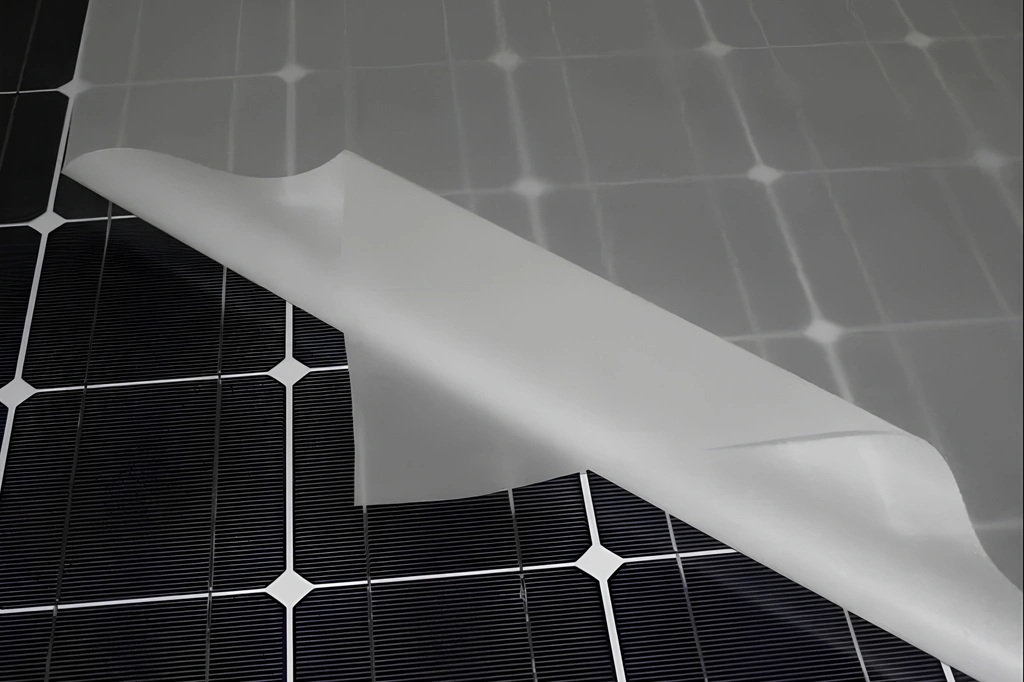
EPE encapsulation film has emerged as one of the fastest-growing encapsulation technologies in recent years.
Rather than replacing EVA or POE, EPE combines their strengths while minimizing their weaknesses.
The structure typically consists of:
- EVA outer layer
- POE core layer
- EVA outer layer
This multilayer design creates a practical balance between manufacturability and long-term reliability.
Better Processing Compatibility
The EVA outer layers maintain excellent adhesion with:
- Glass
- Backsheet
- No contact with frame
Manufacturers can often use existing EVA lamination equipment with only minimal process adjustments.
Improved Moisture Barrier
The POE core acts as the primary moisture barrier, significantly reducing water vapor transmission compared with conventional EVA.
This extends module durability without requiring a complete transition to full POE production.
Enhanced Cost Efficiency
One of EPE’s greatest strengths lies in its economics.
Manufacturers obtain much of POE’s performance improvement while avoiding the full material cost associated with double-sided POE encapsulation.
This creates a highly attractive balance between reliability and investment.
Conclusion
EVA, POE, and EPE each represent a different philosophy of module design.
- EVA prioritizes mature manufacturing, low cost, and broad compatibility.
- POE focuses on maximum reliability, superior electrical insulation, and long-term durability for specified
- EPE bridges the gap by delivering much of POE’s performance while maintaining the processability and cost advantages of EVA.
As the photovoltaic industry moves toward higher efficiency modules and longer performance warranties, encapsulation film selection is becoming a strategic engineering decision rather than simply a material purchase. Manufacturers that align encapsulation technology with module type, installation environment, and lifecycle economics will ultimately deliver more competitive products and greater long-term value to their customers.