
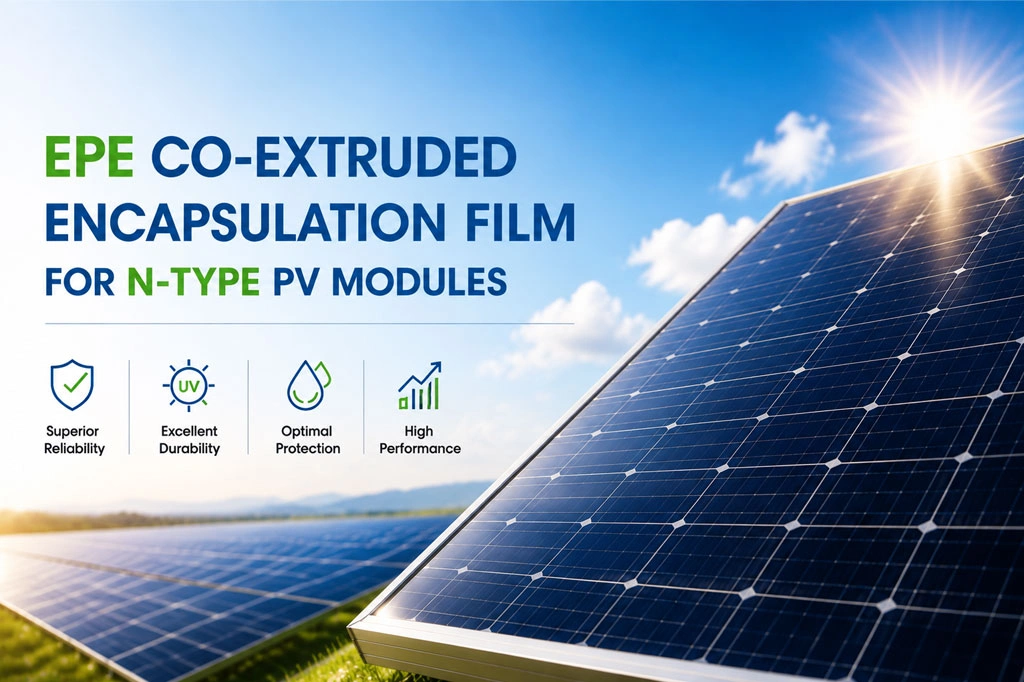
The rapid growth of N-type photovoltaic technologies, including TOPCon, HJT, BC (Back Contact), and other high-efficiency cell types, has raised new requirements for solar module encapsulation materials.
Compared with traditional P-type PERC modules, N-type modules offer higher efficiency potential but are also more sensitive to:
- Potential-induced degradation (PID)
- Moisture penetration
- Acetic acid corrosion
- Metal-ion migration
- Long-term reliability under harsh climates
As a result, POE encapsulation film has become widely adopted in many N-type module applications due to its excellent moisture barrier performance and low ionic impurity characteristics.
However, the increasing demand for POE has also created new challenges:
- Higher material costs compared with EVA
- Limited global supply capacity
- Increased procurement pressure for module manufacturers
- Greater cost sensitivity in a highly competitive PV market
To address this challenge, EPE co-extruded encapsulation film has emerged as an optimized solution, combining the advantages of EVA and POE while reducing dependence on pure POE materials.
1. Why N-Type Modules Require Advanced Encapsulation Materials
The transition from P-type to N-type technology is not only a change in cell structure but also a challenge for module reliability.
Higher Efficiency Requires Better Protection
N-type cells generally feature advanced passivation structures and lower defect density, enabling higher conversion efficiency.
However, these improvements also increase sensitivity to environmental stress factors.
For example:
- TOPCon cells rely on passivation layers that can be affected by moisture and ion contamination.
- HJT cells contain temperature-sensitive structures requiring lower thermal stress during lamination.
- BC cells have complex rear-side electrical designs that require enhanced protection against degradation mechanisms.
Therefore, encapsulation materials must provide:
| Reliability Requirement | Importance for N-Type Modules |
|---|---|
| Low water vapor transmission rate | Prevent moisture-related degradation |
| Strong PID resistance | Protect electrical performance |
| Low ionic migration | Reduce cell corrosion risks |
| High adhesion | Prevent delamination |
| UV resistance | Improve outdoor durability |
This has accelerated the adoption of high-performance encapsulation solutions.
2. POE Film: Excellent Performance but Higher Cost Pressure
POE film has become one of the preferred choices for premium N-type modules because of its outstanding reliability advantages.
Key Advantages of POE
Excellent Moisture Barrier
Compared with EVA, POE has significantly lower water vapor transmission rates (WVTR), making it suitable for:
- Desert PV projects
- Coastal installations
- High-humidity environments
Superior PID Resistance
POE contains no ester groups and generates fewer degradation-related byproducts, providing excellent resistance against PID.
This makes it particularly suitable for:
- TOPCon modules
- HJT modules
- High-voltage PV systems
Reduced Chemical Degradation
Unlike EVA, POE does not generate acetic acid during aging, helping reduce corrosion risks.
However, Pure POE Has Cost Challenges
Although technically attractive, 100% POE encapsulation increases module manufacturing costs.
Major challenges include:
1. Higher Raw Material Cost
POE resin is more expensive than EVA resin due to:
- Complex polymerization technology
- Limited supplier availability
- Higher production costs
2. Supply Chain Pressure
The rapid expansion of N-type module production has increased demand for POE materials, creating procurement challenges.
3. Cost Optimization Requirements
PV manufacturers are under continuous pressure to reduce:
- Manufacturing cost per watt
- Module production expenses
Therefore, the industry needs a solution that balances performance and cost.
3. EPE Co-Extruded Film: A Balanced Solution Between EVA and POE
EPE encapsulation film is designed based on a multi-layer co-extrusion structure:
EVA / POE / EVA
By integrating POE in the functional core layer and EVA in the outer layers, EPE achieves a balance between reliability and cost efficiency.
The design principle is simple:
- The POE middle layer provides moisture resistance and PID protection.
- The EVA outer layers provide excellent adhesion and manufacturing compatibility.
This structure allows module manufacturers to obtain many benefits of POE while reducing the amount of expensive POE material used.
4. How EPE Reduces POE Procurement Costs
Lower POE Consumption
A pure POE solution requires the entire encapsulation layer to use POE material.
EPE reduces POE usage by placing POE only where it provides the greatest value—the functional barrier layer.
This significantly reduces dependence on high-cost POE resin.
For large-scale module production, even a small reduction in POE consumption can create substantial savings.
Optimized Material Cost Without Sacrificing Reliability
EPE provides a more economical pathway:
| Encapsulation Solution | Material Cost | Reliability Performance | Suitable Applications |
|---|---|---|---|
| EVA | ★ Lowest | Good | Conventional modules |
| POE | ★★★ Highest | Excellent | Premium N-type modules |
| EPE | ★★ Medium | Excellent | TOPCon, HJT, BC modules |
EPE achieves a better cost-performance balance, especially for manufacturers producing millions of modules annually.
Improved Supply Chain Flexibility
By reducing reliance on pure POE, manufacturers can:
- Diversify encapsulation material sourcing
- Reduce procurement risks
- Improve production stability
- Better control manufacturing costs
This is increasingly important as global PV capacity continues expanding.
5. EPE Performance Advantages for N-Type Modules
Excellent PID Resistance
The POE layer inside EPE effectively blocks ion migration pathways, helping improve PID resistance.
This makes EPE suitable for:
- TOPCon modules
- BC modules
- HJT modules
Strong Moisture Protection
The POE core layer provides enhanced moisture barrier properties, supporting long-term reliability in:
- Humid regions
- Coastal areas
- Tropical climates
Better Manufacturing Compatibility
Compared with switching completely from EVA to POE, EPE allows manufacturers to maintain existing production processes.
Advantages include:
- Similar lamination conditions
- Easier process transition
- Lower equipment adjustment requirements
This reduces the difficulty of upgrading production lines.
Conclusion
The rise of N-type photovoltaic technology has increased demand for high-performance encapsulation materials. While POE provides excellent reliability, its higher cost and supply challenges create pressure for module manufacturers.
Betterial’s EPE co-extruded encapsulation film enhances N-type PV module reliability with superior moisture resistance, PID protection, cost efficiency, and optimized performance for next-generation solar technologies, offering a smarter alternative by integrating POE’s reliability advantages with EVA’s cost and processing benefits.
For PV manufacturers seeking to reduce encapsulation costs without compromising module reliability, EPE provides an effective pathway toward higher-value, more competitive N-type solar modules.